
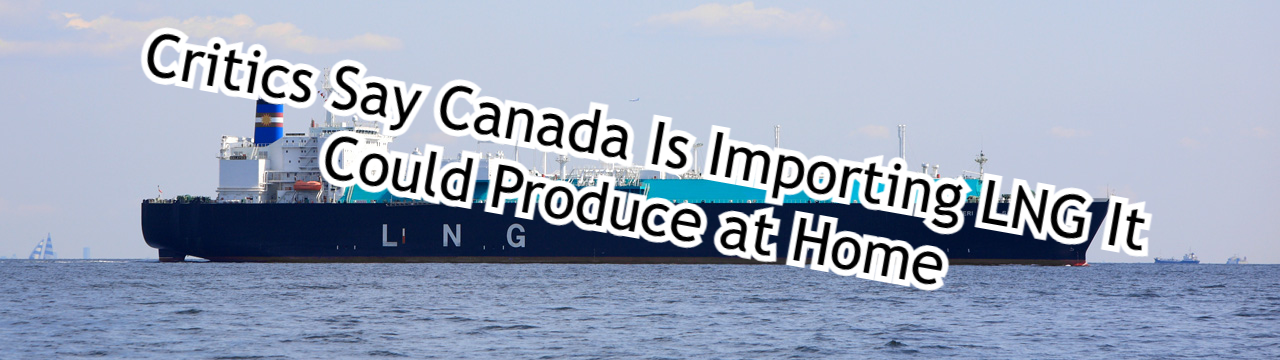
Canada’s stance on liquefied natural gas (LNG) is facing renewed criticism, as opponents argue the federal government’s long‑held claim that there is “no business case” for Canadian LNG exports no longer aligns with reality — especially now that the country is importing LNG from overseas.
For years, federal leaders have maintained that exporting Canadian natural gas as LNG was not economically viable. Critics say this position slowed or halted key infrastructure projects — including pipelines and coastal export terminals — that would have enabled Western Canadian gas to reach global markets.
Because of these delays, Canada failed to build meaningful LNG export capacity despite being one of the world’s top natural gas producers. During that time, countries such as Germany, Japan, and Greece expressed interest in Canadian LNG, but industry proponents were repeatedly told that the economics did not justify major investment.
The situation took a striking turn when Canada recently imported a full LNG shipment from Egypt. The cargo was liquefied at the Idku terminal, shipped across the Atlantic, and unloaded at the Saint John import facility in New Brunswick, where it was regasified and fed into the domestic system. Critics argue this demonstrates that both supply and demand clearly exist — and that Canada’s policy environment has constrained domestic production and export opportunities.
Opposition parties have seized on the import as evidence that the government’s “no business case” stance has allowed other countries to dominate global LNG markets while Canada missed out on jobs, investment, and the chance to help displace higher‑emission fuels like coal abroad.
These concerns have surfaced repeatedly in the House of Commons, with MPs pointing to international partners that sought Canadian LNG and arguing that federal policies prevented the infrastructure needed to meet that demand.
Supporters of the government’s approach counter that climate commitments and emissions standards must guide decisions on large fossil fuel projects. They also note that global LNG prices, construction costs, and market volatility shape investment choices, and they highlight ongoing discussions about expanding energy infrastructure — including potential export capacity in Eastern Canada.
The debate ultimately reflects larger questions about Canada’s place in global energy markets, how to balance economic opportunity with climate goals, and the extent to which federal policy encourages or discourages private‑sector investment. With LNG remaining a major global energy commodity, decisions made now will shape Canada’s competitiveness well into the future.
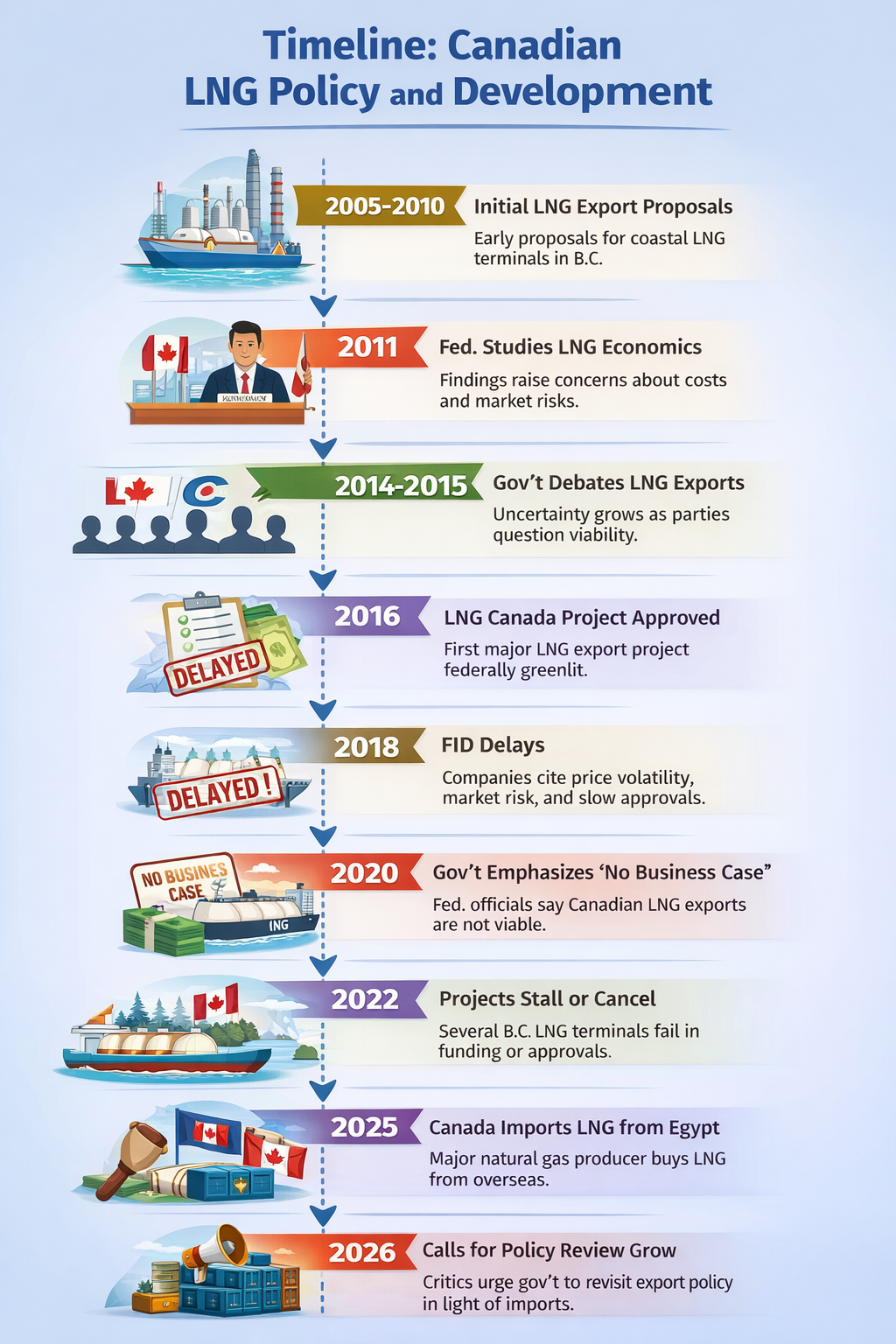
Timeline: Canadian LNG Policy and Development
| Year | Event | Significance |
|---|---|---|
| 2005–2010 | Initial LNG export proposals | Early companies propose coastal LNG export terminals in British Columbia to serve Asian markets; government reviews environmental and economic feasibility. |
| 2011 | Federal government studies LNG export economics | Officials assess global LNG demand and Canadian costs, concluding that infrastructure investments were high and market risks significant. |
| 2014–2015 | Liberal and Conservative governments debate LNG exports | Policy uncertainty grows as governments question the economic justification for large-scale LNG exports amid fluctuating global prices. |
| 2016 | LNG Canada project receives federal environmental approval | The first major project gets greenlight, but financing and construction timelines face delays; debates continue over climate impacts. |
| 2018 | FID (Final Investment Decision) delays | Companies cite market risks, pricing volatility, and lack of regulatory clarity, delaying the start of LNG export projects. |
| 2020 | Federal government emphasizes “no business case” for Canadian LNG | Government officials argue that exporting LNG is not economically viable under current market conditions; critics say this discourages investment. |
| 2022 | Multiple proposed projects stall or cancel | Several BC LNG terminal projects fail to secure financing or government approvals, reinforcing the perception that Canada is losing ground in global LNG markets. |
| 2025 | Canada imports LNG from Egypt | Despite being a major natural gas producer, Canada imports LNG to meet domestic demand, illustrating ongoing supply gaps and infrastructure challenges. |
| 2026 | Calls for policy review grow | Opposition politicians argue that Canada’s export policies have ceded global markets to competitors and that domestic LNG could provide jobs, trade opportunities, and climate benefits abroad. |