
Private property rights in British Columbia are once again under intense scrutiny after a recent court ruling affirmed elements of Aboriginal title that overlap with privately owned land in Richmond. The decision has sparked political debate and legal uncertainty, with critics arguing that the provincial government’s response—ranging from legislative amendments to financial guarantees—falls short of resolving the confusion created by the ruling.
Background: Court Ruling and Its Impact
The controversy originates from a case in which the court recognized Aboriginal title claims over specific parcels of land, including some already held by private owners. The ruling has raised difficult questions about how Indigenous rights intersect with long‑established private property interests.
Homeowners in Richmond say they are already feeling the effects, reporting difficulties selling their homes, securing mortgages, and obtaining financing. Real estate experts warn that prolonged uncertainty could depress property values and deter investment or development in the affected area.
Government Response
Premier David Eby’s government has introduced proposed amendments to the Declaration on the Rights of Indigenous Peoples Act (DRIPA) and announced up to $154 million in financial assistance for impacted homeowners. The funding is intended to help residents navigate legal and financial complications stemming from the ruling.
Provincial officials describe the measures as an attempt to balance the protection of property owners with the province’s commitments to Indigenous reconciliation. They emphasize that DRIPA is part of B.C.’s broader effort to implement the United Nations Declaration on the Rights of Indigenous Peoples and ensure Indigenous rights are reflected in provincial law.
Criticism From Opposition
Opposition voices argue the government’s actions are insufficient. Steve Kooner, Conservative MLA for Richmond‑Queensborough and Opposition critic for the Attorney General, has dismissed the measures as “band‑aid solutions” that fail to address the underlying issues.
Kooner points to several concerns:
Many homeowners were unaware of potential legal implications until after the ruling.
The uncertainty is already disrupting property sales and financing in the region.
Decisions made when Eby served as Attorney General may have contributed to the current ambiguity around how Aboriginal title interacts with private land.
He contends that only sweeping legislative reform—including the possibility of revising or repealing DRIPA—would adequately safeguard private property rights while clarifying how they coexist with constitutionally protected Indigenous rights.
Legal and Policy Context
Legal scholars note that the issue sits at the intersection of provincial legislation, judicial interpretations of Aboriginal title, and constitutional protections for Indigenous rights. Because Aboriginal title is constitutionally recognized, courts must reconcile it with other land interests, including private ownership. This creates a complex legal landscape in which even long‑established property rights can be affected by newly affirmed Indigenous claims.
Broader Implications
The Richmond case is being closely monitored across the province. Many see it as a potential precedent for how B.C. will navigate the relationship between private property rights and Indigenous reconciliation. There is growing concern that similar disputes could arise elsewhere, with implications for development, housing markets, and investor confidence.
Political analysts expect the debate over DRIPA and property rights to remain a flashpoint in provincial politics. Homeowners are calling for clearer communication from the government and a more definitive legal framework that reconciles private property protections with constitutional obligations to Indigenous communities.
Next Steps
As legal proceedings continue, stakeholders are watching to see whether the government will pursue deeper legislative reforms or rely primarily on financial compensation for affected landowners. The decisions made in the coming months could shape how property rights and Indigenous title are balanced not only in British Columbia but potentially across Canada.
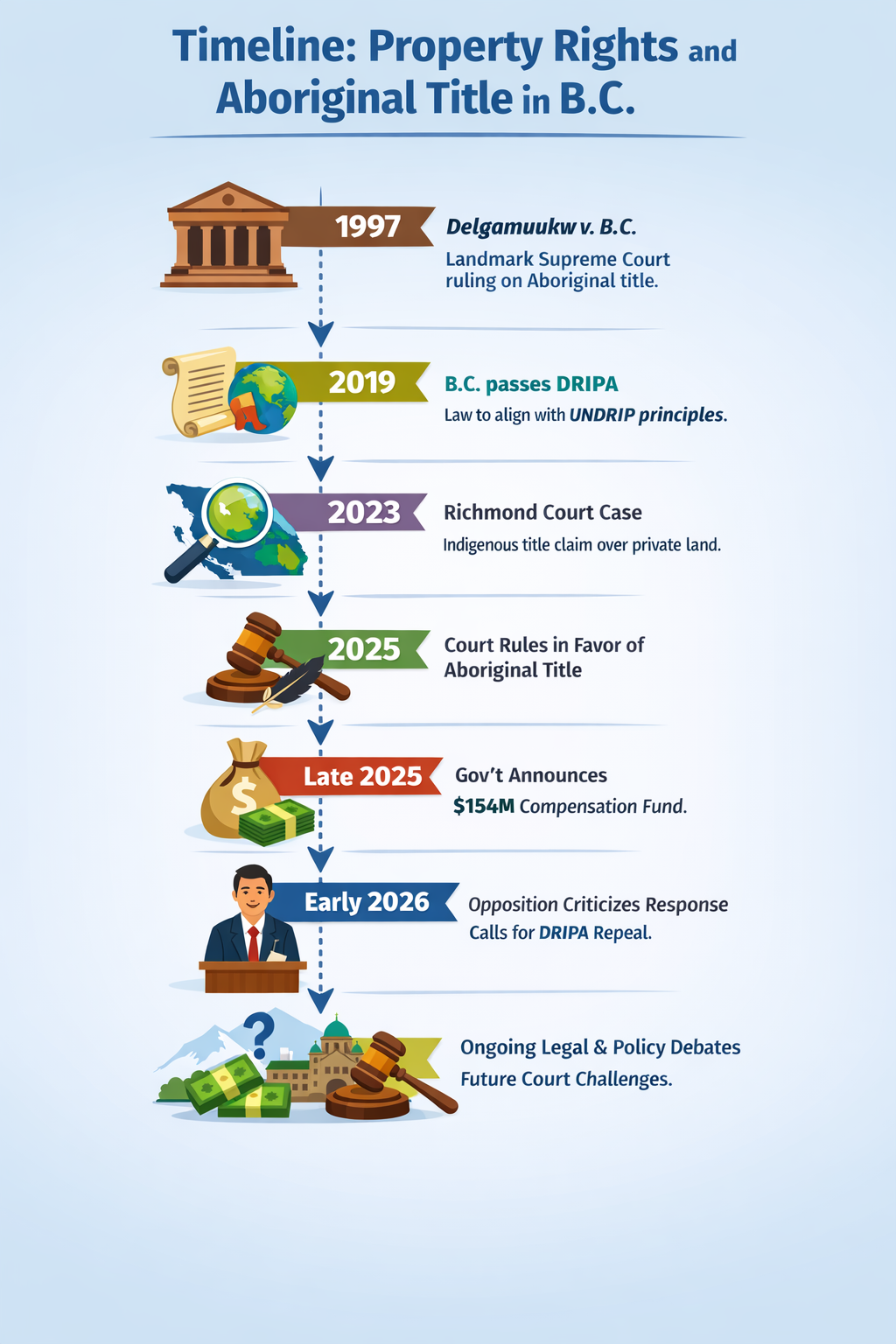
Timeline: Property Rights and Aboriginal Title in BC
| Year | Event | Significance |
|---|---|---|
| 1997 | Delgamuukw v. British Columbia (Supreme Court of Canada) | Landmark ruling establishing the legal framework for Aboriginal title in Canada. Recognized that Indigenous groups have constitutionally protected rights to their traditional lands. |
| 2019 | B.C. passes DRIPA (Declaration on the Rights of Indigenous Peoples Act) | Requires provincial laws to be aligned with UNDRIP (United Nations Declaration on the Rights of Indigenous Peoples). Lays groundwork for reconciliation policies affecting land management. |
| 2020–2022 | Implementation and consultations on DRIPA | Provincial government begins policy alignment; some private landowners raise concerns about potential impact on property rights. |
| 2023 | Court case filed in Richmond over Aboriginal title | Indigenous groups claim title over areas including privately owned land; case raises questions about the intersection of Aboriginal title and private property. |
| 2025 | Court rules in favor of Indigenous title claim | Confirms that Aboriginal title applies to some privately owned parcels; creates uncertainty for homeowners and developers. |
| Late 2025 | Government announces financial compensation plan | Premier Eby’s government proposes up to $154 million in financial guarantees to affected property owners. |
| Early 2026 | MLA Steve Kooner and opposition criticize government response | Opposition labels measures as “band-aid solutions” that do not fully protect private property rights. Calls for DRIPA reform or repeal continue. |
| 2026 and beyond | Ongoing legal and policy discussions | Further court challenges and legislative revisions expected; potential precedent-setting impact for property rights and Indigenous reconciliation in B.C. |