
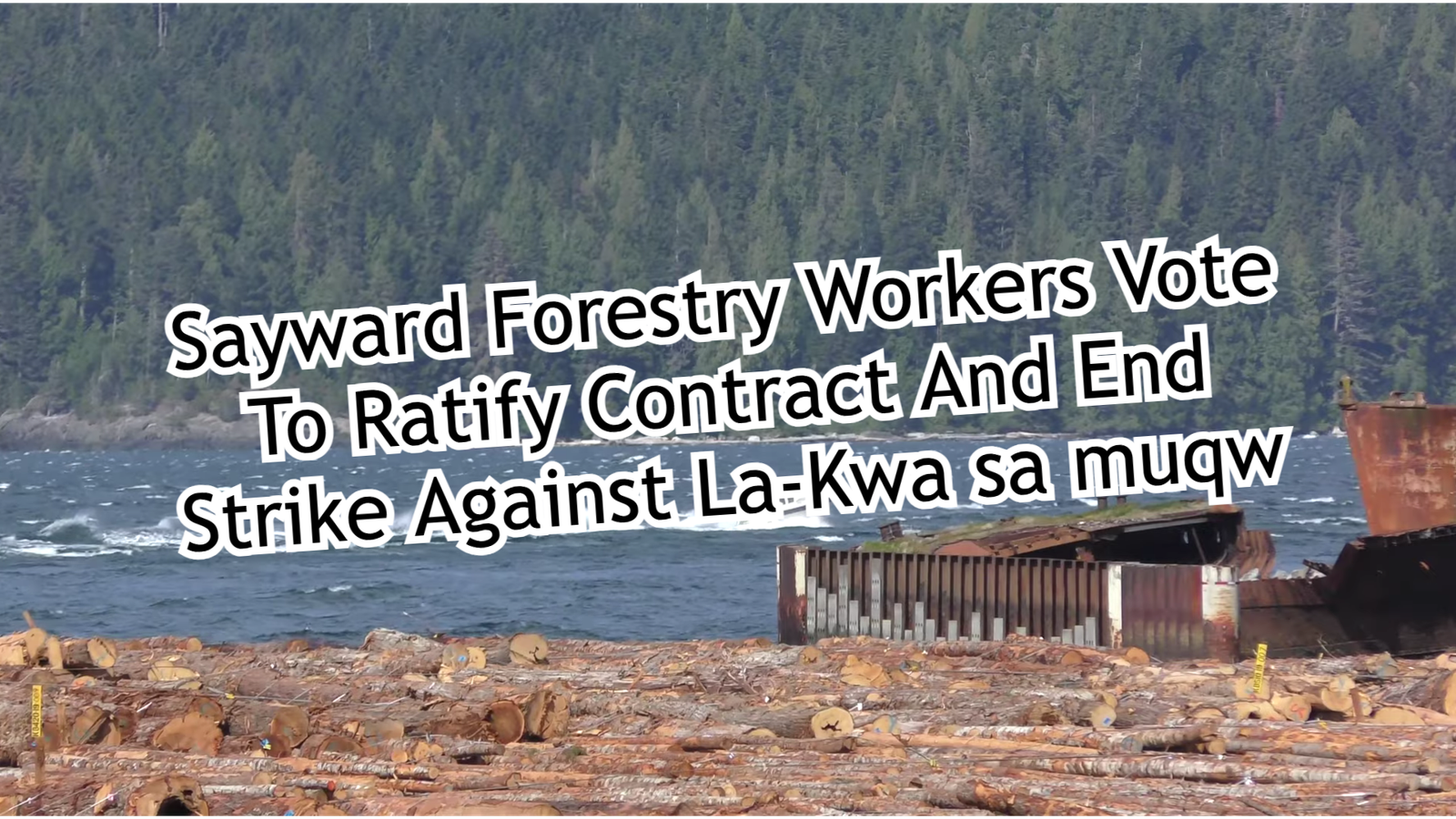
After more than eight grueling months on the picket line, the marathon strike by unionized forestry workers on the North Island has finally come to a close, capped by the ratification of a new collective agreement that brings an end to one of the region’s most protracted labour disputes in recent memory.
The standoff at the La‑kwa sa muqw Forestry Limited Partnership (LKSM) operation near around Sayward erupted in early June 2025, when roughly 100 members of United Steelworkers Local 1‑1937 walked off the job. Their concerns ranged from job security to the company’s push to contract out work long performed by union members — issues that quickly hardened into a months‑long deadlock.
That impasse broke on Feb. 23, 2026, when union members voted to ratify a comprehensive agreement reached with the company the week before. The LKSM board of directors endorsed the deal as well, formally ending the strike and clearing the way for workers to return as soon as operations can ramp back up.
The new contract delivers significant wage increases and improved terms for both production and trades workers, bringing LKSM’s compensation in line with broader industry standards along the B.C. coast. Union leaders say the gains reflect pattern bargaining established elsewhere in the sector and safeguard union work for the long term.
United Steelworkers Local 1‑1937 president Brian Butler hailed the membership’s resolve throughout the drawn‑out fight, emphasizing that the agreement secures key job protections and addresses long‑standing workplace concerns. Company representatives also welcomed the breakthrough, expressing relief that full operations can resume.
The strike had shuttered activity at the Tree Farm License 64 site for months, rippling through local supply chains and straining community economies. With the new agreement now locked in, both sides are looking ahead to a more stable and predictable future for the workforce and the operation.
LKSM itself is a partnership between four First Nations — the Tlowitsis, We Wai Kai, Wei Wai Kum and K’ómoks — and Western Forest Products, reflecting the growing role of nation‑led ownership and stewardship in B.C.’s forestry sector.
Bargaining Battles and Economic Fallout: How the Forestry Strike Rocked Sayward — and What the New Deal Means Now
The end of the eight‑and‑a‑half‑month forestry strike on the North Island has brought a wave of relief to Sayward — but the dispute left deep marks on the village and exposed long‑simmering pressures within British Columbia’s coastal forest sector.
In a community where forestry isn’t just an industry but a defining part of local identity, the strike was far more than a labour standoff. It was an economic shock that rippled through households, businesses, and the social fabric of the village.
What Drove the Breakdown at the Bargaining Table
The conflict at the La‑kwa sa muqw Forestry Limited Partnership (LKSM) operation hinged on issues that cut to the core of job stability in small resource towns.
Members of United Steelworkers Local 1‑1937 said negotiations stalled over job security and the company’s push to contract out work historically done by unionized employees. For workers in Sayward, that wasn’t an abstract concern — it raised fears of losing the kind of steady, family‑supporting jobs that keep the community viable.
Wages were another major flashpoint. Workers pushed for increases that reflected rising living costs and aligned with the coastal forest industry pattern set in other agreements across Vancouver Island. Trades workers, facing a tightening labour market, pressed for recognition of their specialized skills.
The newly ratified collective agreement delivers substantial wage gains — roughly 19 per cent for production workers and more than 20 per cent for trades over the life of the deal — along with language aimed squarely at protecting union work. Union leaders say these protections were essential to winning support after months of financial strain.
Sayward’s Economy Takes the Hit
As negotiations dragged on, Sayward felt the impact almost immediately. With dozens of residents off the job, household spending dropped sharply. Local businesses — from gas stations to service providers — saw fewer customers as families tightened their belts.
Some workers picked up temporary jobs, burned through savings, or left the area in search of income. Others leaned on family support networks. The strike laid bare how vulnerable single‑industry communities can be when their economic engine stalls.
The shutdown also rippled outward. Contractors, truckers, and suppliers tied to the LKSM operation saw work evaporate. Municipal revenues were indirectly squeezed as economic activity slowed, adding pressure to a village already grappling with rising infrastructure and service costs.
A Cautious Path Back to Normal
With the strike now over, the LKSM operation — jointly owned by four First Nations in partnership with Western Forest Products — is preparing to restart. Paycheques returning to local households will bring immediate relief, but residents say it may take months for the village to fully rebound.
The dispute also reignited a broader conversation about Sayward’s economic fragility. Some residents argue the community needs more diversification to weather future shocks. Others insist that protecting strong forestry jobs remains the most realistic way to sustain the village.
What Comes Next
As workers prepare to head back into the bush, the new agreement is being viewed as more than a contract — it’s a test of whether the lessons of the strike will stick. For Sayward, the hope is that stronger job protections and industry‑standard wages will reduce the risk of future disruptions and bring greater stability to families who depend on forestry.
After eight months of uncertainty, the community is ready to move forward. But the memory of the strike lingers — a reminder of just how closely Sayward’s fortunes are tied to the labour battles unfolding in the forests beyond town.