
BC Residents Urge Province to Rein In Spending Instead of Raising Taxes or Increasing Debt

As the provincial government prepares to release its next budget, many residents in Sayward and other small communities are questioning how British Columbia is managing taxpayer dollars. Local taxpayers and fiscal advocates are urging Finance Minister Brenda Bailey to curb provincial spending rather than relying on higher taxes and increased borrowing.

Advocates note that provincial spending has grown rapidly in recent years and now exceeds the pace of B.C.’s economic growth. They argue this trajectory is unsustainable and places added pressure on families already dealing with rising costs for groceries, fuel, housing, and other essentials.

In practical terms, the province is projected to spend billions more this year than it did just a few years ago, even after adjusting for inflation. Meanwhile, economic growth has lagged behind, leaving less wealth to support expanding government budgets. Those monitoring the province’s finances say this imbalance is contributing to larger deficits and mounting debt — costs that ultimately fall on taxpayers through future tax hikes or reduced services.

For residents of Sayward, these broader fiscal concerns feel very real. Rural communities rely heavily on core public services such as health care, education, transportation, and emergency response. But when government debt grows, interest payments consume a larger share of the budget, leaving fewer resources for frontline services that communities depend on.

Critics of the current spending path are calling on the province to reassess its priorities and identify meaningful savings. They argue this could include reviewing the size of the provincial bureaucracy, cutting wasteful or low‑value spending, and focusing on essential services that directly support communities rather than expanding programs without clear justification.

Supporters of fiscal restraint say responsible budgeting today can help prevent steeper tax increases in the future and protect vital services for the next generation. As budget discussions continue in Victoria, residents in Sayward will be watching closely to see whether provincial leaders respond to calls for spending discipline — and whether the upcoming budget reflects the affordability concerns of rural British Columbians.
Black Bear Deaths in BC Drop to Lowest Level in Over a Decade

New data from the British Columbia Conservation Officer Service shows that fewer black bears were killed in the province in 2025 than in any year over the past decade, marking a significant decline in lethal wildlife encounters.

According to the figures, conservation officers dispatched 178 black bears for public safety reasons and euthanized 33 bears due to injury or welfare concerns. The combined total represents the lowest number of bears killed in conflict situations in roughly 15 years of available records and reflects a substantial drop compared with previous years, including a sharp decrease from 2023 levels.

Conservation officials note that bears are classified differently depending on circumstances. Bears are dispatched when they pose an immediate risk to public safety, often after becoming habituated to human food sources and repeatedly entering residential areas. Euthanization occurs when bears are suffering from serious injuries or health issues that cannot be treated.

Regionally, the West Coast recorded the highest number of bears killed for public safety reasons, while the Okanagan reported the most euthanizations linked to animal welfare concerns.

Strong Natural Food Supply Credited for Decline

Wildlife experts point to a particularly strong berry crop across much of British Columbia in 2025 as a key factor behind the reduced number of bear conflicts. When natural food sources are abundant, bears are less likely to roam into communities in search of unsecured garbage, compost, or other human-related attractants.

Some communities also reported fewer bear sightings overall, suggesting that many bears remained deeper in forested areas rather than venturing into populated zones.

Focus Remains on Prevention and Public Safety

Despite the encouraging numbers, conservation officers stress that human-bear conflicts remain largely preventable and continue to emphasize public education as a cornerstone of wildlife management.

Residents are encouraged to:

  • Secure garbage, compost, pet food, and bird feeders;
  • Keep barbecues clean and manage fruit trees carefully;
  • Practice bear-aware behaviour when hiking or living near forested areas;
  • Report bear sightings when animals show concerning behaviour.

Officials say proactive measures help protect both people and wildlife by reducing situations that lead to bears becoming habituated and ultimately destroyed.

A Positive Trend, With Caution

While the decline in bear killings is viewed as a positive sign for wildlife conservation in British Columbia, authorities caution that continued vigilance is necessary, particularly as communities expand into traditional bear habitat.

Conservation officers and wildlife advocates agree that ongoing education, community cooperation, and responsible management of attractants will be essential to maintaining and improving this trend in the years ahead.

Critics Say Canada Is Importing LNG It Could Produce at Home

Canada’s stance on liquefied natural gas (LNG) is facing renewed criticism, as opponents argue the federal government’s long‑held claim that there is “no business case” for Canadian LNG exports no longer aligns with reality — especially now that the country is importing LNG from overseas.

For years, federal leaders have maintained that exporting Canadian natural gas as LNG was not economically viable. Critics say this position slowed or halted key infrastructure projects — including pipelines and coastal export terminals — that would have enabled Western Canadian gas to reach global markets.

Because of these delays, Canada failed to build meaningful LNG export capacity despite being one of the world’s top natural gas producers. During that time, countries such as Germany, Japan, and Greece expressed interest in Canadian LNG, but industry proponents were repeatedly told that the economics did not justify major investment.

The situation took a striking turn when Canada recently imported a full LNG shipment from Egypt. The cargo was liquefied at the Idku terminal, shipped across the Atlantic, and unloaded at the Saint John import facility in New Brunswick, where it was regasified and fed into the domestic system. Critics argue this demonstrates that both supply and demand clearly exist — and that Canada’s policy environment has constrained domestic production and export opportunities.

Opposition parties have seized on the import as evidence that the government’s “no business case” stance has allowed other countries to dominate global LNG markets while Canada missed out on jobs, investment, and the chance to help displace higher‑emission fuels like coal abroad.

These concerns have surfaced repeatedly in the House of Commons, with MPs pointing to international partners that sought Canadian LNG and arguing that federal policies prevented the infrastructure needed to meet that demand.

Supporters of the government’s approach counter that climate commitments and emissions standards must guide decisions on large fossil fuel projects. They also note that global LNG prices, construction costs, and market volatility shape investment choices, and they highlight ongoing discussions about expanding energy infrastructure — including potential export capacity in Eastern Canada.

The debate ultimately reflects larger questions about Canada’s place in global energy markets, how to balance economic opportunity with climate goals, and the extent to which federal policy encourages or discourages private‑sector investment. With LNG remaining a major global energy commodity, decisions made now will shape Canada’s competitiveness well into the future.

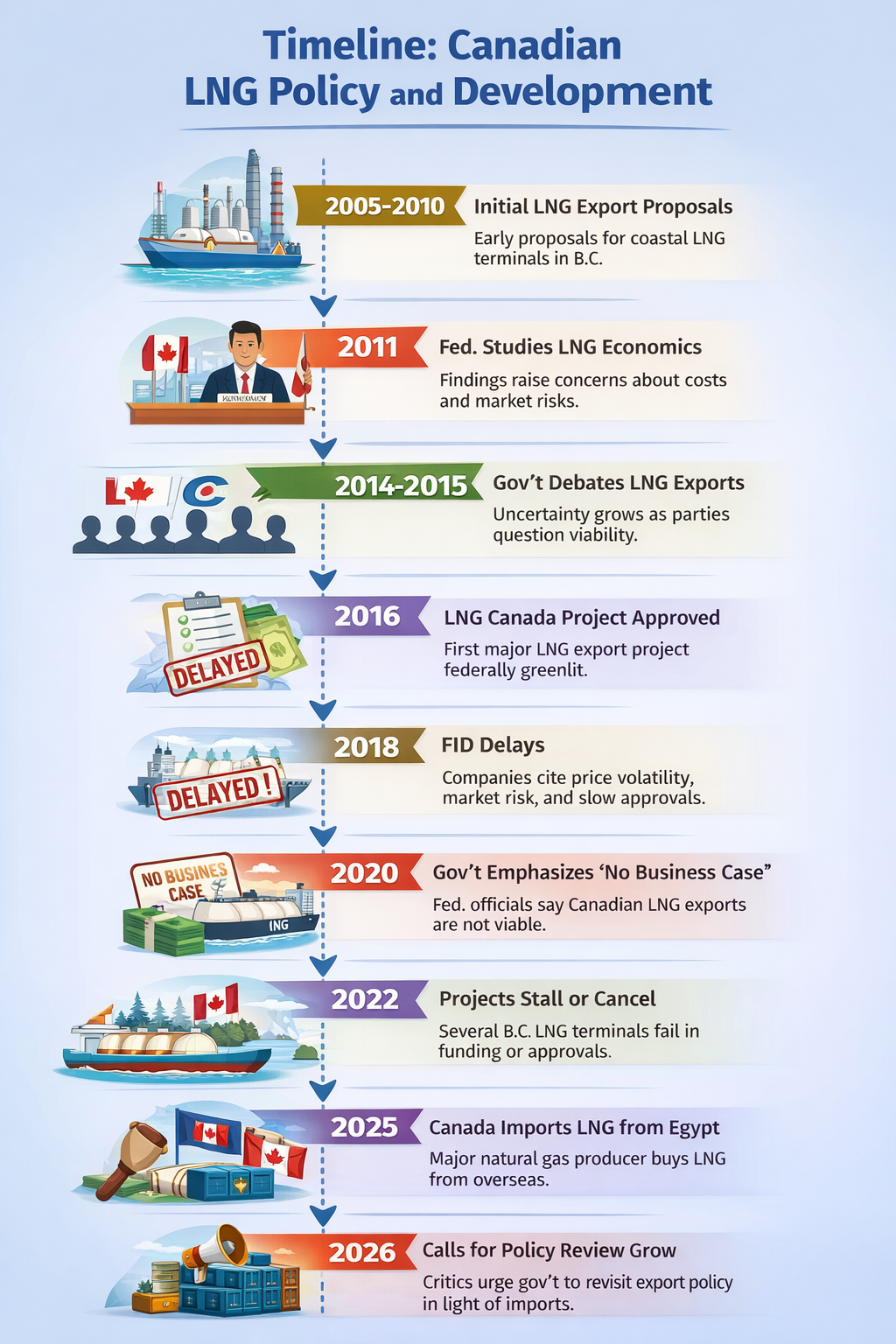
Timeline: Canadian LNG Policy and Development

Timeline: Canadian LNG Policy and Development

Year Event Significance
2005–2010 Initial LNG export proposals Early companies propose coastal LNG export terminals in British Columbia to serve Asian markets; government reviews environmental and economic feasibility.
2011 Federal government studies LNG export economics Officials assess global LNG demand and Canadian costs, concluding that infrastructure investments were high and market risks significant.
2014–2015 Liberal and Conservative governments debate LNG exports Policy uncertainty grows as governments question the economic justification for large-scale LNG exports amid fluctuating global prices.
2016 LNG Canada project receives federal environmental approval The first major project gets greenlight, but financing and construction timelines face delays; debates continue over climate impacts.
2018 FID (Final Investment Decision) delays Companies cite market risks, pricing volatility, and lack of regulatory clarity, delaying the start of LNG export projects.
2020 Federal government emphasizes “no business case” for Canadian LNG Government officials argue that exporting LNG is not economically viable under current market conditions; critics say this discourages investment.
2022 Multiple proposed projects stall or cancel Several BC LNG terminal projects fail to secure financing or government approvals, reinforcing the perception that Canada is losing ground in global LNG markets.
2025 Canada imports LNG from Egypt Despite being a major natural gas producer, Canada imports LNG to meet domestic demand, illustrating ongoing supply gaps and infrastructure challenges.
2026 Calls for policy review grow Opposition politicians argue that Canada’s export policies have ceded global markets to competitors and that domestic LNG could provide jobs, trade opportunities, and climate benefits abroad.

BC Property Rights Under Scrutiny as Critics Say Government Response Falls Short

Private property rights in British Columbia are once again under intense scrutiny after a recent court ruling affirmed elements of Aboriginal title that overlap with privately owned land in Richmond. The decision has sparked political debate and legal uncertainty, with critics arguing that the provincial government’s response—ranging from legislative amendments to financial guarantees—falls short of resolving the confusion created by the ruling.

Background: Court Ruling and Its Impact

The controversy originates from a case in which the court recognized Aboriginal title claims over specific parcels of land, including some already held by private owners. The ruling has raised difficult questions about how Indigenous rights intersect with long‑established private property interests.

Homeowners in Richmond say they are already feeling the effects, reporting difficulties selling their homes, securing mortgages, and obtaining financing. Real estate experts warn that prolonged uncertainty could depress property values and deter investment or development in the affected area.

Government Response

Premier David Eby’s government has introduced proposed amendments to the Declaration on the Rights of Indigenous Peoples Act (DRIPA) and announced up to $154 million in financial assistance for impacted homeowners. The funding is intended to help residents navigate legal and financial complications stemming from the ruling.

Provincial officials describe the measures as an attempt to balance the protection of property owners with the province’s commitments to Indigenous reconciliation. They emphasize that DRIPA is part of B.C.’s broader effort to implement the United Nations Declaration on the Rights of Indigenous Peoples and ensure Indigenous rights are reflected in provincial law.

Criticism From Opposition

Opposition voices argue the government’s actions are insufficient. Steve Kooner, Conservative MLA for Richmond‑Queensborough and Opposition critic for the Attorney General, has dismissed the measures as “band‑aid solutions” that fail to address the underlying issues.

Kooner points to several concerns:

  • Many homeowners were unaware of potential legal implications until after the ruling.

  • The uncertainty is already disrupting property sales and financing in the region.

  • Decisions made when Eby served as Attorney General may have contributed to the current ambiguity around how Aboriginal title interacts with private land.

He contends that only sweeping legislative reform—including the possibility of revising or repealing DRIPA—would adequately safeguard private property rights while clarifying how they coexist with constitutionally protected Indigenous rights.

Legal and Policy Context

Legal scholars note that the issue sits at the intersection of provincial legislation, judicial interpretations of Aboriginal title, and constitutional protections for Indigenous rights. Because Aboriginal title is constitutionally recognized, courts must reconcile it with other land interests, including private ownership. This creates a complex legal landscape in which even long‑established property rights can be affected by newly affirmed Indigenous claims.

Broader Implications

The Richmond case is being closely monitored across the province. Many see it as a potential precedent for how B.C. will navigate the relationship between private property rights and Indigenous reconciliation. There is growing concern that similar disputes could arise elsewhere, with implications for development, housing markets, and investor confidence.

Political analysts expect the debate over DRIPA and property rights to remain a flashpoint in provincial politics. Homeowners are calling for clearer communication from the government and a more definitive legal framework that reconciles private property protections with constitutional obligations to Indigenous communities.

Next Steps

As legal proceedings continue, stakeholders are watching to see whether the government will pursue deeper legislative reforms or rely primarily on financial compensation for affected landowners. The decisions made in the coming months could shape how property rights and Indigenous title are balanced not only in British Columbia but potentially across Canada.

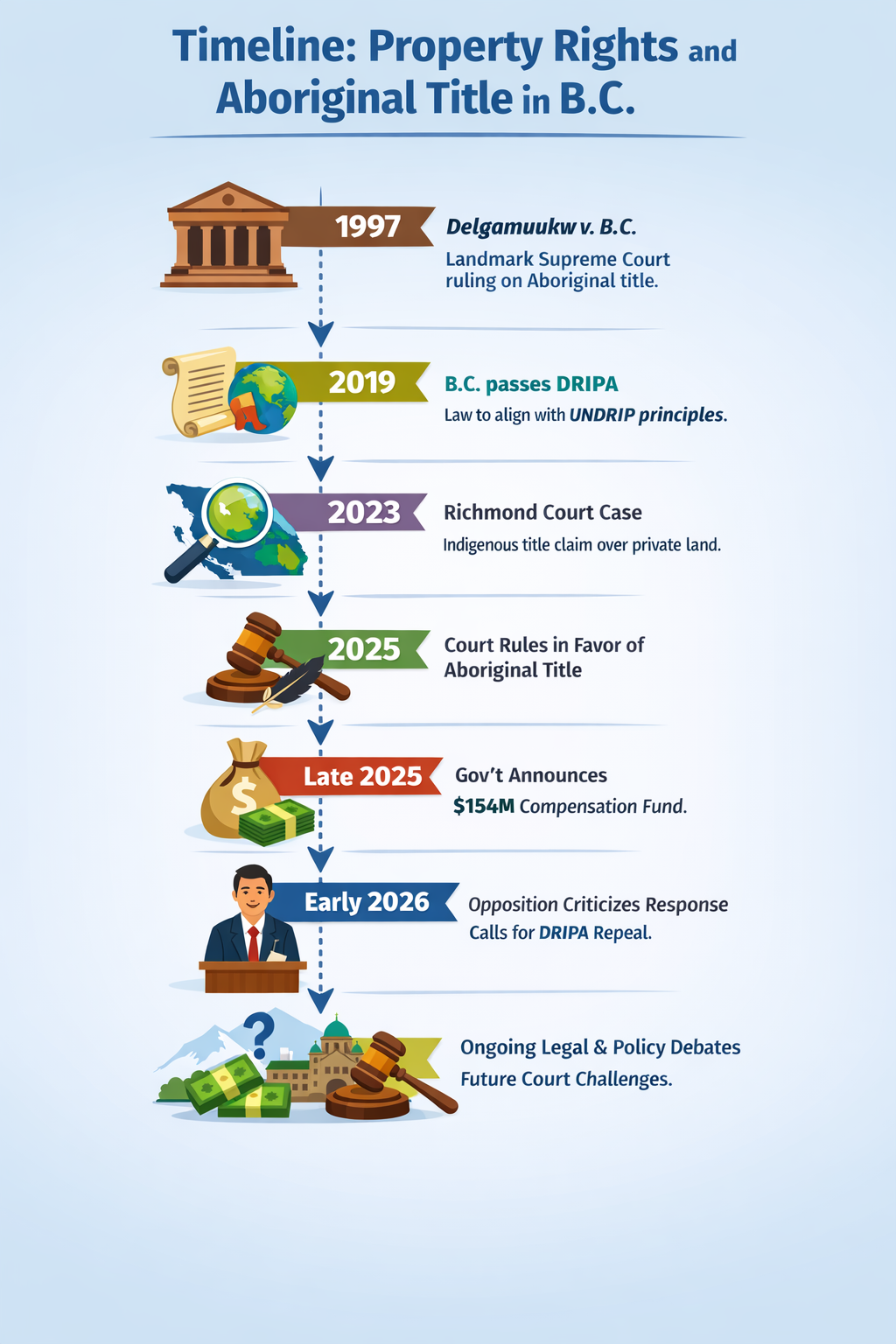
Timeline Property Rights and Aboriginal Title in BC

Timeline: Property Rights and Aboriginal Title in BC

Year Event Significance
1997 Delgamuukw v. British Columbia (Supreme Court of Canada) Landmark ruling establishing the legal framework for Aboriginal title in Canada. Recognized that Indigenous groups have constitutionally protected rights to their traditional lands.
2019 B.C. passes DRIPA (Declaration on the Rights of Indigenous Peoples Act) Requires provincial laws to be aligned with UNDRIP (United Nations Declaration on the Rights of Indigenous Peoples). Lays groundwork for reconciliation policies affecting land management.
2020–2022 Implementation and consultations on DRIPA Provincial government begins policy alignment; some private landowners raise concerns about potential impact on property rights.
2023 Court case filed in Richmond over Aboriginal title Indigenous groups claim title over areas including privately owned land; case raises questions about the intersection of Aboriginal title and private property.
2025 Court rules in favor of Indigenous title claim Confirms that Aboriginal title applies to some privately owned parcels; creates uncertainty for homeowners and developers.
Late 2025 Government announces financial compensation plan Premier Eby’s government proposes up to $154 million in financial guarantees to affected property owners.
Early 2026 MLA Steve Kooner and opposition criticize government response Opposition labels measures as “band-aid solutions” that do not fully protect private property rights. Calls for DRIPA reform or repeal continue.
2026 and beyond Ongoing legal and policy discussions Further court challenges and legislative revisions expected; potential precedent-setting impact for property rights and Indigenous reconciliation in B.C.

Ferry Sailings Cancelled as Powerful Gusts Hit Coastal BC

Strong winds sweeping across coastal British Columbia have forced multiple ferry cancellations, disrupting travel on several major BC Ferries routes and raising the possibility of further service interruptions.

BC Ferries confirmed sailings were cancelled due to unsafe marine conditions, with gusts in the Strait of Georgia and surrounding waterways making operations hazardous. Environment Canada issued wind warnings for much of the region, cautioning that conditions could remain challenging until the weather system passes.

Routes affected include Tsawwassen–Swartz Bay, Horseshoe Bay–Departure Bay, and Tsawwassen–Duke Point—some of the busiest connections between Vancouver Island and the Lower Mainland, serving thousands of passengers daily.

The company said cancellations were made out of an abundance of caution to protect passengers, crew, and vessels. High winds can compromise maneuverability, docking, and overall safety, making ferry operations highly weather‑dependent.

Customers with reservations are being contacted directly with options to rebook or receive refunds, while walk‑on passengers are advised to expect delays and possible further cancellations. BC Ferries urged travelers to check sailing status before heading to terminals and to allow extra time for their journeys.

The operator warned that additional sailings may be cancelled if conditions do not improve. Environment Canada noted strong winds are likely to persist in some coastal areas, advising motorists and travelers to remain flexible and exercise caution.

BC Ferries said updates will be provided as the situation evolves and thanked customers for their patience as crews work to resume service safely.