Sayward Taxpayers Alliance Town Hall Meeting – March 6th

Join the Sayward Taxpayers Alliance, 7pm on March 6th at the Heritage Hall.

Topics to be discussed:

  • The future of the Village of Sayward
  • Extreme taxation
  • Fiscal responsibility

Come and make your voice heard at this critical time in our community.

Sayward Forestry Workers Vote To Ratify Contract And End Strike Against La-Kwa sa muqw

After more than eight grueling months on the picket line, the marathon strike by unionized forestry workers on the North Island has finally come to a close, capped by the ratification of a new collective agreement that brings an end to one of the region’s most protracted labour disputes in recent memory.

The standoff at the La‑kwa sa muqw Forestry Limited Partnership (LKSM) operation near around Sayward erupted in early June 2025, when roughly 100 members of United Steelworkers Local 1‑1937 walked off the job. Their concerns ranged from job security to the company’s push to contract out work long performed by union members — issues that quickly hardened into a months‑long deadlock.

That impasse broke on Feb. 23, 2026, when union members voted to ratify a comprehensive agreement reached with the company the week before. The LKSM board of directors endorsed the deal as well, formally ending the strike and clearing the way for workers to return as soon as operations can ramp back up.

The new contract delivers significant wage increases and improved terms for both production and trades workers, bringing LKSM’s compensation in line with broader industry standards along the B.C. coast. Union leaders say the gains reflect pattern bargaining established elsewhere in the sector and safeguard union work for the long term.

United Steelworkers Local 1‑1937 president Brian Butler hailed the membership’s resolve throughout the drawn‑out fight, emphasizing that the agreement secures key job protections and addresses long‑standing workplace concerns. Company representatives also welcomed the breakthrough, expressing relief that full operations can resume.

The strike had shuttered activity at the Tree Farm License 64 site for months, rippling through local supply chains and straining community economies. With the new agreement now locked in, both sides are looking ahead to a more stable and predictable future for the workforce and the operation.

LKSM itself is a partnership between four First Nations — the Tlowitsis, We Wai Kai, Wei Wai Kum and K’ómoks — and Western Forest Products, reflecting the growing role of nation‑led ownership and stewardship in B.C.’s forestry sector.

Bargaining Battles and Economic Fallout: How the Forestry Strike Rocked Sayward — and What the New Deal Means Now

The end of the eight‑and‑a‑half‑month forestry strike on the North Island has brought a wave of relief to Sayward — but the dispute left deep marks on the village and exposed long‑simmering pressures within British Columbia’s coastal forest sector.

In a community where forestry isn’t just an industry but a defining part of local identity, the strike was far more than a labour standoff. It was an economic shock that rippled through households, businesses, and the social fabric of the village.

What Drove the Breakdown at the Bargaining Table

The conflict at the La‑kwa sa muqw Forestry Limited Partnership (LKSM) operation hinged on issues that cut to the core of job stability in small resource towns.

Members of United Steelworkers Local 1‑1937 said negotiations stalled over job security and the company’s push to contract out work historically done by unionized employees. For workers in Sayward, that wasn’t an abstract concern — it raised fears of losing the kind of steady, family‑supporting jobs that keep the community viable.

Wages were another major flashpoint. Workers pushed for increases that reflected rising living costs and aligned with the coastal forest industry pattern set in other agreements across Vancouver Island. Trades workers, facing a tightening labour market, pressed for recognition of their specialized skills.

The newly ratified collective agreement delivers substantial wage gains — roughly 19 per cent for production workers and more than 20 per cent for trades over the life of the deal — along with language aimed squarely at protecting union work. Union leaders say these protections were essential to winning support after months of financial strain.

Sayward’s Economy Takes the Hit

As negotiations dragged on, Sayward felt the impact almost immediately. With dozens of residents off the job, household spending dropped sharply. Local businesses — from gas stations to service providers — saw fewer customers as families tightened their belts.

Some workers picked up temporary jobs, burned through savings, or left the area in search of income. Others leaned on family support networks. The strike laid bare how vulnerable single‑industry communities can be when their economic engine stalls.

The shutdown also rippled outward. Contractors, truckers, and suppliers tied to the LKSM operation saw work evaporate. Municipal revenues were indirectly squeezed as economic activity slowed, adding pressure to a village already grappling with rising infrastructure and service costs.

A Cautious Path Back to Normal

With the strike now over, the LKSM operation — jointly owned by four First Nations in partnership with Western Forest Products — is preparing to restart. Paycheques returning to local households will bring immediate relief, but residents say it may take months for the village to fully rebound.

The dispute also reignited a broader conversation about Sayward’s economic fragility. Some residents argue the community needs more diversification to weather future shocks. Others insist that protecting strong forestry jobs remains the most realistic way to sustain the village.

What Comes Next

As workers prepare to head back into the bush, the new agreement is being viewed as more than a contract — it’s a test of whether the lessons of the strike will stick. For Sayward, the hope is that stronger job protections and industry‑standard wages will reduce the risk of future disruptions and bring greater stability to families who depend on forestry.

After eight months of uncertainty, the community is ready to move forward. But the memory of the strike lingers — a reminder of just how closely Sayward’s fortunes are tied to the labour battles unfolding in the forests beyond town.

Sayward Taxpayers Alliance — A Grassroots Push for Fiscal Reform and Local Governance Change

In the small Vancouver Island community of Sayward, British Columbia, a new grassroots movement—the Sayward Taxpayers Alliance—has become a prominent voice calling for fiscal restraint, government reform, and a fresh look at how local services are delivered. Formed by concerned residents, the Alliance reflects growing unease about rising municipal costs, increasing tax burdens, and the long‑term sustainability of Sayward’s current governance structure.

Origins and Purpose

The Sayward Taxpayers Alliance describes itself as “a grassroots alliance of citizens who are opposed to wasteful spending of taxpayer dollars.” Its mission is to push for stronger financial accountability at the municipal level and to ensure residents have a meaningful say in decisions that shape their taxes and community services.

A Bold Proposal: Dissolving the Village

Central to the Alliance’s platform is a significant and controversial idea: dissolving the Village of Sayward as an incorporated municipality and integrating it fully into the Strathcona Regional District (SRD). Supporters argue that this shift would streamline governance, reduce administrative overhead, and potentially deliver services more efficiently—ultimately easing the tax burden on property owners.

They contend that a small municipality like Sayward struggles to maintain a standalone council and administrative staff without duplicating services already available through the SRD. Dissolution, they say, is a practical response to the financial and operational pressures facing rural local governments across British Columbia.

Why Dissolution?

According to the Alliance, several potential benefits support the case for change:

  • Reduced Administrative Load: Sayward would no longer need its own council and municipal bureaucracy; instead, residents would be represented by an SRD director.
  • Stronger Governance Capacity: Regional administration, they argue, can offer more professional oversight and long‑term planning than a small, resource‑limited local council.
  • Possible Tax Relief: While not guaranteed, integrating services regionally could help stabilize or even lower property taxes over time.

These arguments echo concerns that have surfaced repeatedly in local news, including council dysfunction, resignations, and questions about financial planning and service delivery. For some residents, these issues signal that the village’s current governance model may no longer be viable.

Building Community Momentum

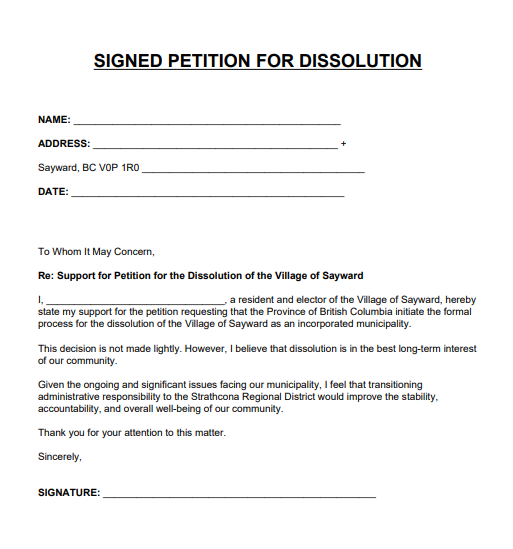
To advance the dissolution effort, the Alliance is organizing petition drives aimed at triggering a provincially guided governance review. Only eligible voters living within the Village of Sayward and aged 18 or older can sign. If the petition meets the required threshold, the process could lead to a formal review or even a community vote under the Local Government Act.

Beyond Governance: Life in Sayward

The Alliance’s work unfolds against the backdrop of a small rural community navigating broader challenges—from infrastructure needs to the cost of recreational services. Sayward relies on a mix of local, regional, and provincial supports, and debates about governance are intertwined with questions about long‑term sustainability and quality of life.

Looking Forward

As the Sayward Taxpayers Alliance continues its campaign, it has become a catalyst for deeper conversations about local democracy, financial stewardship, and the future of small municipalities in British Columbia. Whether dissolution ultimately moves forward remains uncertain, but the movement has already sparked a significant community dialogue about how to balance effective governance with affordability and local values.

Petition Form

Click on the petition to download a printable copy.

Petition

Request For Quotations – Sayward Fire Hall #1 Renovation

The Village of Sayward is seeking quotations from qualified vendors to complete FireSmart renovation work at Firehall #1, located at 620 Kelsey Way, Sayward, British Columbia.

Quotations must be clearly labeled “Firehall #1 – FireSmart Renovations” and submitted to:

Village of Sayward PO Box 29 652‑A H’Kusam Way Sayward, BC V0P 1R0

The submission deadline is 2:00 p.m. Pacific Time on Friday, February 27, 2026.

All pricing must be provided in Canadian dollars, with applicable taxes listed separately. Quoted prices must remain valid for at least 120 days from the closing date.

Vendors are solely responsible for ensuring their quotation is received by the Village of Sayward before the deadline.

Evaluation Criteria Quotations will be assessed based on: a) Ability to meet the timelines and requirements outlined in this RFQ b) Relevant experience and qualifications c) Lowest overall cost to the Village of Sayward

Inquiries All questions regarding this RFQ should be directed to: Shaun Koopman Phone: 250‑830‑6702 Email: skoopman@srd.ca

Any addenda issued for this RFQ will be posted on the Village of Sayward website and the BC Bid website. Verbal communications are not binding unless confirmed through written addenda.

Ottawa Poised To Severely Restrict Salmon Take For Recreational Fishery

Sport fishing on Vancouver Island — a long‑standing tradition and an economic anchor for communities like Sayward — is facing renewed uncertainty as the federal government moves ahead with major changes to salmon‑fisheries management.

Ottawa is rewriting salmon policy and regulations with a stronger focus on conservation and Indigenous‑led management. While many agree that protecting declining salmon stocks is essential, anglers, guides, and coastal communities worry the new approach could sharply restrict recreational fishing without addressing the deeper causes of salmon decline.

For Sayward, where sport fishing supports local businesses, tourism, and family traditions, the potential impacts reach far beyond the docks.

What’s Changing

The federal government has signalled that recreational salmon fishing could face tighter limits, shorter seasons, or expanded closures as part of a broader overhaul of fisheries management. These measures are intended to prioritize conservation and food fisheries, particularly for Indigenous communities. But critics say the approach risks sidelining the sport‑fishing sector.

Anglers note that recreational fishing already operates under strict rules — including size limits, seasonal openings, gear restrictions, and catch limits. Many feel additional restrictions unfairly target sport fishers while larger pressures on salmon — such as habitat loss, warming oceans, predation, and industrial impacts — remain insufficiently addressed.

Why It Matters to Sayward

In Sayward, sport fishing is more than a hobby. It supports charter operators, lodges, restaurants, fuel docks, marinas, and local retailers. Visiting anglers bring crucial seasonal income, especially during the summer months when tourism helps sustain small businesses.

Residents also rely on recreational fishing for food and as a way to stay connected to the water. For many families, fishing is part of their identity — a tradition passed down through generations.

Any reduction in fishing opportunities could ripple through the community, making it harder for businesses to stay afloat and for residents to maintain the coastal lifestyle that defines the region.

Conservation vs. Community Impacts

Most anglers in Sayward support conservation and recognize the serious pressures facing salmon stocks. But many question whether focusing on recreational fishing will meaningfully improve salmon returns if larger issues remain unresolved.

Habitat degradation, blocked fish passage, warming rivers, poor marine survival, and predation are often cited as more significant drivers of salmon decline. Critics argue that without stronger action in these areas, restricting sport fishing risks becoming symbolic rather than effective.

There is also concern about uneven impacts. While industrial activities and large‑scale pressures continue, small coastal communities fear they will bear the brunt of policy changes that reduce access to a resource they depend on.

Calls for Local Input and Balance

Fishing groups and coastal residents are urging Ottawa to slow down and consult more closely with communities like Sayward before finalizing new rules. They want decisions grounded in transparent science, local data, and a clear understanding of how policy changes affect rural economies.

Many are calling for a balanced approach — one that recognizes sport fishing as both a cultural tradition and an economic contributor, rather than treating it as expendable.

Looking Ahead

As Ottawa continues reshaping salmon management, Sayward residents will be watching closely. The outcome could determine not only the future of recreational fishing, but also the health of local businesses and the character of the community itself.

For many here, the message is clear: protecting salmon is essential — but conservation efforts must include the people and communities who have relied on these waters for generations. Decisions made far from the coast should not come at the expense of rural livelihoods unless there is clear evidence they will truly help salmon recover.