
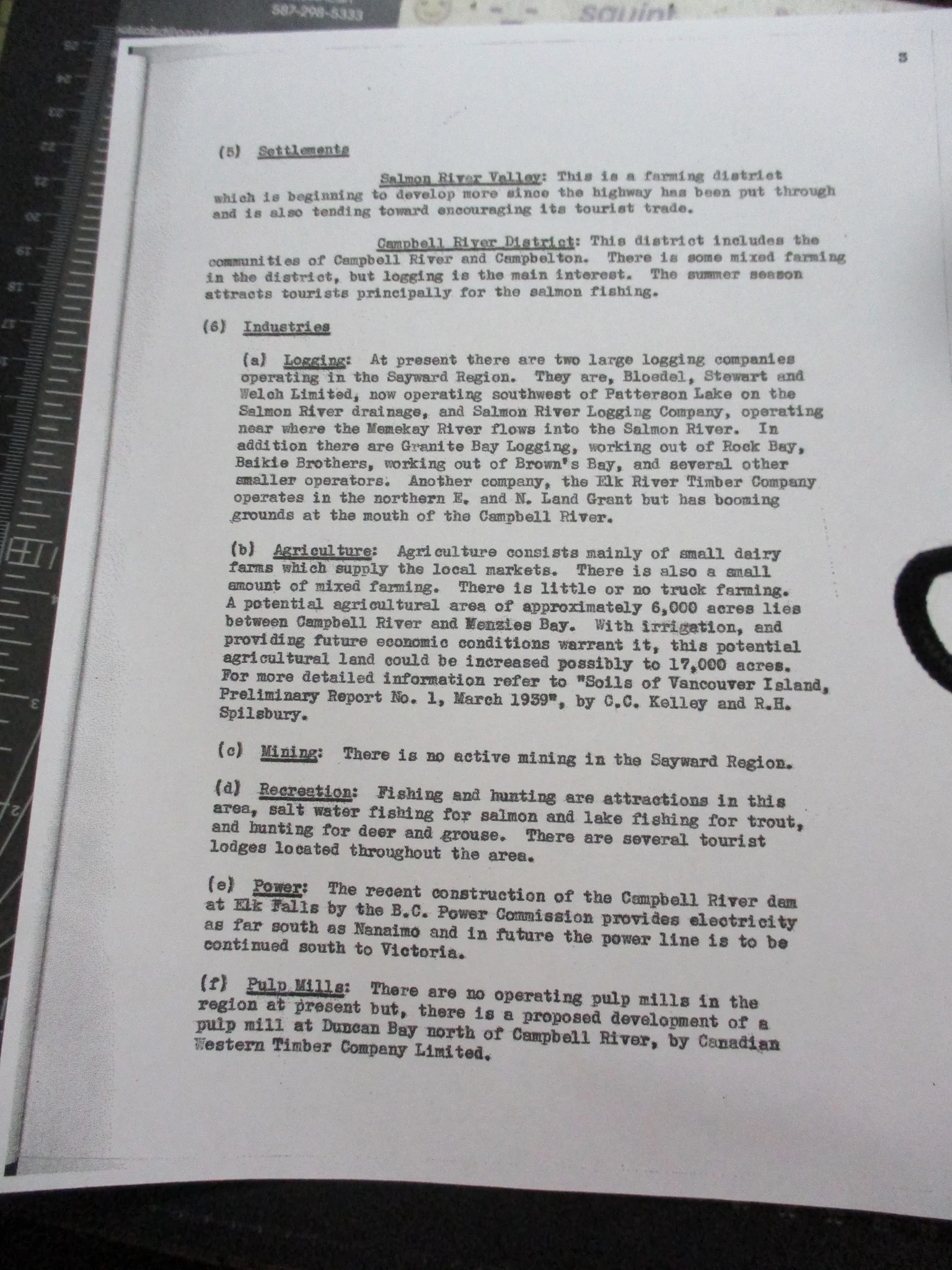
Tucked away on northern Vancouver Island, the Sayward Valley has long been a region shaped by its rugged landscape, abundant natural resources, and quiet resilience. A recently surfaced excerpt from a 1948 government document offers a fascinating snapshot of life in the valley during a time when industry and settlement were beginning to take firmer root.
A Region on the Edge of Growth
In the late 1940s, the Sayward Valley was still very much in transition. The document highlights early signs of agricultural development, particularly in the Salmon River Valley, where farming was just beginning to expand. The construction of a highway through the area played a pivotal role, improving access and opening the door to both economic growth and tourism.
Even at this early stage, the region was already being recognized for its recreational appeal. Visitors were drawn by the promise of salmon fishing, a resource that would become synonymous with the area’s identity.
Logging: The Backbone of the Local Economy
If one industry defined the Sayward Valley at the time, it was logging. The document makes clear that forestry operations dominated the economic landscape, with several major and minor companies active in the region.
Large firms operated near key waterways like the Salmon River and Memekay River, using them as vital transportation routes for timber. Smaller outfits worked out of coastal inlets such as Rock Bay and Brown’s Bay, contributing to a bustling—if geographically dispersed—network of logging activity.
This reliance on forestry reflects a broader trend across British Columbia during the mid-20th century, where vast forests fueled both local employment and provincial economic growth.
Agriculture: Modest but Promising
Compared to logging, agriculture in the Sayward Valley was still in its infancy. The document describes small dairy farms supplying local markets, along with limited mixed farming. Large-scale crop production—especially truck farming—was virtually nonexistent.
However, there was optimism about the future. Officials identified thousands of acres of potentially viable farmland between Campbell River and Menzies Bay. With irrigation and favorable economic conditions, this land could significantly expand the region’s agricultural capacity.
This forward-looking perspective suggests that even in 1948, planners saw the valley not just as a resource hub, but as a place where communities could grow and diversify.
Recreation and Natural Appeal
While industry drove the economy, recreation was already emerging as an important secondary draw. The valley’s rivers and coastal waters offered excellent fishing opportunities, while forests and hills supported hunting for deer and grouse.
Small tourist lodges scattered throughout the area catered to visitors seeking a wilderness experience—an early indication of the tourism sector that continues to thrive on Vancouver Island today.
Little Mining, Big Potential
Interestingly, the document notes a complete absence of active mining in the Sayward region at the time. Whether due to lack of exploration or limited mineral deposits, this absence stands in contrast to other parts of British Columbia where mining was a major economic force.
Looking Back—and Forward
What makes this 1948 document so compelling is not just what it tells us about the past, but what it reveals about the trajectory of the Sayward Valley. It captures a moment when the region stood at the intersection of tradition and development—rooted in natural resource extraction, yet beginning to explore agriculture and tourism as complementary paths.
Today, the Sayward Valley still reflects many of these foundational elements. Logging remains part of the economy, while recreation and tourism have grown significantly. The seeds of diversification noted nearly 80 years ago continue to shape the region’s identity.
In many ways, this historical snapshot reminds us that even the quietest places have dynamic stories—stories of adaptation, opportunity, and the enduring relationship between people and the land.