
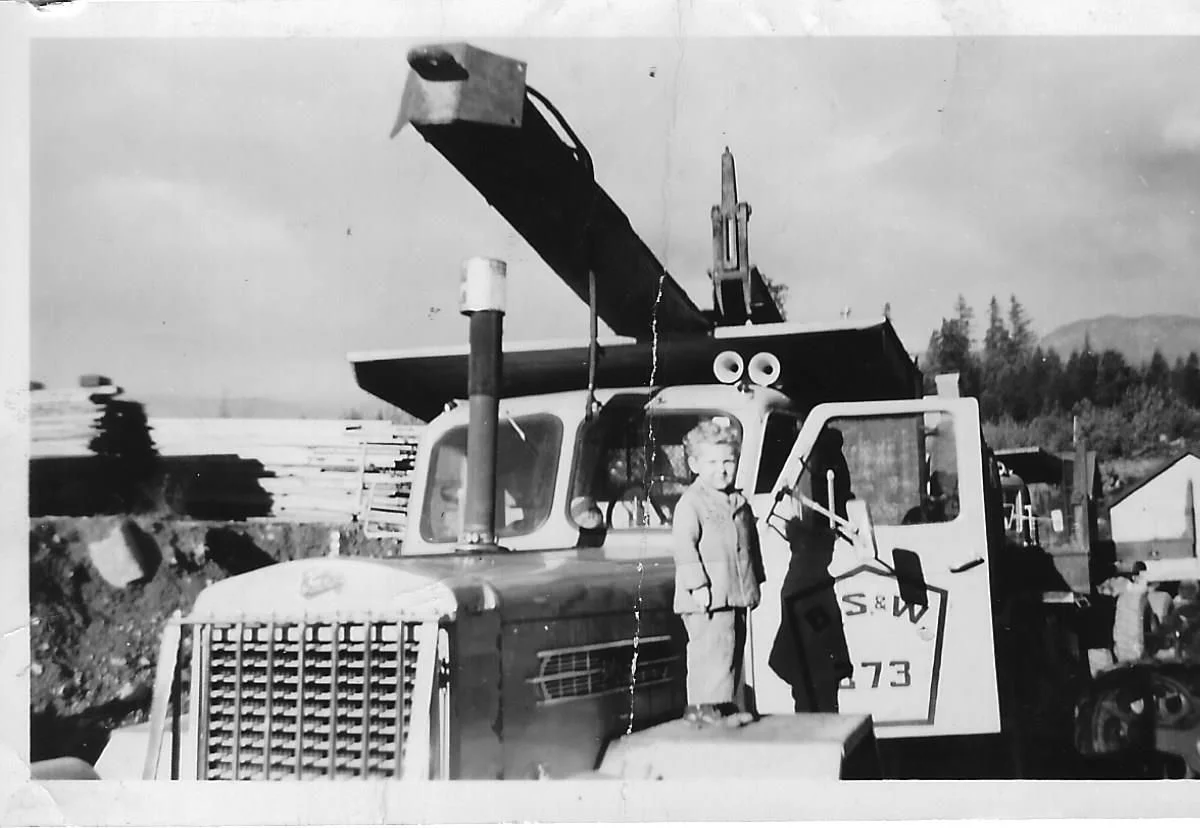
In the rugged coastal forests of northern Vancouver Island, the 1950s marked a defining era for industrial logging—and few names were as central to that story as Bloedel, Stewart and Welch. Operating extensively in and around the Sayward region, B&S&W helped transform a remote landscape into a hub of resource extraction, innovation, and tight-knit community life.
Amid the roar of chainsaws and the thunder of falling timber, a generation of young men came of age in the bush. Among them was a young Larry McKinlay—one of many who would be shaped by the grit, danger, and camaraderie of coastal logging camps.
The Rise of Industrial Logging in Sayward
By the early 1950s, Bloedel, Stewart and Welch had established itself as a dominant force in British Columbia’s forestry sector. With vast timber licenses and access to old-growth forests, the company set up operations throughout the Sayward Valley and surrounding inlets.
Logging in this era was not for the faint of heart. Crews worked in steep, rain-soaked terrain, felling massive Douglas fir and cedar trees that had stood for centuries. Equipment was evolving—steam donkeys were giving way to diesel-powered yarders—but the work remained intensely physical and often dangerous.
Logs were hauled to booming grounds in coastal inlets like Kelsey Bay, then sorted and transported to mills. The scale of operations was immense, and B&S&W played a key role in feeding both domestic and international demand for lumber during the postwar boom.
Life in the Camps
For workers, logging camps were more than just job sites—they were entire communities. Isolated from towns, these camps provided bunkhouses, cookhouses, and a structured daily rhythm built around long shifts and hard labor.
Meals were hearty, the coffee was strong, and the bonds between workers ran deep. In an environment where every man relied on the others for safety, trust was everything.
It was into this world that young Larry McKinlay stepped.
A Young Logger’s Beginning
Like many local boys, Larry McKinlay was drawn into the logging industry at a young age. Opportunities in Sayward during the 1950s were closely tied to the forest, and logging offered both a livelihood and a rite of passage.
Starting out in entry-level roles—perhaps as a chokerman or swamper—Larry would have quickly learned the realities of bush work: the unpredictability of falling timber, the precision required to rig cables, and the constant awareness needed to stay alive.
But beyond the danger, there was also pride. Logging wasn’t just a job; it was a craft. Young workers like Larry were mentored by seasoned hands, absorbing knowledge that couldn’t be taught in classrooms.
Innovation Meets Tradition
The 1950s were also a time of transition in the logging industry. Companies like B&S&W were beginning to adopt new technologies that would eventually reshape forestry work—chainsaws replacing crosscut saws, improved transportation networks, and early mechanization.
Yet much of the work still relied on human strength and skill. This blend of old and new defined the era, and those who worked through it—like Larry McKinlay—experienced firsthand the shift from traditional to modern logging practices.
A Lasting Legacy
The impact of Bloedel, Stewart and Welch on Sayward cannot be overstated. The company’s operations brought jobs, infrastructure, and a sense of purpose to the region. Roads carved through dense forest would later open access for residents and tourists alike.
For individuals like Larry McKinlay, the experience of working in the bush during this formative period likely left a lasting imprint—one of resilience, resourcefulness, and connection to the land.
Remembering the Era
Today, it’s easy to forget just how demanding and foundational this work was. The forests around Sayward still stand as a testament to both nature’s scale and the human effort required to harvest it.
Looking back at the 1950s, we see more than just an industry—we see a way of life. One where companies like B&S&W drove economic growth, and where young men like Larry McKinlay found their footing in a world defined by towering trees and the relentless rhythm of the saw.
It’s a story of hard work, community, and the enduring legacy of logging on Vancouver Island.