
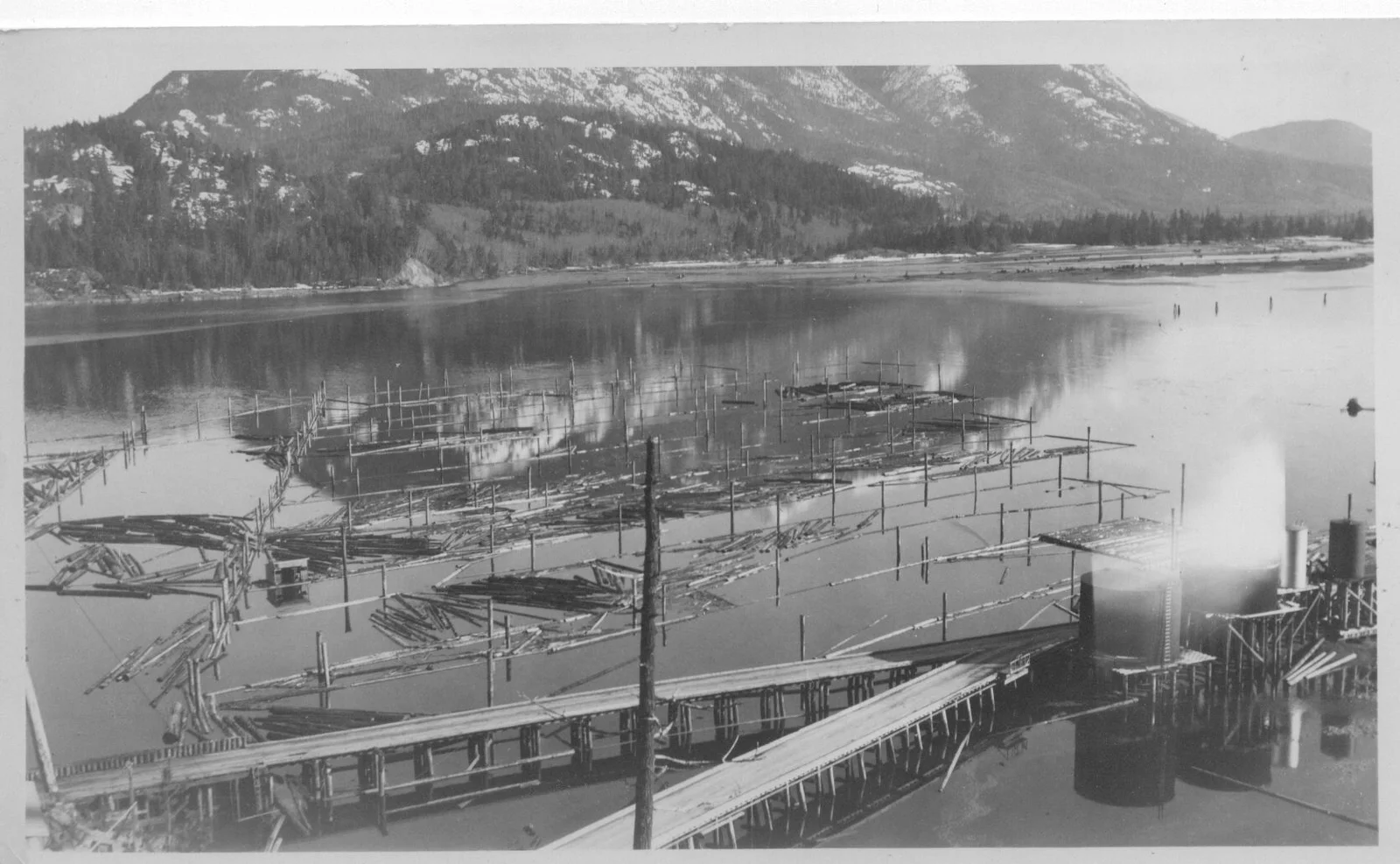
Along the rugged shoreline of northern Vancouver Island, the small coastal settlement of Kelsey Bay became one of the most important timber-handling points in the region. In the early decades of industrial logging, the Kelsey Bay log sort played a crucial role in receiving, organizing, and shipping vast quantities of timber harvested from the surrounding forests of the Sayward Valley.
Before modern ports and automated sorting systems, this was hard, manual, and highly coordinated work—shaped by tides, weather, and the constant flow of logs coming down from the hills.
A Coastal Gateway for Inland Forests
The development of the log sort at Kelsey Bay was driven by geography. The steep terrain inland made direct transport to mills difficult, so coastal transfer points became essential.
Logs were brought down from the forest by:
-
Truck roads carved into the valley
-
Older rail and cable systems in earlier phases
-
Small tributary landings feeding larger collection points
Once they reached tidewater at Kelsey Bay, the logs entered a floating and shoreline system designed to organize massive volumes of timber.
What a “Log Sort” Actually Was
A log sort was not a mill, but a distribution and sorting hub.
At Kelsey Bay, arriving logs were:
-
Floated into booming grounds (contained log pens on the water)
-
Separated by size, species, and ownership marks
-
Bundled into rafts for towing
Sorting crews worked directly on the water, standing on floating logs or narrow walkways, using pike poles and boom sticks to maneuver massive cedar, fir, and hemlock logs into their designated areas.
It was precise work in an unstable environment—where everything floated and nothing stayed still for long.
The Early Operation: Labour on the Water
In its early days, the Kelsey Bay log sort was entirely manual. There were no automated conveyors or computerized tracking systems. Instead, it relied on:
-
Boom boats to push and guide log rafts
-
Hand crews to separate and sort timber
-
Chains and cables to secure floating pens
-
Constant vigilance against tides and wind
Workers had to understand both the forest and the sea. A shifting tide could tighten a boom system dangerously or scatter logs across the bay if not properly secured.
Despite the difficulty, the system was efficient for its time and allowed enormous volumes of timber to be staged for transport.
Connection to the Valley
The log sort was only one part of a larger industrial chain that extended deep into the inland forests of the Sayward region.
Upstream, logging crews were felling old-growth stands and hauling timber out of cutblocks. Downstream, the log sort acted as the final staging area before export or delivery to mills elsewhere on Vancouver Island or beyond.
This connection between forest and coast defined the region’s economy for much of the 20th century.
Life Around the Log Sort
While the log sort itself was an industrial site, it also influenced the surrounding community.
Kelsey Bay developed as:
-
A working waterfront
-
A gathering point for log transport crews
-
A hub for marine traffic supporting logging operations
The area was busy with boom boats, tugs, work skiffs, and loaded log rafts waiting for tow. The rhythm of life was dictated by tides, weather conditions, and the steady arrival of timber from inland operations.
Challenges of the Early Years
Operating a log sort in open coastal waters came with constant challenges:
-
Storms could break up boom systems
-
Strong currents could scatter floating logs
-
Fog and rain limited visibility for crews
-
Mechanical equipment required constant maintenance in saltwater conditions
Every day required adaptation. Crews had to respond quickly to changing conditions to prevent losses and keep the system running.
The Foundation of a Regional Industry
Despite these challenges, the early Kelsey Bay log sort became a cornerstone of the regional forestry economy. It helped transform the Sayward Valley into a productive timber corridor by linking remote inland forests with coastal shipping routes.
Over time, the system would modernize, incorporating better equipment, larger tugs, and more efficient sorting methods. But its early foundation remained rooted in manual labour, coastal ingenuity, and deep familiarity with the land and sea.
Legacy on the Shoreline
Today, much of the original early infrastructure has changed or disappeared, replaced by newer industrial systems or reclaimed by nature. But the legacy of those early log sort operations remains visible in:
-
The continued importance of Kelsey Bay as a coastal point
-
Historical traces of boom sites and working waterfronts
-
Stories passed down from logging families in the Sayward area
-
The broader industrial history of coastal British Columbia
A Working Landscape Remembered
The early days of the Kelsey Bay log sort were defined by hard work, improvisation, and an intimate connection between people, forest, and sea. It was not just an industrial site—it was a living system that linked the deep forests of the Sayward Valley to the global timber trade.
And while the methods have changed, the story of that shoreline remains part of the identity of the region today.