
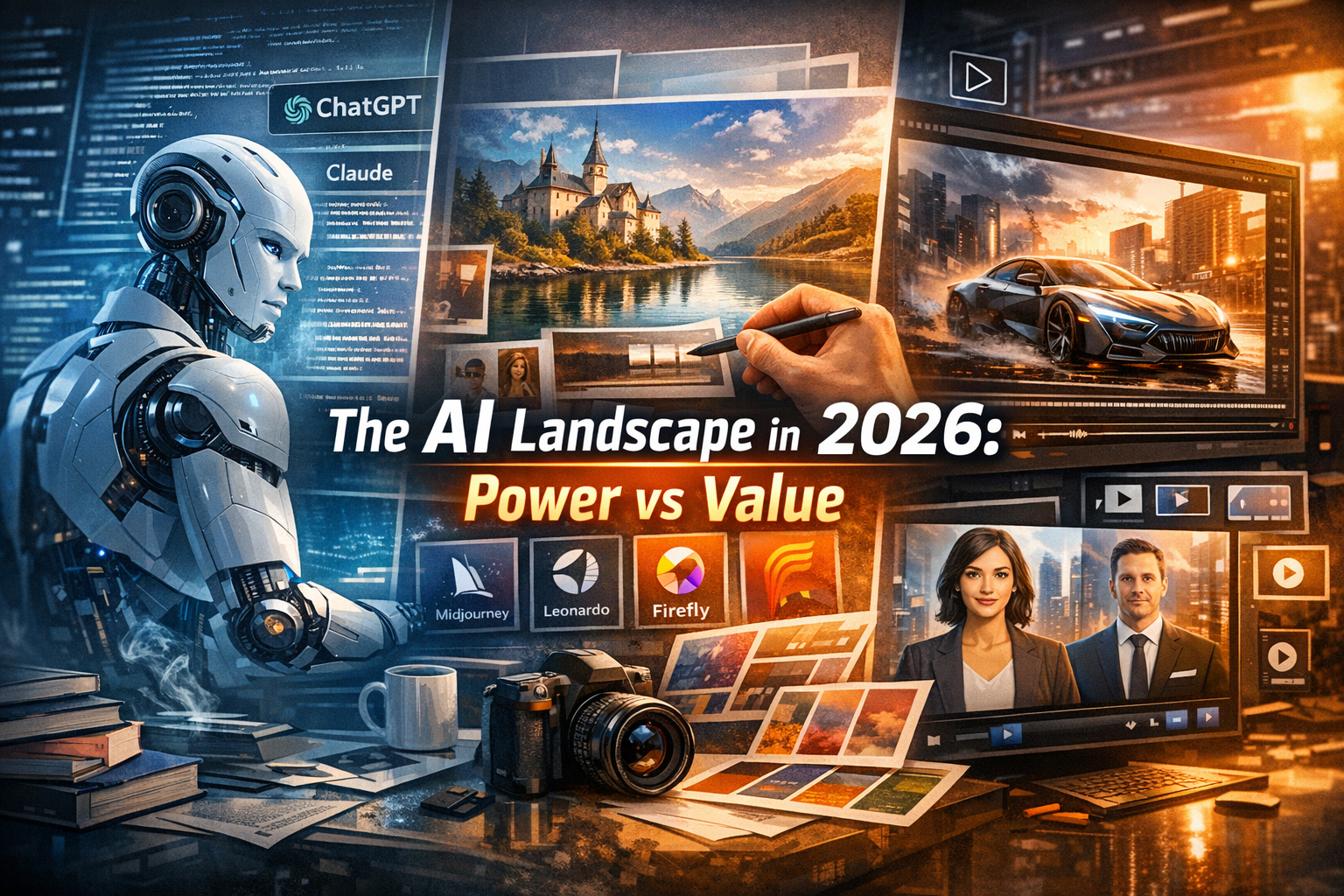
The New AI Landscape: Which Tools Actually Deliver Value in 2026?
Artificial intelligence is no longer a single category—it’s an ecosystem. Over the past two years, the market has fractured into specialized domains: large language models powering reasoning and productivity, image generators redefining visual creation, and video tools attempting to automate what was once the most expensive form of content production.
But as capabilities surge, so does confusion. The question is no longer “what can AI do?”—it’s “which tools are actually worth paying for?”
Here’s a grounded look at the current state of AI across its three most important categories, and where real value lies.
The LLM Wars: Power vs Price
Large language models remain the backbone of the AI revolution. Systems like GPT-4o and Claude Opus represent the cutting edge—capable of complex reasoning, long-form writing, coding, and increasingly, multimodal tasks that blend text, images, and audio.
Yet the most important shift in 2026 isn’t raw capability—it’s pricing divergence.
At the top end, frontier models deliver exceptional reasoning and reliability, but at a steep cost. For high-stakes use—legal drafting, advanced engineering, or research synthesis—they’re often worth it. But these use cases represent a minority of real-world demand.
Instead, the center of gravity has moved toward mid-tier models like Claude Sonnet and GPT-4o mini. These systems achieve something closer to a breakthrough than a compromise: near-premium performance at a fraction of the cost. For most business workflows—emails, reports, coding assistance—they are effectively “good enough,” and dramatically cheaper to scale.
At the bottom end, ultra-low-cost models such as Gemini Flash and DeepSeek V3 are reshaping high-volume applications. They lack consistency and depth, but their pricing makes them ideal for bulk generation tasks like summarization, tagging, or first drafts.
The emerging consensus is clear: the smartest users don’t pick one model—they orchestrate several. Cheap models handle volume, while premium ones refine the final output. In practice, that hybrid approach delivers the best return on investment.
READ MORE HERE >> https://saywardmarketing.com/2026/03/29/the-ai-landscape-in-2026-power-versus-value/