
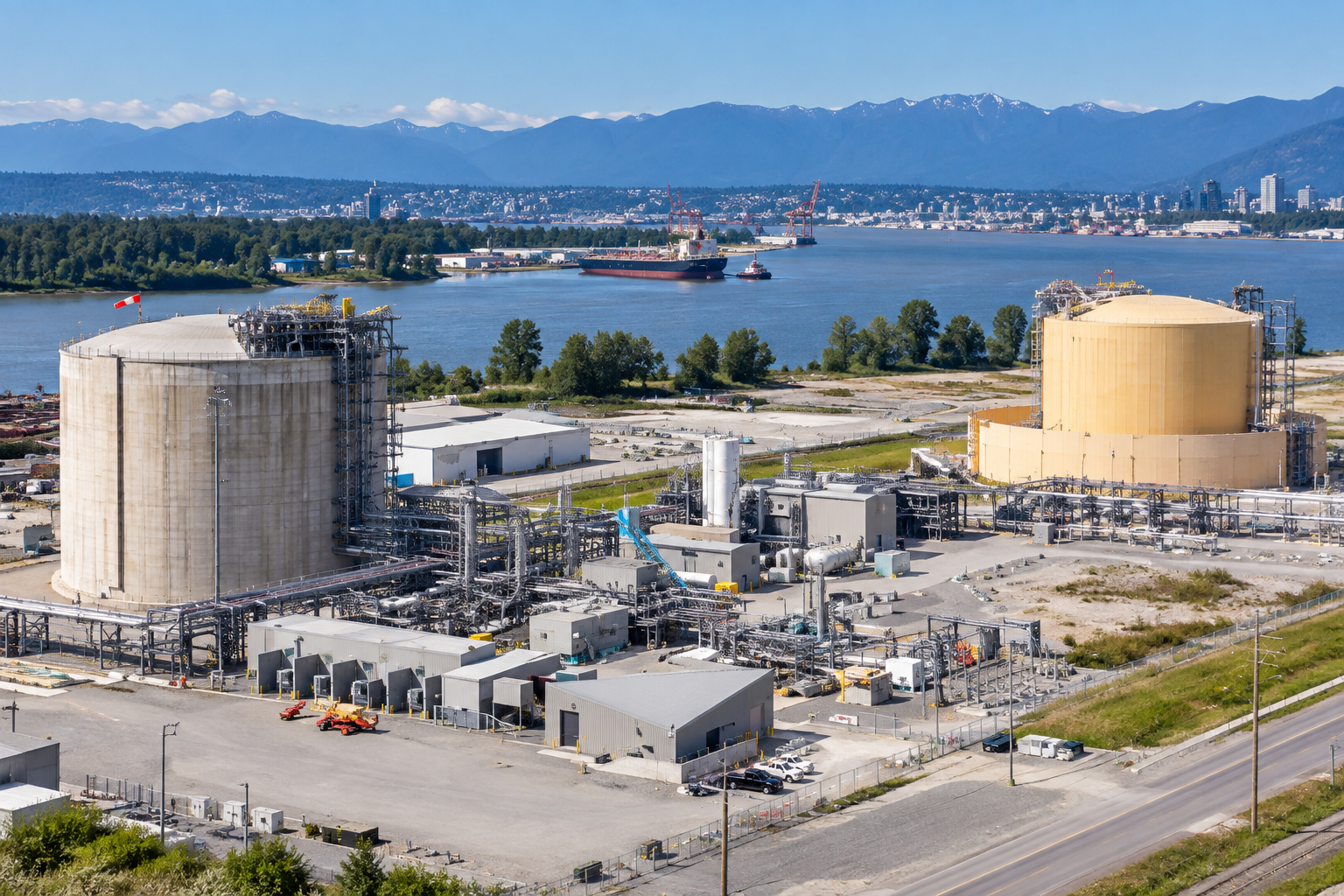
Major project receives both provincial and federal environmental approvals, clearing a key hurdle for a major increase in LNG production and storage capacity in Metro Vancouver
A major expansion of FortisBC’s liquefied natural gas facility on Tilbury Island in Delta has cleared its two biggest environmental review hurdles, setting the stage for the company to move ahead with a much larger LNG operation in the Lower Mainland.
The federal government issued its decision on September 21, 2026, shortly after the B.C. government granted the project an environmental assessment certificate. Together, the decisions allow FortisBC to proceed toward the remaining permits and approvals required before construction can begin.
The Tilbury Phase 2 LNG Expansion Project would add a new LNG storage tank with a working capacity of up to 142,400 cubic metres, along with new liquefaction equipment capable of producing as much as 7,700 tonnes of LNG per day. The project is planned within the existing Tilbury industrial site on the Fraser River.
For a region where industrial development, energy infrastructure and environmental concerns increasingly intersect, the approval represents a significant step for FortisBC — and a project that could change the scale of LNG production in Metro Vancouver.
A much larger Tilbury facility
FortisBC has operated its Tilbury LNG facility since 1971, making it one of the longest-running LNG facilities in British Columbia.
The facility already plays several roles in the regional energy system. LNG produced at Tilbury is used for transportation and marine fuel, while the facility also provides storage that can help supplement natural gas supplies during periods of peak demand.
A previous expansion completed in 2018 added a 46,000-cubic-metre storage tank. FortisBC now describes the site as serving transportation, shipping and export markets in addition to its role in the Lower Mainland gas system.
Phase 2 would take that operation considerably further.
The proposed expansion includes a new storage tank and additional liquefaction facilities, as well as supporting infrastructure needed to process, store and transfer LNG. The federal assessment says the project is expected to operate for at least 40 years.
At full production, the new equipment would add up to approximately 2.5 million tonnes of LNG production capacity per year.
That would make the project substantially larger than the existing Tilbury operation.
Two approvals arrived within hours of each other
The project has been moving through the environmental assessment process for years.
The Tilbury Phase 2 assessment formally entered the B.C. environmental review process in February 2020. FortisBC later submitted a revised application in February 2026 before the assessment was completed this summer.
On September 21, B.C. Environment and Parks Minister Tamara Davidson and Energy and Climate Solutions Minister Adrian Dix issued the provincial environmental assessment certificate.
The certificate contains 18 legally binding conditions covering areas including air quality, wildlife, greenhouse-gas reductions, health and emergency planning, and monitoring of impacts on First Nations.
Later the same day, federal Environment, Climate Change and Nature Minister Julie Dabrusin issued the federal decision statement.
Ottawa determined that the project’s potential adverse effects within federal jurisdiction were justified when considered alongside the benefits associated with the development.
The federal assessment was conducted using a “one project, one review” approach in cooperation with B.C.
Rather than conducting two completely separate environmental assessments, the provincial Environmental Assessment Office carried out a substituted assessment on behalf of the federal government. Federal officials then used that assessment, along with federal conditions, to make the federal decision.
The federal government says the approach was intended to reduce regulatory duplication while still addressing effects that fall under federal jurisdiction.
Thousands of construction jobs
The project is expected to have a significant economic footprint during construction.
According to the B.C. government, FortisBC estimates the expansion could generate approximately 6,200 full-time-equivalent person-years of employment during construction.
Once the expanded facility is operating, the company estimates it could support approximately 100 permanent jobs. The province also says construction could contribute as much as $1.7 billion to B.C.’s GDP.
Those numbers include employment and economic activity generated over the construction period rather than 6,200 individual permanent jobs.
The province has placed the project within its broader Look West strategy, which is aimed at attracting major investment and expanding B.C.’s trade and export opportunities.
For FortisBC, the expansion also fits into a larger strategy around LNG as a marine fuel.
The company’s existing Tilbury operation already supplies LNG to customers including BC Ferries and Seaspan Ferries. A separate Phase 1B project is intended to expand the facility’s marine-fuelling capabilities and support ship-to-ship LNG transfers.
That project is separate from Phase 2.
Phase 1B and Phase 2 are not the same project
The distinction is important because FortisBC is pursuing several developments at the Tilbury site.
Phase 1B is primarily associated with expanding LNG production and marine fuelling infrastructure. The province moved that project forward in July 2026 through regulatory changes that allowed FortisBC to proceed with more than $2 billion in planned investment.
Phase 2, which received the provincial and federal environmental approvals in September, is the much larger expansion involving the new storage tank and additional liquefaction capacity.
There is also a separate Tilbury Marine Jetty project. That project received its own environmental assessment certificate in 2024.
The three projects are related geographically and operationally, but they have gone through separate regulatory processes.
The environmental questions aren’t going away
The approvals do not mean the environmental debate surrounding Tilbury is finished.
The facility is located in an industrial area on Tilbury Island, but it is also in the heavily developed Lower Mainland and sits along the Fraser River, across the water from parts of Richmond and downstream from New Westminster.
That location has made air quality, greenhouse-gas emissions, marine activity, wildlife and cumulative environmental effects important issues throughout the assessment.
The project’s environmental review included analysis of existing air quality and projected emissions. The assessment documents note that nitrogen dioxide levels in the surrounding airshed are already elevated in some circumstances and that background concentrations account for a substantial portion of predicted annual nitrogen dioxide levels.
FortisBC has committed to installing emissions-control technology, with the specific technology to be determined during detailed design and subsequent permitting.
The assessment also concluded that the project’s footprint is overwhelmingly industrial land, with more than 98 per cent described as industrial land use rather than vegetated area.
The provincial certificate’s legally binding conditions are intended to address those and other potential effects during construction and operation.
Indigenous consultation was part of the review
Indigenous participation was another major component of the environmental assessment.
The federal government says the assessment process involved consultation with 41 Indigenous groups represented by 21 Indigenous organizations. The process also included information from the Tsawwassen First Nation, which is a modern treaty Nation with a relationship with both governments.
The environmental assessment examined potential effects on Indigenous interests including harvesting and subsistence activities, cultural use areas, social and economic conditions, health and well-being, cultural continuity and governance systems.
The final project conditions include ongoing monitoring of impacts on First Nations.
That means approval is not the end of the regulatory process. FortisBC will remain subject to conditions and additional permitting requirements as the project moves toward construction and operation.
What happens next?
Despite the headlines describing the project as approved, FortisBC still has work to do before construction can begin.
The federal Impact Assessment Agency notes that the project can proceed toward construction only as federal authorizations and permits are issued and the applicable conditions and requirements are met.
FortisBC must also complete detailed engineering, permitting and other regulatory work.
The company has been developing the project for years, and its revised application was submitted earlier in 2026 after the assessment process was delayed from its original timeline.
If the remaining approvals and investment decisions move forward, construction would transform an already significant industrial operation into a much larger LNG production and storage facility.
A bigger role for LNG in the Lower Mainland
The Tilbury expansion comes at a time when British Columbia is becoming an increasingly important part of Canada’s LNG industry.
LNG Canada began exports from Kitimat in 2025, while other projects and expansions are being developed along the B.C. coast. Tilbury is different from those large coastal export terminals because of its location in the Lower Mainland and its mix of domestic storage, marine fuelling and potential export uses.
That location is both an advantage and a source of scrutiny.
Tilbury is close to major transportation infrastructure, the Port of Vancouver and a large concentration of industrial customers. At the same time, it operates within one of Canada’s most densely populated metropolitan regions and within the Fraser River industrial corridor.
The Phase 2 approval means FortisBC now has a clearer path to substantially increasing the amount of LNG that can be produced and stored at the site.
Whether the project ultimately reaches full construction and operation will depend on the remaining permits, detailed design and FortisBC’s final investment decisions.
For now, however, the biggest regulatory hurdle has been cleared.
The Tilbury LNG expansion has received both provincial and federal environmental approval, putting one of Metro Vancouver’s largest proposed energy projects another major step closer to becoming reality.