
Group is calling on B.C., Alberta, Saskatchewan and Manitoba to remove provisions it says allow human-rights bodies to intervene in public debate
A national civil-liberties organization is calling on four Western Canadian provinces to change their human-rights laws, arguing that provisions originally intended to address discrimination are being used to regulate political, social and moral expression.
The Justice Centre for Constitutional Freedoms (JCCF) launched the campaign on September 22, asking the governments of British Columbia, Alberta, Saskatchewan and Manitoba to repeal or amend provisions dealing with discriminatory publications and statements. The organization says the provisions can expose people to human-rights complaints and tribunal proceedings over public comments that do not amount to criminal hate speech.
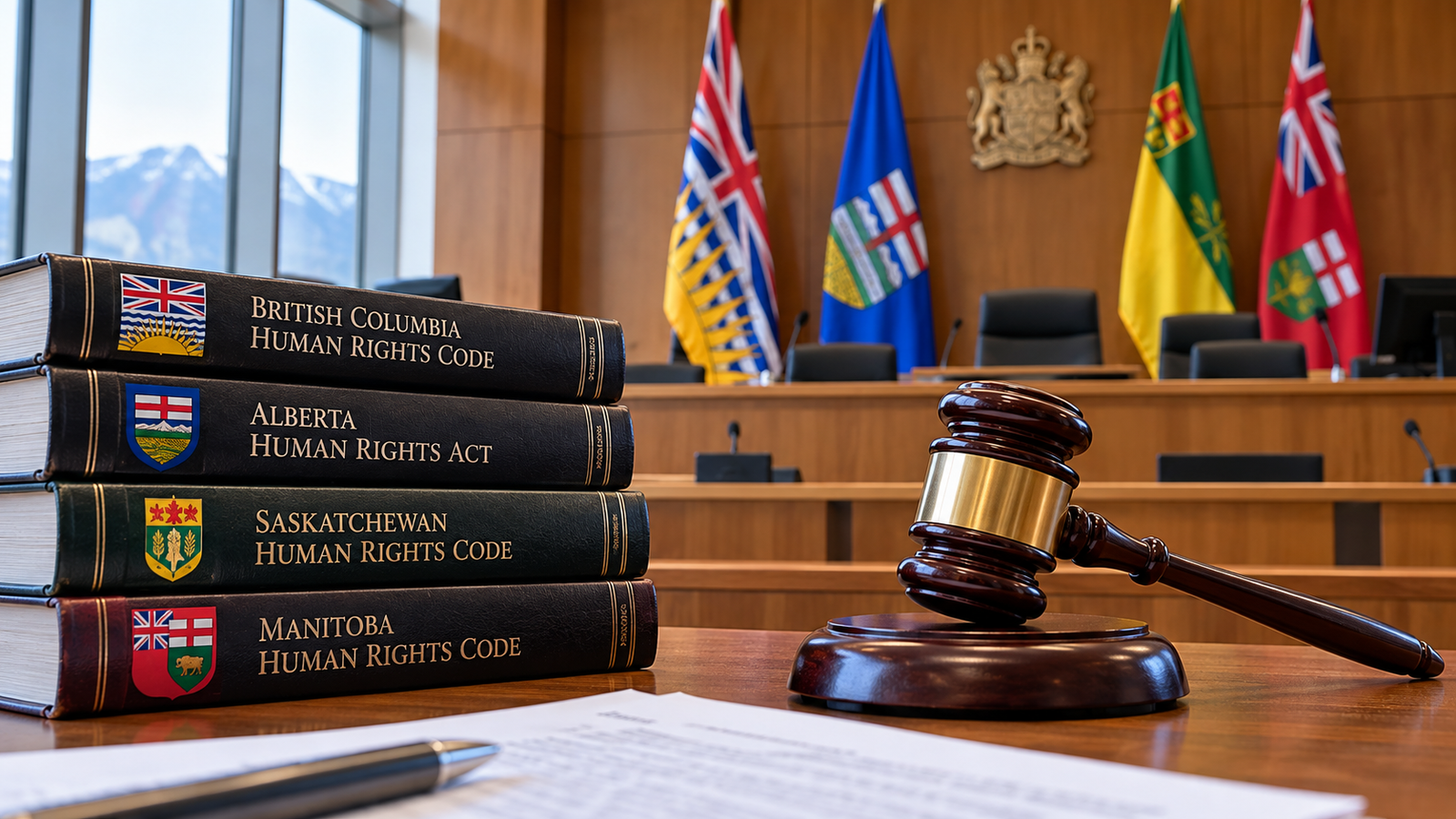
The campaign targets Section 7 of B.C.’s Human Rights Code, Section 3 of Alberta’s Human Rights Act, Section 14(1)(b) of Saskatchewan’s Human Rights Code, 2018, and Section 18 of Manitoba’s Human Rights Code.
The issue is particularly relevant in B.C. and Alberta, where recent cases involving public statements and political advocacy have brought the question of free expression and human-rights law into the spotlight.
At the same time, the provincial human-rights bodies involved say these provisions are directed at discriminatory or hateful public communications connected to protected characteristics, rather than ordinary political disagreement.
That distinction sits at the centre of the debate.
Four provinces, four similar provisions
The laws differ in their wording, but each gives human-rights legislation some authority over public expression.
In B.C., Section 7 prohibits publishing or displaying a statement, publication, notice, sign, symbol or other representation that indicates discrimination or an intention to discriminate, or is likely to expose a person or group to hatred or contempt, when connected to specified protected characteristics.
The B.C. Human Rights Commissioner’s office says the provision applies to public communications including flyers, signs, articles, speeches and online comments. It also says the provision does not apply to private communications.
Alberta’s Section 3 similarly prohibits certain public statements and publications that indicate discrimination or an intention to discriminate, or are likely to expose a person or group to hatred or contempt based on protected grounds. The Alberta Human Rights Commission says the law does not cover every offensive or upsetting statement and notes that political views themselves are not a protected ground.
Manitoba’s Section 18 prohibits publicly publishing, broadcasting, circulating or displaying a sign, symbol, notice or statement that discriminates, indicates an intention to discriminate, or incites, advocates or counsels discrimination in an activity covered by the Human Rights Code.
Saskatchewan’s provision is somewhat different. Section 14(1)(b) addresses representations that expose or tend to expose people to hatred on the basis of a prohibited ground. The wording also historically included language concerning ridicule, belittling and affronting dignity, but the Supreme Court of Canada struck those portions from the legislation as unconstitutional in its 2013 decision in Saskatchewan (Human Rights Commission) v. Whatcott.
That Supreme Court ruling is an important part of the discussion because it demonstrates that Canadian law already recognizes a constitutional tension between human-rights protections and freedom of expression.
Why the Justice Centre wants the laws changed
The JCCF’s position is that human-rights legislation should focus on conduct such as discrimination in employment, housing and services, rather than giving commissions and tribunals jurisdiction over political or cultural arguments.
In its May 2026 report, “Speech on trial: Censorship by human rights commissions,” the organization examined cases from several provinces and argued that human-rights proceedings can subject people to investigations, hearings and financial consequences for expression that falls outside the Criminal Code’s hate-propaganda provisions.
The new campaign builds on that report.
JCCF president John Carpay argues that human-rights commissions were established to prevent people from being denied jobs, housing or services because of who they are, and says public policy disputes should instead be settled through political debate.
The organization has created an online tool allowing residents of the four provinces to generate letters to their provincial governments requesting legislative changes.
The Alberta case putting the issue in the spotlight
One of the most prominent current examples is unfolding in Westlock, Alberta.
Benita Pedersen is facing a human-rights proceeding arising from a flyer she distributed in June 2023 opposing a proposed rainbow crosswalk.
The flyer encouraged residents to contact elected officials and oppose the project. A complaint was subsequently filed alleging discrimination based on gender, gender identity and gender expression.
In October 2025, the director of the Alberta Human Rights Commission referred the complaint to the Alberta Human Rights Tribunal under Section 3 of the Alberta Human Rights Act. The director later assumed carriage of the complaint.
The hearing began in September 2026, with testimony scheduled across multiple dates and involving expert witnesses from both sides.
The JCCF is providing legal assistance to Pedersen and describes the case as an example of a human-rights tribunal being used to adjudicate political expression.
But the complaint itself is not proof that Pedersen violated the law. The tribunal process is intended to determine whether the legal requirements have been met.
That distinction is important because the campaign’s broader argument rests partly on what the organization sees as the potential consequences of allowing these cases to proceed.
Another Alberta complaint involves a Facebook group
Leduc business owner and former municipal candidate Karen Richert is also facing a human-rights complaint.
The case involves comments she made in a local Facebook group about a dance studio’s “family-friendly” drag show in 2024. The JCCF says Richert expressed concerns about the appropriateness of the event for children. A complaint was subsequently filed under Alberta’s human-rights legislation.
The organization is representing Richert and argues that the case illustrates how Section 3 can bring public commentary about controversial community issues into the human-rights system.
Again, the existence of a complaint does not establish that a violation occurred.
The B.C. case involving Barry Neufeld
B.C. provides another major example.
Former Chilliwack school trustee Barry Neufeld became the subject of a human-rights case following a series of public statements concerning sexual orientation and gender identity education.
The B.C. Human Rights Tribunal ultimately found against Neufeld and ordered a total of $750,000 in compensation to LGBTQ teachers. Reporting on the decision said the tribunal found multiple publications discriminatory and several constituted hate speech.
The case has been controversial.
The JCCF cites the decision as an example of human-rights law reaching into public debate. The B.C. Office of the Human Rights Commissioner, meanwhile, describes the case as involving allegations of online hate speech and says the tribunal determined it had jurisdiction to hear such complaints.
The Commissioner’s office says the complaint arose from Facebook posts concerning trans and queer-inclusive education and that the B.C. Supreme Court had previously declined to intervene in the case before the tribunal proceedings were complete.
The case therefore illustrates the competing interpretations of what these provisions are designed to accomplish.
What the human-rights commissions say
The argument isn’t simply that one side supports free speech while the other side supports censorship.
B.C.’s Human Rights Commissioner explicitly states that Section 7 is intended to protect people from discriminatory and hateful public communications connected to protected characteristics. The office says that not every offensive statement qualifies and identifies specific requirements involving a protected characteristic and actual, intended or likely negative impact.
Alberta’s Human Rights Commission makes a similar distinction.
Its guidance says Section 3 does not prohibit every insulting or upsetting comment. It also notes that a dispute based solely on political disagreement does not fall under the Act simply because the comments are hateful or hurtful. The Commission says its jurisdiction depends on the statutory requirements being met, including the connection to a protected ground.
That means the central disagreement is less about whether discrimination should be prohibited and more about where the boundary between discriminatory expression and protected expression should be drawn.
The Supreme Court has already drawn one important line
The Saskatchewan provision provides an unusually clear example of that boundary.
In Whatcott, the Supreme Court of Canada considered flyers distributed by William Whatcott that targeted homosexual people. The Court found that Section 14(1)(b) infringed freedom of expression but concluded that its prohibition against expression that exposes protected groups to hatred could be justified under Section 1 of the Charter.
However, the Court reached a different conclusion regarding language prohibiting material that merely “ridicules,” “belittles” or “affronts the dignity” of a protected group. Those portions were found unconstitutional and severed.
The decision effectively established that offensiveness alone is not enough to justify restricting expression under that provision.
The Supreme Court also emphasized the particularly serious nature of speech that meets the legal definition of hatred.
That precedent is relevant to today’s debate because the JCCF’s campaign is arguing that provincial human-rights legislation should leave political and social disagreement outside the human-rights complaint system, while existing law continues to regulate genuinely discriminatory or hateful expression.
Saskatchewan’s history makes the issue especially significant
Saskatchewan is particularly important because its human-rights speech provision was at the centre of the Whatcott case.
The current Saskatchewan Human Rights Code, 2018, retains Section 14 dealing with discriminatory publications. Its language includes restrictions concerning representations that tend to restrict a person’s enjoyment of a legal right on a prohibited ground and representations that expose or tend to expose people to hatred.
The Supreme Court’s constitutional ruling means the provision cannot simply be read as prohibiting anything that insults or offends a protected group.
Instead, the Court established a much narrower constitutional boundary around hate speech.
The JCCF nonetheless argues that governments should remove the relevant provisions from provincial human-rights legislation rather than relying on tribunal decisions and constitutional interpretation to establish those limits.
Why the campaign extends beyond Alberta and B.C.
The JCCF’s campaign isn’t limited to the provinces where current cases have received the most attention.
It is asking all four Western provinces to make legislative changes.
The organization argues that residents should not have to defend themselves through lengthy administrative proceedings simply because they participate in contentious public debates.
Its May report examined examples involving political commentary, religious expression and other controversial speech and concluded that the current system can create significant legal and financial burdens even before a final decision is reached.
The opposing perspective is that human-rights legislation provides a civil and administrative mechanism for dealing with discriminatory conduct that may not meet the much higher threshold required for criminal prosecution.
That difference matters.
A person does not necessarily have to commit a criminal offence for conduct to violate a provincial human-rights code. Human-rights law serves a different legal purpose and generally deals with discrimination and its effects in areas governed by the relevant legislation.
A debate over where the line should be drawn
At its core, the campaign raises a difficult question for provincial lawmakers:
When does public expression cross the line from protected political debate into unlawful discrimination?
There is broad agreement that Canadians have freedom of expression under the Charter.
There is also established Canadian law recognizing that freedom of expression is not absolute and that governments can impose limits in circumstances that satisfy constitutional requirements. The Supreme Court’s Whatcott decision is one example.
The disagreement is over how those principles should operate within provincial human-rights systems.
The JCCF says the existing provisions allow government-funded bodies to become involved in political and cultural disputes that should instead be resolved through public debate.
Human-rights authorities say the laws are aimed at public communications that meet specific legal tests involving discrimination, protected characteristics and harm, and are part of a broader system designed to protect people from discriminatory treatment.
Those competing views are now being tested not only in courtrooms and tribunals, but also in the political arena.
What happens next?
For the Justice Centre, the next step is political pressure.
The organization is asking the governments of B.C., Alberta, Saskatchewan and Manitoba to repeal the targeted provisions and has created a mechanism for residents to contact their provincial ministers.
For the provinces, any legislative changes would have to balance several competing interests: protecting people from discrimination, maintaining access to human-rights remedies, respecting Charter-protected expression and determining how public communications involving protected characteristics should be regulated.
The Alberta Human Rights Tribunal proceedings involving Benita Pedersen are also continuing, with additional hearing dates scheduled for late September and early October.
And in B.C., the Neufeld case remains part of a broader discussion about how human-rights law applies to speech published online. The B.C. Human Rights Commissioner’s office says the tribunal has already affirmed its jurisdiction to hear allegations involving online hate speech.
For residents across Western Canada, the outcome of these debates could have implications well beyond the individual cases.
The question is ultimately about where provincial governments draw the legal boundary between protecting people from discrimination and allowing Canadians to freely argue about controversial issues.
And that is a debate that is unlikely to disappear anytime soon.