
What Happens When You Can’t Pay Your Property Taxes

For most homeowners in Sayward, paying property taxes is a routine annual responsibility. But when finances tighten, falling behind can quickly become overwhelming. Knowing how the process works in British Columbia—and how it applies specifically in the Village of Sayward—helps residents make informed choices before the situation becomes serious.

Property Taxes Are a Legal Obligation

In British Columbia, municipal property taxes are mandatory. They are secured against the property itself rather than the individual owner. As a result, unpaid taxes stay with the land, regardless of who owns it or whether the property is refinanced.

If taxes are not paid by the annual deadline (usually July 2), penalties are applied immediately. In Sayward, as in most BC municipalities, a 10% penalty is added to any outstanding balance—even if only a small amount is overdue.

Year One: Arrears and Penalties

During the first year of non-payment, taxes move into arrears. Interest may also accumulate depending on local policy. The homeowner still retains full ownership, but the debt continues to grow.

Partial payments are typically allowed and can reduce interest charges, though they do not reverse penalties already applied.

Year Two and Beyond: The Property Tax Sale

If taxes remain unpaid for three consecutive years, the property becomes eligible for a tax sale. In BC, tax sales take place annually on the last Monday of September.

At a tax sale:

  • The municipality auctions the property to recover unpaid taxes, interest, and associated costs.

  • The opening bid equals the amount owed—not the property’s market value.

  • Properties may sell for significantly less than their assessed worth.

Importantly, ownership does not transfer immediately at the sale.

The One-Year Redemption Period

After the tax sale, the original owner enters a one-year redemption period. During this time, the homeowner can reclaim the property by paying:

  • All outstanding taxes

  • Interest

  • Penalties

  • Legal and administrative fees

If the full amount is paid within the year, the sale is cancelled and ownership remains with the homeowner.

If the Property Is Not Redeemed

If the homeowner does not redeem the property within the one-year period:

  • Ownership is legally transferred to the tax sale purchaser.

  • The former owner permanently loses the property.

  • No compensation is provided for any remaining equity.

This means a home worth hundreds of thousands of dollars can be lost over a relatively small tax debt.

Can the Municipality Take Your Home Directly?

BC municipalities cannot simply seize a property for unpaid taxes. They must follow the tax sale process. However, the end result—loss of the home—can still occur if taxes remain unpaid long enough.

Options for Homeowners Facing Difficulty

Homeowners who are struggling should act early. Possible steps include:

  • Contacting the Village for clarification or to discuss payment timing

  • Exploring refinancing or short-term borrowing

  • Applying for the BC Property Tax Deferment Program (available to qualifying seniors, families with children, and persons with disabilities)

Delaying action significantly reduces available options.

A Serious but Preventable Outcome

BC’s property tax enforcement system is strict but predictable. Losing a home over unpaid taxes is uncommon, yet it does happen—often because homeowners misunderstand the process or wait too long to seek help.

For Sayward residents experiencing financial hardship, early communication and a clear understanding of the system can be the difference between a temporary setback and a permanent loss.

Sayward Taxpayers Alliance Logo

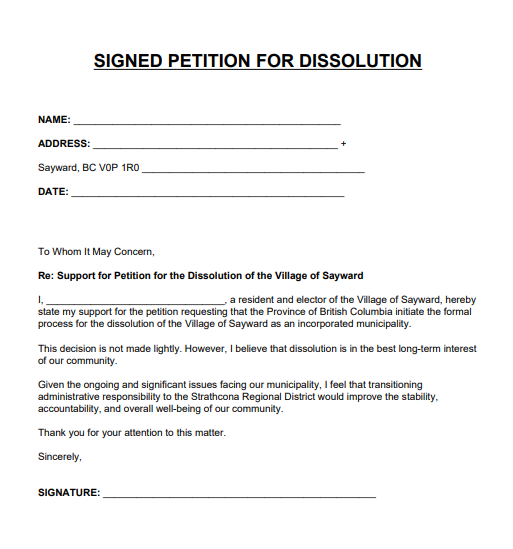
Signing the petition means your voice is heard in calling for: reduced administrative burden, governance improvements, respect of citizen concerns, fiscal responsibility and professionalism.

Petition

Village Of Sayward Residents Face 42% Tax Increase With Dysfunctional Council

The Village of Sayward is preparing for a steep 42% increase in property taxes under its draft 2026–2030 financial plan — a dramatic shift for a community of fewer than 400 residents and one that underscores the severity of its financial challenges. The plan is expected to be finalized in April, but the scale of the proposed increase has already sparked concern, debate, and renewed scrutiny of the village’s governance.

At a Feb. 17 committee meeting, village CPA Jeannie Bradburne walked council through the draft budget and laid out the structural issues that have brought Sayward to this point. For years, she explained, the village’s expenditures have consistently exceeded its revenues. Rather than raising taxes or cutting services earlier, the village relied heavily on reserve funds to cover annual shortfalls. Those reserves, once a buffer against financial instability, are now nearly depleted.

With no meaningful surplus left to draw from, Bradburne said the village has reached a legal and practical limit: the only remaining tool to balance the budget is a substantial increase in property taxes. Even after implementing cost-saving measures — including cancelling programs and closing the Kelsey Recreation Centre, a facility that once served as a community hub — the gap between what the village spends and what it brings in remains significant.

The first draft of the budget projected a nearly 50% tax increase, but subsequent adjustments and recalculations brought the figure down to approximately 42%. For the average household, that means an annual increase of about $725, or roughly $60 per month. Sewer and water fees are also slated to rise, while solid waste fees will remain unchanged. Taken together, the total estimated monthly impact for residents is expected to be around $72.

The financial discussion quickly intersected with ongoing political tensions. During the meeting, Councillor Scott Burchett criticized the village’s high legal expenses in 2025, noting that a large portion of those costs stemmed from litigation involving himself and Councillor Sue Poulsen. The village is reportedly considering censure and potential legal action against the two councillors, and has applied to the province to reduce the required council quorum from three members to two — a move intended to ensure council can continue functioning despite persistent conflict and absences.

Sayward’s council has been mired in turmoil since the last municipal election. Two councillors resigned in 2024, citing dysfunction and an inability to work effectively within the current political climate. Their departures left the remaining council members struggling to maintain quorum and make decisions, further complicating efforts to address the village’s financial problems.

At the Feb. 17 meeting, Councillor Debbie Coates urged her colleagues to undertake a detailed, line-by-line review of the budget in search of additional savings. She argued that residents deserve assurance that every possible cost-saving measure has been explored before council approves such a significant tax increase. Village CAO Andrew Young added that declining provincial grants, rising operational costs, and long-term structural challenges have all contributed to Sayward’s precarious fiscal position.

The village’s difficulties have not gone unnoticed by residents. Some, frustrated by both the financial strain and the ongoing governance issues, have launched the Sayward Taxpayers Alliance, and a petition calling for the dissolution of the Village of Sayward and its integration into the Strathcona Regional District. Supporters of the petition argue that joining the regional district could provide a broader tax base, more stable service delivery, and relief from the political turmoil that has plagued the village.

Sayward Taxpayers Alliance Logo

Council is expected to reconvene in March to continue budget deliberations and explore whether the proposed tax increase can be reduced before the financial plan is finalized. For now, Sayward faces a pivotal moment — one that will shape not only its finances but also its future as an independent municipality.