
What Happens When You Can’t Pay Your Property Taxes

For most homeowners in Sayward, paying property taxes is a routine annual responsibility. But when finances tighten, falling behind can quickly become overwhelming. Knowing how the process works in British Columbia—and how it applies specifically in the Village of Sayward—helps residents make informed choices before the situation becomes serious.

Property Taxes Are a Legal Obligation

In British Columbia, municipal property taxes are mandatory. They are secured against the property itself rather than the individual owner. As a result, unpaid taxes stay with the land, regardless of who owns it or whether the property is refinanced.

If taxes are not paid by the annual deadline (usually July 2), penalties are applied immediately. In Sayward, as in most BC municipalities, a 10% penalty is added to any outstanding balance—even if only a small amount is overdue.

Year One: Arrears and Penalties

During the first year of non-payment, taxes move into arrears. Interest may also accumulate depending on local policy. The homeowner still retains full ownership, but the debt continues to grow.

Partial payments are typically allowed and can reduce interest charges, though they do not reverse penalties already applied.

Year Two and Beyond: The Property Tax Sale

If taxes remain unpaid for three consecutive years, the property becomes eligible for a tax sale. In BC, tax sales take place annually on the last Monday of September.

At a tax sale:

  • The municipality auctions the property to recover unpaid taxes, interest, and associated costs.

  • The opening bid equals the amount owed—not the property’s market value.

  • Properties may sell for significantly less than their assessed worth.

Importantly, ownership does not transfer immediately at the sale.

The One-Year Redemption Period

After the tax sale, the original owner enters a one-year redemption period. During this time, the homeowner can reclaim the property by paying:

  • All outstanding taxes

  • Interest

  • Penalties

  • Legal and administrative fees

If the full amount is paid within the year, the sale is cancelled and ownership remains with the homeowner.

If the Property Is Not Redeemed

If the homeowner does not redeem the property within the one-year period:

  • Ownership is legally transferred to the tax sale purchaser.

  • The former owner permanently loses the property.

  • No compensation is provided for any remaining equity.

This means a home worth hundreds of thousands of dollars can be lost over a relatively small tax debt.

Can the Municipality Take Your Home Directly?

BC municipalities cannot simply seize a property for unpaid taxes. They must follow the tax sale process. However, the end result—loss of the home—can still occur if taxes remain unpaid long enough.

Options for Homeowners Facing Difficulty

Homeowners who are struggling should act early. Possible steps include:

  • Contacting the Village for clarification or to discuss payment timing

  • Exploring refinancing or short-term borrowing

  • Applying for the BC Property Tax Deferment Program (available to qualifying seniors, families with children, and persons with disabilities)

Delaying action significantly reduces available options.

A Serious but Preventable Outcome

BC’s property tax enforcement system is strict but predictable. Losing a home over unpaid taxes is uncommon, yet it does happen—often because homeowners misunderstand the process or wait too long to seek help.

For Sayward residents experiencing financial hardship, early communication and a clear understanding of the system can be the difference between a temporary setback and a permanent loss.
Sayward Taxpayers Alliance Logo

Signing the petition means your voice is heard in calling for: reduced administrative burden, governance improvements, respect of citizen concerns, fiscal responsibility and professionalism.
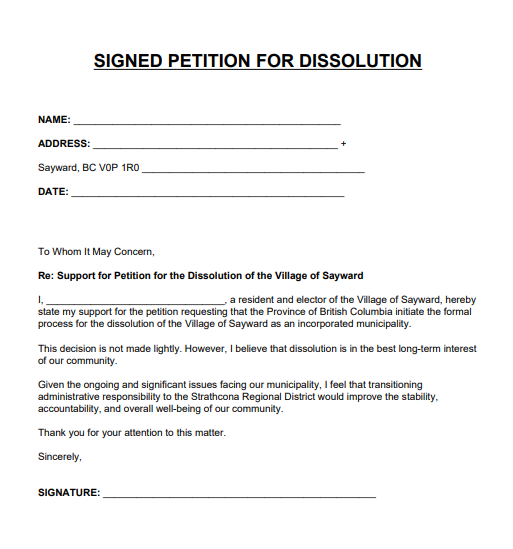
Petition

BC Property Rights Under Scrutiny as Critics Say Government Response Falls Short

Private property rights in British Columbia are once again under intense scrutiny after a recent court ruling affirmed elements of Aboriginal title that overlap with privately owned land in Richmond. The decision has sparked political debate and legal uncertainty, with critics arguing that the provincial government’s response—ranging from legislative amendments to financial guarantees—falls short of resolving the confusion created by the ruling.

Background: Court Ruling and Its Impact

The controversy originates from a case in which the court recognized Aboriginal title claims over specific parcels of land, including some already held by private owners. The ruling has raised difficult questions about how Indigenous rights intersect with long‑established private property interests.

Homeowners in Richmond say they are already feeling the effects, reporting difficulties selling their homes, securing mortgages, and obtaining financing. Real estate experts warn that prolonged uncertainty could depress property values and deter investment or development in the affected area.

Government Response

Premier David Eby’s government has introduced proposed amendments to the Declaration on the Rights of Indigenous Peoples Act (DRIPA) and announced up to $154 million in financial assistance for impacted homeowners. The funding is intended to help residents navigate legal and financial complications stemming from the ruling.

Provincial officials describe the measures as an attempt to balance the protection of property owners with the province’s commitments to Indigenous reconciliation. They emphasize that DRIPA is part of B.C.’s broader effort to implement the United Nations Declaration on the Rights of Indigenous Peoples and ensure Indigenous rights are reflected in provincial law.

Criticism From Opposition

Opposition voices argue the government’s actions are insufficient. Steve Kooner, Conservative MLA for Richmond‑Queensborough and Opposition critic for the Attorney General, has dismissed the measures as “band‑aid solutions” that fail to address the underlying issues.

Kooner points to several concerns:

  • Many homeowners were unaware of potential legal implications until after the ruling.

  • The uncertainty is already disrupting property sales and financing in the region.

  • Decisions made when Eby served as Attorney General may have contributed to the current ambiguity around how Aboriginal title interacts with private land.

He contends that only sweeping legislative reform—including the possibility of revising or repealing DRIPA—would adequately safeguard private property rights while clarifying how they coexist with constitutionally protected Indigenous rights.

Legal and Policy Context

Legal scholars note that the issue sits at the intersection of provincial legislation, judicial interpretations of Aboriginal title, and constitutional protections for Indigenous rights. Because Aboriginal title is constitutionally recognized, courts must reconcile it with other land interests, including private ownership. This creates a complex legal landscape in which even long‑established property rights can be affected by newly affirmed Indigenous claims.

Broader Implications

The Richmond case is being closely monitored across the province. Many see it as a potential precedent for how B.C. will navigate the relationship between private property rights and Indigenous reconciliation. There is growing concern that similar disputes could arise elsewhere, with implications for development, housing markets, and investor confidence.

Political analysts expect the debate over DRIPA and property rights to remain a flashpoint in provincial politics. Homeowners are calling for clearer communication from the government and a more definitive legal framework that reconciles private property protections with constitutional obligations to Indigenous communities.

Next Steps

As legal proceedings continue, stakeholders are watching to see whether the government will pursue deeper legislative reforms or rely primarily on financial compensation for affected landowners. The decisions made in the coming months could shape how property rights and Indigenous title are balanced not only in British Columbia but potentially across Canada.

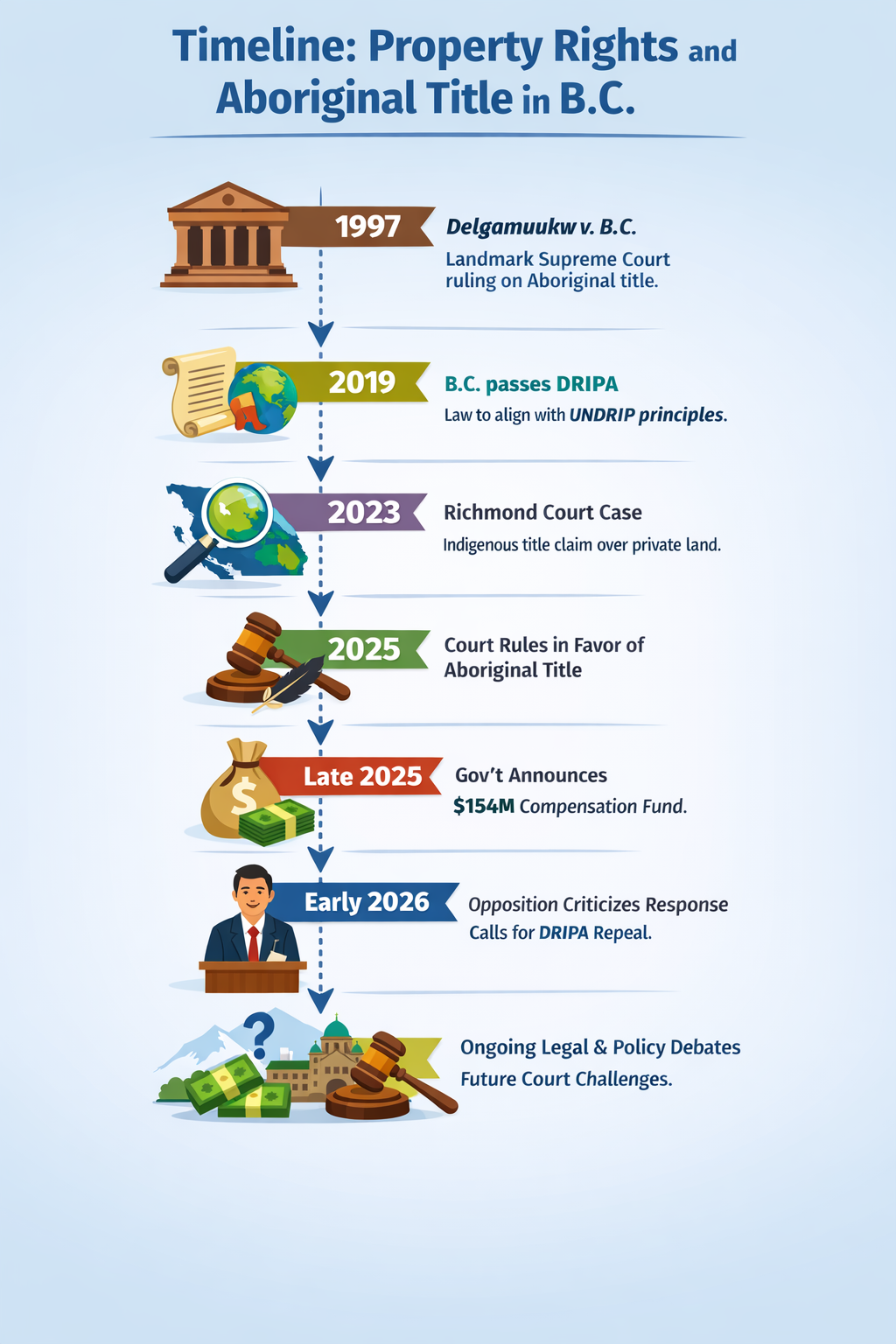
Timeline Property Rights and Aboriginal Title in BC

Timeline: Property Rights and Aboriginal Title in BC

YearEventSignificance
1997Delgamuukw v. British Columbia (Supreme Court of Canada)Landmark ruling establishing the legal framework for Aboriginal title in Canada. Recognized that Indigenous groups have constitutionally protected rights to their traditional lands.
2019B.C. passes DRIPA (Declaration on the Rights of Indigenous Peoples Act)Requires provincial laws to be aligned with UNDRIP (United Nations Declaration on the Rights of Indigenous Peoples). Lays groundwork for reconciliation policies affecting land management.
2020–2022Implementation and consultations on DRIPAProvincial government begins policy alignment; some private landowners raise concerns about potential impact on property rights.
2023Court case filed in Richmond over Aboriginal titleIndigenous groups claim title over areas including privately owned land; case raises questions about the intersection of Aboriginal title and private property.
2025Court rules in favor of Indigenous title claimConfirms that Aboriginal title applies to some privately owned parcels; creates uncertainty for homeowners and developers.
Late 2025Government announces financial compensation planPremier Eby’s government proposes up to $154 million in financial guarantees to affected property owners.
Early 2026MLA Steve Kooner and opposition criticize government responseOpposition labels measures as “band-aid solutions” that do not fully protect private property rights. Calls for DRIPA reform or repeal continue.
2026 and beyondOngoing legal and policy discussionsFurther court challenges and legislative revisions expected; potential precedent-setting impact for property rights and Indigenous reconciliation in B.C.