
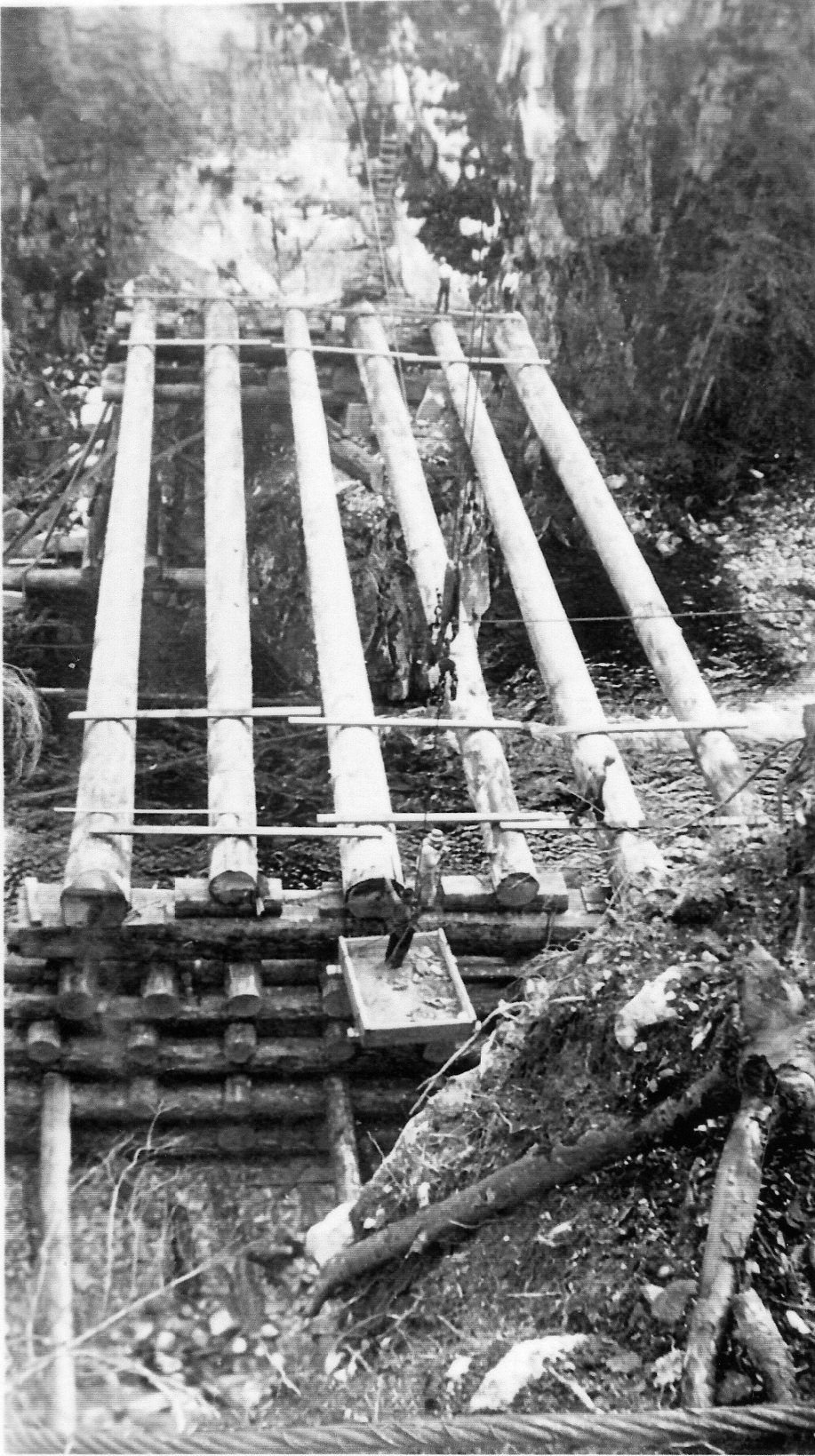
In the rugged backcountry, where rivers cut through dense forest and the terrain resists easy passage, necessity has always driven ingenuity. This striking photograph captures one such moment—an early-stage logging bridge under construction at the Adam River crossing, where raw materials and human effort come together in a careful balance of practicality and risk.
At first glance, the scene looks deceptively simple: a series of long, stripped logs laid side by side across a narrow span. But a closer look reveals the complexity behind this structure. Each log has been placed with intention, aligned to distribute weight evenly and anchored with crosspieces and cables. Beneath them, a foundation of stacked timber supports the approach, elevating the roadway above uneven ground and guiding loads safely onto the bridge.
This type of bridge wasn’t built for elegance—it was built for survival. Logging operations depended on reliable crossings to move heavy timber out of remote areas. Steel and concrete were often unavailable or too costly to transport, so crews relied on what the forest provided. Trees became beams, braces, and decking, shaped with hand tools and muscle power. Every decision—spacing, anchoring, reinforcement—had immediate consequences for safety.
Notice the cables and rigging suspended near the center. These likely played a role in positioning the logs, acting as both lifting aids and stabilizers during construction. The workers, though difficult to make out clearly, would have operated in close quarters with heavy materials, often above rushing water. It was dangerous, exacting work that demanded both coordination and trust.
The surrounding environment tells its own story. Fallen branches, uneven banks, and dense vegetation frame the crossing, emphasizing how isolated these projects often were. There were no roads leading in—this bridge was the road. Before its completion, everything had to be carried or dragged into place.
What stands out most is the resourcefulness. Without modern machinery, crews engineered durable solutions using simple principles: load distribution, redundancy, and friction. The logs act like parallel beams, spreading the weight of wagons or early trucks. Cross-bracing prevents shifting, while the stacked base absorbs impact and stabilizes the structure against erosion.
Bridges like this were temporary by design, yet many lasted far longer than expected. They bore the weight of countless loads, endured seasonal floods, and stood as quiet testaments to the craftsmanship of the people who built them.
Today, images like this remind us that infrastructure doesn’t always begin with blueprints and cranes. Sometimes, it begins with an axe, a rope, and a clear understanding of how to make the land work with you—not against you.
The Adam River crossing is more than a bridge—it’s a snapshot of resilience, adaptation, and the relentless push to connect even the most remote corners of the landscape.