
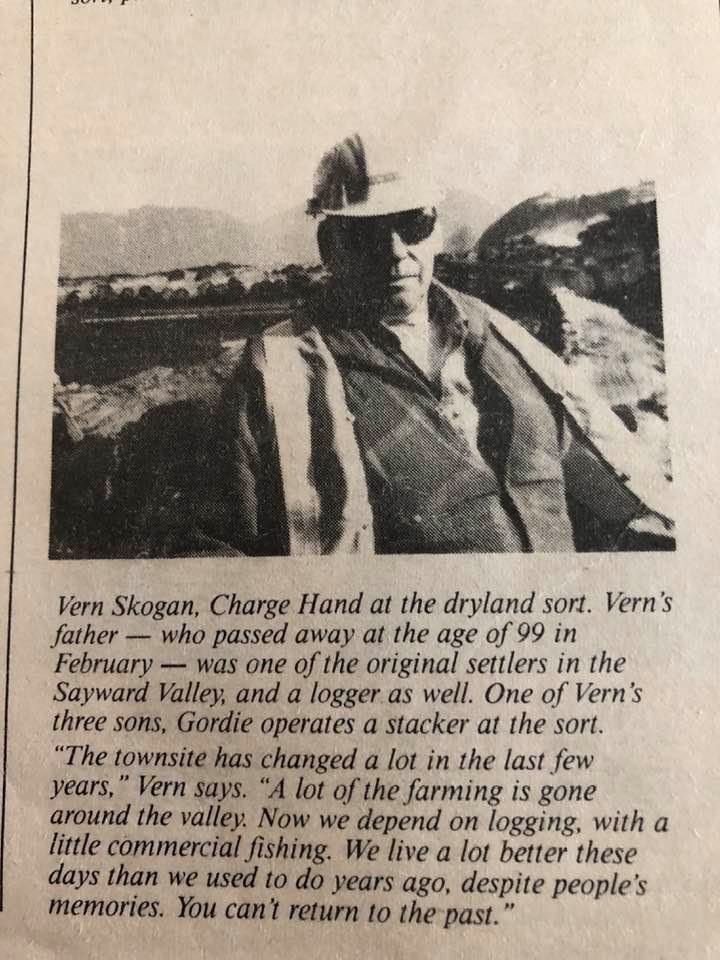
There’s something quietly powerful about old bulletin clippings—those small, grainy windows into everyday lives that rarely make it into history books. This one, pulled from an old Beavertails Bulletin, captures exactly that kind of moment: a man, a place, and a way of life mid-transition.
The photo shows Vern Skogan, seated outdoors, wearing a cap and dark glasses, framed by what looks like a rugged, working landscape. The image itself feels weathered, almost as if it absorbed the same elements Vern likely did—wind, dust, long days. It’s not posed in any modern sense. It’s practical. Functional. Honest.
The caption does most of the storytelling.
Vern is identified as a “Charge Hand at the dryland sort,” which already situates him firmly within the logging industry. This isn’t just a job—it’s part of a generational thread. His father, who lived to 99, was among the original settlers in the Sawmill Valley and worked as a logger too. That detail alone stretches the story back decades, hinting at a time when the valley was being carved—both literally and figuratively—out of wilderness.
But what stands out most is not the past—it’s the change.
Vern reflects on how the townsite has shifted in recent years. Farming, once a cornerstone of the valley, has largely disappeared. Logging has taken over as the primary livelihood, supplemented slightly by commercial fishing. It’s a familiar story in many rural regions: industries evolve, economies pivot, and communities reshape themselves around what remains viable.
Yet Vern doesn’t sound bitter. There’s no romanticizing of the “good old days,” at least not in the way we might expect when looking back from the present. In fact, he says something strikingly pragmatic: “We live a lot better these days than we used to do years ago, despite people’s memories.”
That line cuts through nostalgia.
It challenges the idea that the past was inherently better. Vern acknowledges progress—material improvement, perhaps stability—even as he recognizes that people tend to remember things differently. Memory, after all, edits out the hardship and keeps the sentiment.
And then comes the final line, simple but firm: “You can’t return to the past.”
There’s no drama in it. No regret. Just acceptance.
This small clipping becomes more than a record of one man’s life. It’s a snapshot of a community in transition and a reminder of how people adapt. Vern stands at the intersection of generations—his father’s pioneering era behind him, his son working alongside him, and a changing economy unfolding in real time.
In a way, the most modern thing about this decades-old clipping is its message. We still wrestle with the same tension today: holding onto what was, while navigating what is.
And like Vern, whether we admit it or not, we’re all living somewhere in between.