
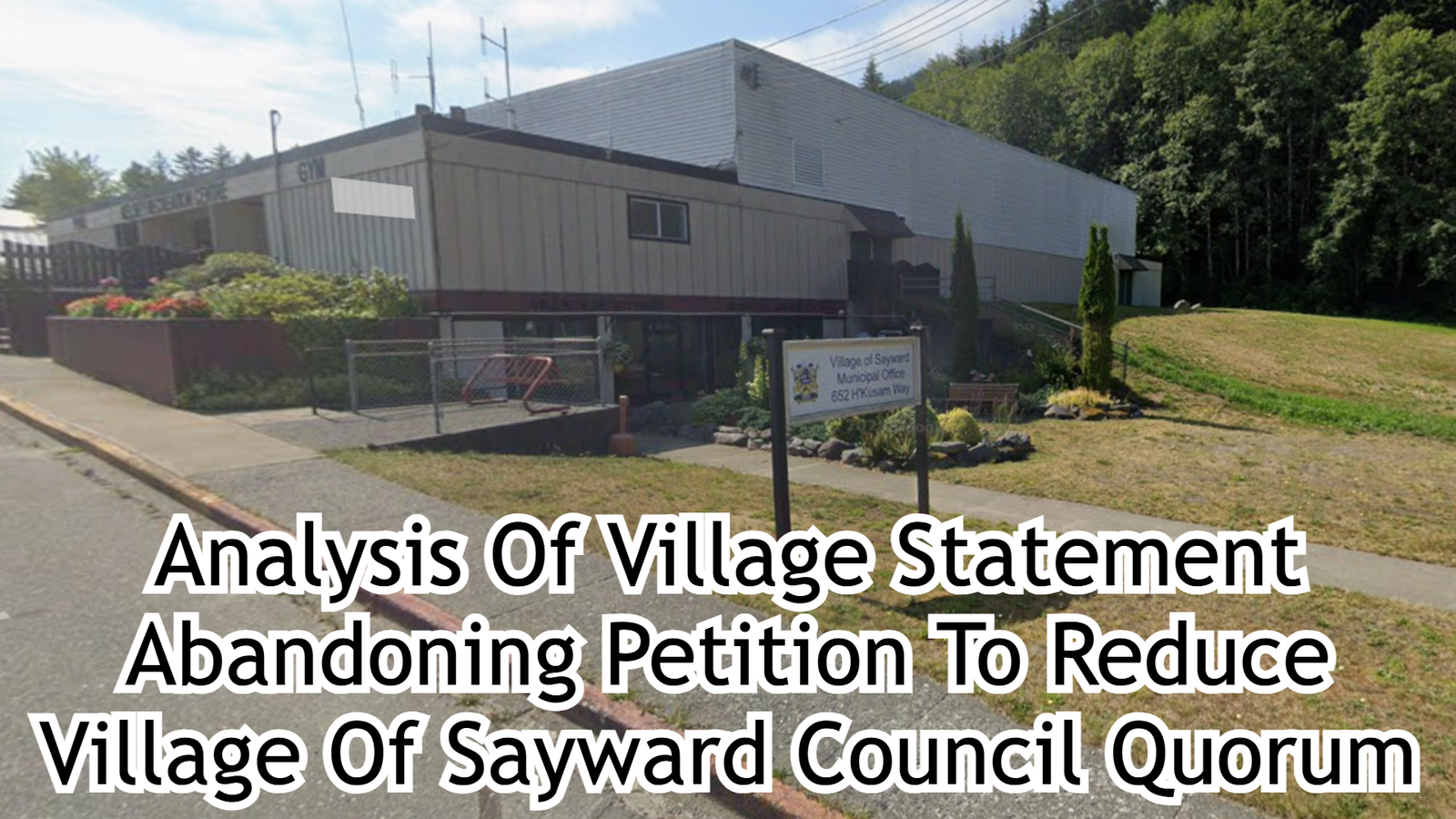
We asked the Village of Sayward for comment on why the Petition to Reduce Village of Sayward Council Quorum was being withdrawn. They responded with the following update on their website:
“The Village of Sayward made a decision on Thursday, May 14, 2026 not to proceed with the hearing of its Petition dated October 14, 2025 which was commenced under Community Charter section 129.
The Village of Sayward was confident in proceeding with its Petition and the likelihood of obtaining the sought order. However, after issuance on May 8, 2026 of Justice Hamilton’s findings in Baker v. France, 2026 BCSC 850 and with the hearing date of the Petition being so close to the general election coupled with the likelihood of a delayed decision by the Supreme Court making the sought order moot, the Village of Sayward decided the cost of proceeding further was prohibitive.”
Analysis Of Village Of Sayward Statement
This statement is tightly written and appears designed to accomplish three things simultaneously: preserve credibility, justify abandoning the petition, and minimize political fallout.
Several elements stand out.
First, the Village explicitly says it “was confident” in both proceeding with the petition and obtaining the order sought. That sentence is important because it attempts to avoid the appearance of defeat. Rather than saying the petition lacked merit or became untenable, the statement frames the withdrawal as a strategic and financial decision.
The wording suggests the Village wants readers to conclude:
- the legal argument remained strong
- circumstances changed
- continuing no longer made practical sense.
Second, the statement places significant emphasis on timing.
It cites:
- the May 8, 2026 decision in Baker v. France
- the proximity of the general election
- the likelihood of a delayed Supreme Court ruling.
This creates a layered justification for discontinuing the matter. The Village is effectively arguing that even if successful, the court process may not have concluded before the election, which would make the requested order “moot.”
The use of the word “moot” is particularly notable. In legal and political communication, that word implies the dispute may no longer have practical value because changing circumstances would overtake the court process.
Third, the statement carefully avoids directly explaining how Baker v. France affected the petition.
It references Justice Hamilton’s findings, but does not summarize them or say whether they weakened the Village’s position. That omission matters.
By mentioning the case without explaining its impact, the Village gains two advantages:
- it acknowledges a potentially important development
- it avoids admitting the ruling may have created legal risk for the petition.
The wording leaves readers to infer that the decision complicated matters without conceding the Village’s legal position had deteriorated.
Fourth, the final sentence shifts the focus to taxpayer cost.
The phrase:
“the cost of proceeding further was prohibitive”
is likely intended to resonate politically with residents. After asserting confidence in the petition, the Village closes by framing withdrawal as a fiscally responsible decision rather than a legal retreat.
Structurally, that ending is important because it reframes the issue from:
“Can we win?”
to:
“Is continuing worth the cost?”
That is a much safer public position for a municipality.
Finally, the overall tone is defensive but controlled. The statement appears carefully constructed to avoid three perceptions:
- that the Village lost confidence in its case
- that the petition failed on legal grounds
- that public funds were wasted pursuing it.
Instead, the Village presents the decision as a pragmatic response to changing legal and electoral realities.