
By Rene Harding
We hadn’t been on the farm at Salmon River long when the scattered residents called a welcoming party for the new settlers, namely Colletts, and ourselves, the J. B. Howes family, and also for a bachelor not long returned from active service overseas. Colletts had been in the valley since December, 1919, four months before us. They were included in the official welcome even though they had attended a couple of once-a-month dances held in the schoolhouse.
We were informed that ladies brought refreshments and cups—putting in two extra for bachelors—and the affair was to be held on Saturday evening. We looked forward to meeting valley residents; up until now we hadn’t become acquainted with many.
Fridays were bath nights. Out came the wash boiler, the stove was stuffed with wood and towels draped over kitchen chairs, and a galvanized tub placed before the stove. We took turns in washing and there was the chore of packing water in pails. It was not very convenient, but it is amazing. Nothing seemed inconvenient but we were learning to cope.
On the Saturday evening of the party we packed our bags with the required articles, plus slippers, and waited for the Collett family to call for us. When they arrived Mother and I were advised to pin our skirts up above our gum boots as it would be a wet walk.
Off we started, carrying lanterns and bugs; a bug being a tin can with a hole punched on one side and fitted with a candle. A wire handle was added. Lard pails made excellent bugs as they had handles which could be attached. These home-made lanterns gave quite a good light.
We avoided the muddy and pot-holed road by following a forest trail running between it and the river. A footing spanned Springer Creek. Most of the upper settlers preferred to walk this trail instead of using the road.
The little one-room schoolhouse sat in a clearing where Woodlands Lodge now stands.
We were welcomed in and Mother and I were shown the women’s dressing area, a space behind a large pot-bellied heater where a big preserving kettle full of water was in preparation for coffee making. A bucket and dipper stood on a bench by the door in case one should require a drink before refreshment time.
Desks had been pushed against the walls to make a space for dancing and a couple of coal oil lamps cast their glow upon the happy faces of men, women and children, glad to get together for a social evening and to exchange news and gossip.
A small organ stood in one corner next to the teacher’s desk and Mother, who was musical, seemed interested in it but was told it didn’t work as mice had chewed the insides.
Music for the dance was provided by the Duncan boys with their Amberola gramophone. They packed it to and from the dances. It was a heavy iron-based model dated in the late 1800s and had a large flared horn supported by a metal rod.
Alternate music was supplied by Frank Schmidt with his fiddle. Frank was an amiable Dutchman nicknamed Flannel-Foot because of his shuffling walk.
Then there was Hank McDonald with his concertina. We were duly warned about a step-up in the floor level, caused when the building had been enlarged.
I watched, fascinated, as people kicked up their heels in square dances, waltz lemonades and brownies. Other dances were called but the first-mentioned were best on account of the floor. The children amused themselves on the sidelines.
Halfway through the evening the MC called on Louis Proulx to entertain with a step-dance. Louis, a swarthy French-Canadian, bounced onto the floor and when Frank struck up a jig on his fiddle, Louis’ feet fairly flew. Charlie Gentry, a trapper, was next on the floor. Charlie was slim and loose-jointed and his dancing ran to Buck-and-Wing. They received hearty applause.
An impromptu barbershop quartet came next with Gordie Lawson, Harold Lewis and Ernie Williams along with another man, all facing in, arms over shoulders as they warbled Listen to the Mocking Bird, The Old Oaken Bucket, and other songs I came to know through their subsequent performances. The younger men were noticeably too shy to join in.
We danced with both young and old, there being no segregation on account of age in those days.
There was Two-step John Wilson, so named because he knew no other dance. John’s leading arm would pump-handle all out of time with the music, which was rather awkward to get used to. John wore a navy blue suit with peg-topped pants and yellow pugnosed boots, antiquated even in those days.
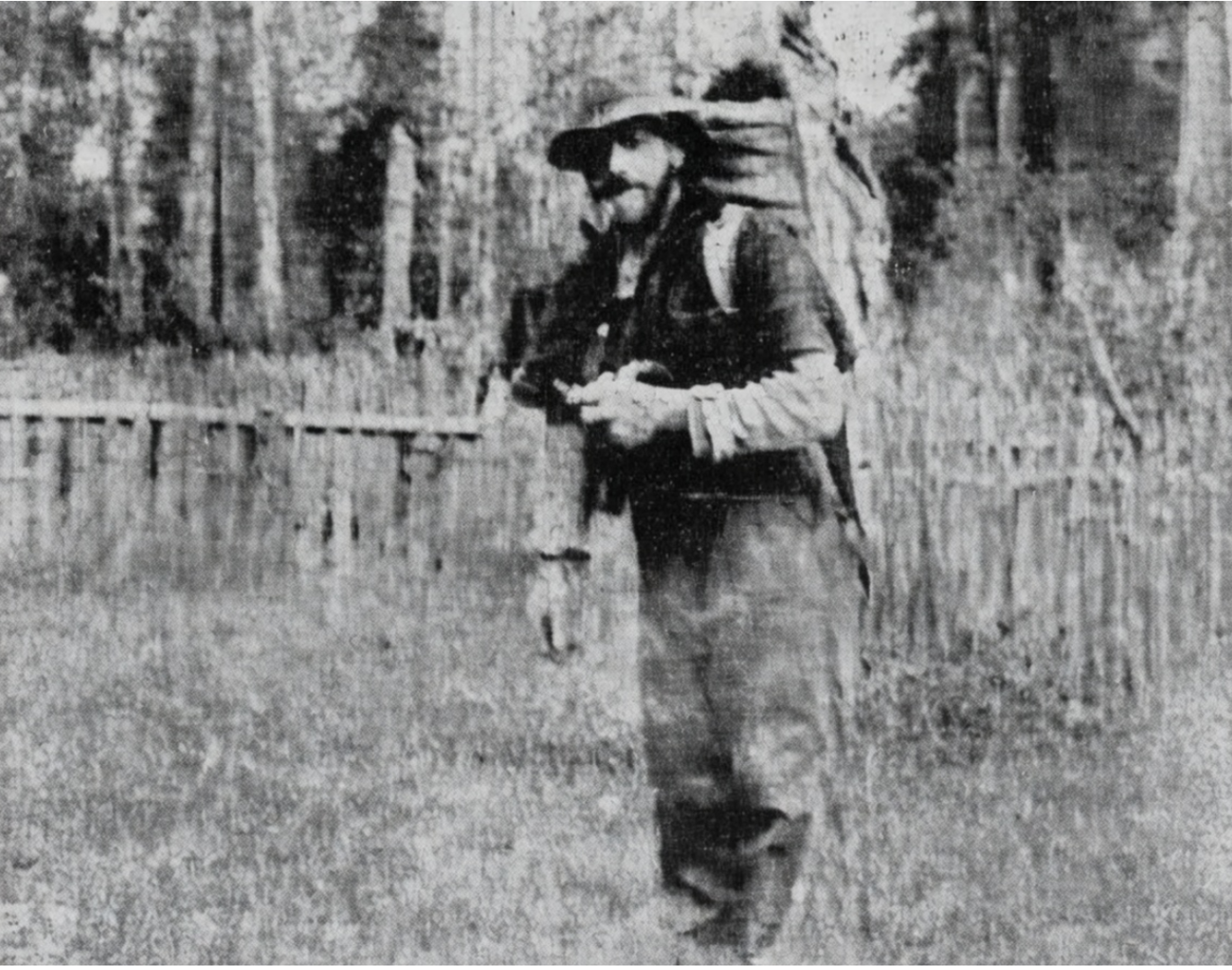
I was intrigued by the bachelor just returned from overseas, Alex LeClair by name, another French-Canadian. He sat all night, no coat over a grey Stanfield undershirt and kept his hat on. He hardly uttered a word, which may have been just as well as I learned later his vocabulary would “curl the hair of a mule skinner.”
Now that people had met us they began calling in on their way up or down the valley, which was nice, especially for Mother. She appreciated the easy friendliness and began to adjust to this new way of living.
One Sunday word came that Rev. J. Antle of the Columbia Coast Mission would be holding a service in the schoolhouse. Mother and I decided to go along, but Dad and Ivan were too busy.
As we passed through Hughie Jamieson’s place we were joined by the school teacher, Miss Christie Smith, who boarded with them. Miss Smith was tall, very pleasant and well suited to country life. Everyone liked her, especially Frank Schmidt.
It had been raining, so Miss Smith took along a big black umbrella. As we came into the clearing near the schoolhouse Jamieson’s brindle steers were there. They were big fellows, and wild to boot. When we appeared they came charging full speed at us. There wasn’t a fence nor a stump to get behind. Mother and I were petrified, but Miss Smith, calm and collected, said: “Don’t run. Never run.”
She quickly aimed her umbrella at them, opening and closing it several times. That did the trick. The steers circled backward to the schoolhouse, tails up and hooves pounding.
Not many people came to the service but Rev. Antle preached a good sermon and all the while those wretched steers galloped around and around the building. Finally they took off down the valley.
Mother liked to sing, even without accompaniment as in this instance. She had a pretty voice. Rev. Antle chose the hymn Unto the Hills Around Do I Lift Up My Longing Eyes. As he announced its title he gazed thoughtfully out of the window at the Prince of Wales range of mountains, then remarked that it was his favorite hymn. I never hear that music without recalling Rev. Antle and our first church service at Salmon River.
The work of the Columbia Coast Mission had been somewhat curtailed during the First World War. Now Rev. Antle, the founder of that wonderful organization, planned to give services again to isolated communities along the inland waters off northern Vancouver Island.
The Columbia Coast Mission ran a hospital at Alert Bay and one at Rock Bay. What a blessing they were to settlers and loggers who otherwise had to go down to Vancouver for medical attention—or do without.
Later on Rev. Antle arranged for a doctor on board the MV Columbia, and when called on in an emergency, no matter how far away they might have been they always came. Those doctors and the crew will long be gratefully remembered.