
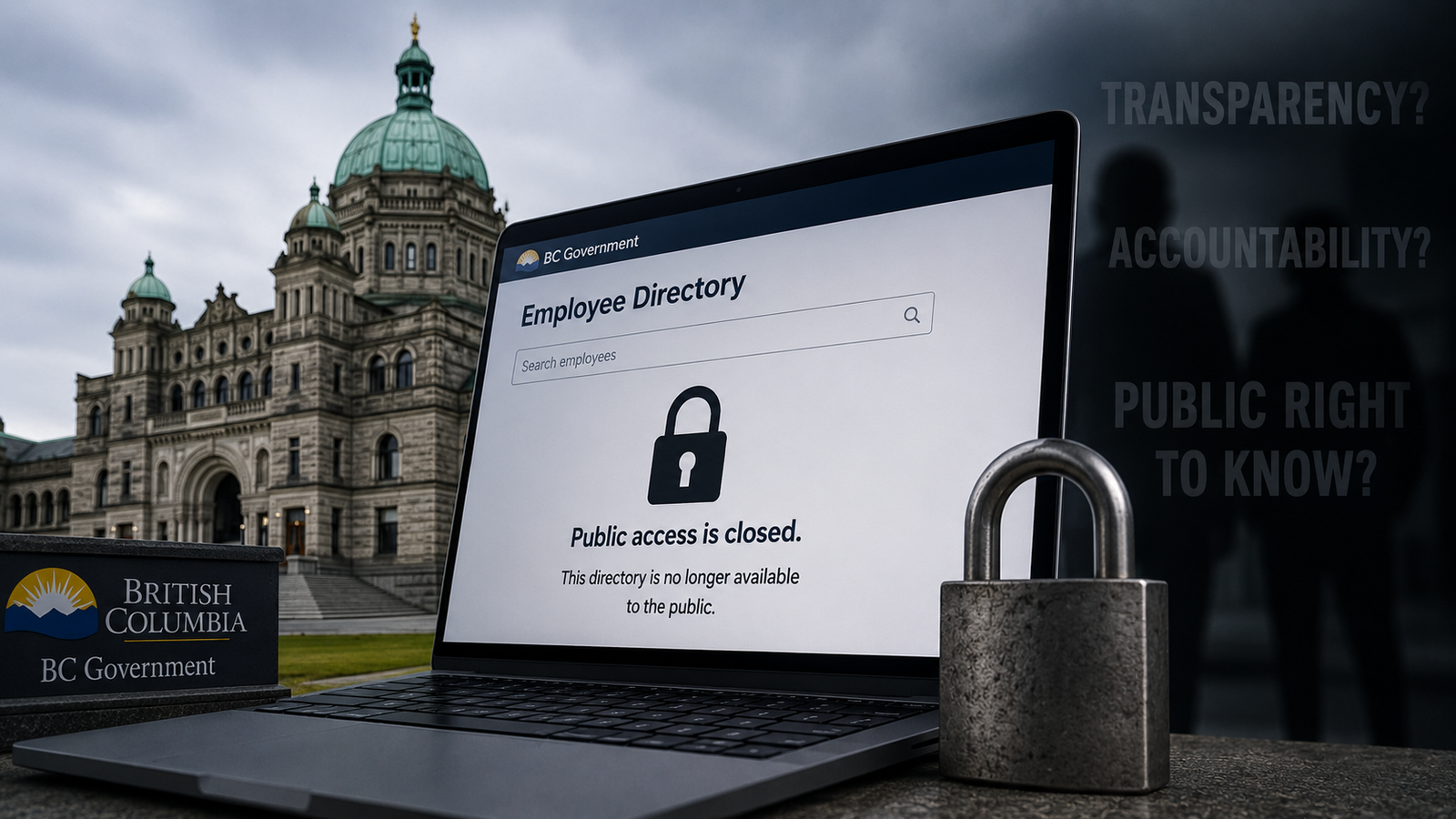
British Columbians have lost public access to a longstanding government directory that allowed anyone to see who worked for the provincial government, what ministry they worked for and how to contact them.
The change took effect this week, with the provincial government citing cybersecurity and employee-privacy concerns.
The B.C. Government Directory now displays a notice saying public access has been restricted to strengthen cybersecurity and protect employee privacy. Access to employee and organizational information requires a B.C. government credential.
The directory had provided public access to employee names, positions, departments, work email addresses and telephone numbers. Reports indicate the resource has roots stretching back decades, with printed government directories dating to the 1930s.
The province’s decision has triggered criticism from opposition politicians and transparency advocates, who argue that protecting employees from harassment and cyber threats does not necessarily require eliminating public visibility into the structure of government.
Government Cites Cybersecurity And Privacy
The provincial government’s stated rationale is security.
The notice posted on the directory says the government has taken steps to strengthen cybersecurity and protect employee privacy by restricting access to the site. Employees continue to have access through the government’s internal system.
The government has also directed members of the public toward general government services and Service BC rather than individual employees.
The issue is particularly relevant for journalists, researchers, businesses and members of the public attempting to determine which ministry or official is responsible for a particular program or decision.
Critics argue that there may have been alternatives to completely removing public access, including limiting the information displayed publicly while retaining organizational and departmental contact information.
The B.C. Conservatives have questioned whether privacy and cybersecurity concerns justify eliminating the public directory altogether.
“Privacy and transparency must go hand in hand,” said Conservative MLA Jody Toor, according to reporting by Rebel News. She argued that protecting public employees should not mean government becomes less accountable to the people it serves.
Conservative MLA Steve Kooner also criticized the decision, arguing that the public has historically been able to use the directory to understand the size and structure of the provincial bureaucracy.
The Directory Decision Comes After A Broader FOI Fight
The directory shutdown comes only months after the B.C. government faced criticism over changes to the province’s freedom-of-information system.
Bill 9, the Freedom of Information and Protection of Privacy Amendment Act, 2026, received Royal Assent on May 28, 2026. The legislation changes several aspects of the province’s information-access system.
Among the changes, the legislation replaces the previous requirement that public bodies respond to requests “without delay” with a requirement to respond “without unreasonable delay.”
It also changes the rules governing how much detail an applicant must provide when making a request and gives the head of a public body a role in determining whether enough information has been provided to identify records within a reasonable amount of time.
The legislation also expands the circumstances in which an information request can be disregarded, including requests considered abusive or malicious and requests that would unreasonably interfere with government operations.
The government has described the changes as modernization intended to make the system more efficient and improve digital service delivery.
Critics have taken a different view.
The B.C. Freedom of Information and Privacy Association warned when Bill 9 was introduced that the amendments could narrow access rights and give public bodies greater discretion over information requests. The organization also argued that government should address recordkeeping and information-management problems rather than reducing access rights.
The organization specifically criticized the absence of a statutory duty requiring public bodies to create and maintain detailed records of government decisions and actions.
A Debate Over What “Transparency” Means
The two issues are separate: shutting down the employee directory does not change the legal right to make a freedom-of-information request.
Under B.C.’s Freedom of Information and Protection of Privacy Act, members of the public retain a right to request records in the custody or control of public bodies, subject to exemptions in the legislation.
However, transparency advocates argue that formal freedom-of-information requests are only one part of an open government system.
A publicly available directory can answer basic questions without requiring a formal request: Which ministry is responsible? Which branch handles a particular issue? Who occupies a particular position? How is a ministry organized?
Removing that information means some questions that could previously be answered immediately may now require contacting a general government office or filing an information request.
That distinction is important because freedom-of-information requests can take time and resources on both sides.
According to The Narwhal, B.C. received 8,347 general FOI requests in 2020, compared with 4,691 in 2025 — a decline of roughly 44 per cent. At the same time, the number of pages processed increased from approximately 1.64 million to 2.18 million.
The numbers suggest that although fewer requests are being submitted, the requests that are processed can involve substantial amounts of information.
Government Says Access To Services Remains
The closure of the directory does not mean British Columbians have lost access to provincial government services.
The province continues to provide information through its main government website and Service BC, while ministries maintain their own public-facing contact information.
The government has also established general communications and public-engagement contact information for media inquiries.
The disagreement is therefore less about whether British Columbians can contact government at all and more about how much information the public should be able to obtain directly about the people and organizational structure behind government programs.
Transparency Under Increasing Scrutiny
The timing has added significance to the debate.
B.C.’s 2026 budget projects a $13.3-billion deficit for 2026-27, followed by projected deficits of $12.2 billion and $11.4 billion in the following two fiscal years.
Taxpayer-supported debt is projected to rise from $116.5 billion at the end of 2025-26 to approximately $189 billion by 2028-29. Total provincial debt, including debt carried by self-supported commercial Crown corporations, is forecast to reach about $234.6 billion.
Those figures make questions about government spending, staffing and organizational structure particularly relevant to taxpayers.
The closure of the directory does not, by itself, demonstrate that government spending or staffing is being concealed. Nor does it eliminate the province’s legal obligations under freedom-of-information legislation.
But it does remove one longstanding, readily accessible source of information about the provincial public service.
For critics, that represents an unnecessary reduction in transparency.
For government, the decision is being presented as a security and privacy measure in an increasingly difficult cybersecurity environment.
The broader question now facing British Columbia is how to balance those competing interests: how much information about government employees and operations should be publicly accessible, and how much protection can be provided without making government harder for taxpayers to understand and scrutinize?
That debate is likely to continue as the province implements the changes to its freedom-of-information system and adjusts to the loss of a public directory that had been available in one form or another for generations.