
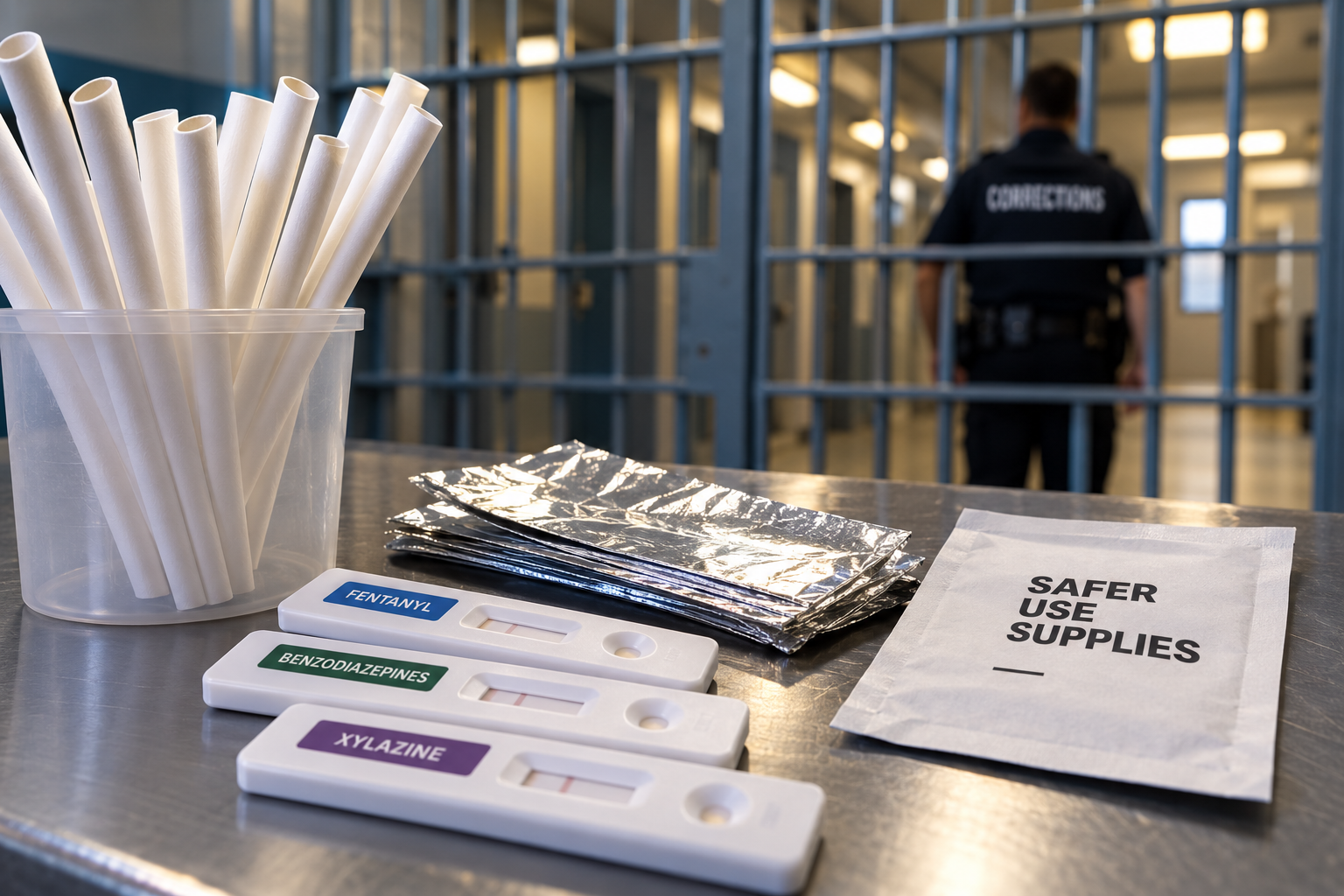
Correctional Service Canada is expanding its harm-reduction programs to include supplies for snorting and smoking drugs, raising questions about prison security, addiction treatment and the ongoing challenge of keeping illegal substances out of federal institutions.
The Correctional Service of Canada (CSC) has confirmed plans to distribute paper straws, foil strips and drug-testing supplies to federal inmates as part of an expanded harm-reduction initiative.
The decision, first reported by the National Post on September 27, 2026, follows an internal staff memorandum outlining additional supplies intended to reduce the health risks associated with illicit drug use inside federal correctional facilities.
Under the initiative, paper straws will be made available for snorting powdered substances, while foil strips will be provided for smoking. Testing strips capable of detecting fentanyl, benzodiazepines and xylazine are also included in the expansion.
The measures reflect a broader shift in Canada’s correctional approach to substance use, emphasizing overdose prevention and infectious disease reduction alongside traditional enforcement and addiction treatment.
However, the initiative also raises questions about how correctional authorities intend to balance harm reduction with their responsibility to prevent illegal drugs from entering prisons.
Internal memorandum confirms expanded drug-use supplies
According to the National Post’s reporting, the initiative became public after photographs of an internal CSC memorandum circulated on social media.
The document described the introduction of additional harm-reduction supplies in response to increased reports of inmates inhaling, smoking and snorting substances.
CSC communications officer Laurence Côté subsequently confirmed to the newspaper that the memorandum was authentic and had been prepared to inform employees about the expansion.
The reported supplies include:
Paper straws: Intended to reduce nasal injuries and the sharing of improvised equipment.
Foil strips: Provided as part of safer-smoking initiatives.
Fentanyl testing strips: Intended to help identify the presence of the powerful synthetic opioid.
Benzodiazepine testing strips: Designed to detect certain sedative substances.
Xylazine testing strips: Intended to identify a veterinary sedative increasingly associated with the contaminated drug supply.
The memorandum reportedly instructs staff that possession of these supplies alone should not result in criminal charges.
However, where supplies are discovered alongside illegal drugs or unauthorized paraphernalia, existing operational procedures are to remain in effect.
The distinction is important: the new policy addresses the possession of specific harm-reduction equipment, rather than authorizing the possession of illicit substances.
The announcement does not establish that every federal institution has already begun distributing the supplies, and a complete institution-by-institution implementation schedule has not been confirmed in the reporting reviewed.
Source: National Post reporting, September 27, 2026.
Why are paper straws being distributed?
The reasoning behind the paper straws is primarily medical.
According to the British Columbia Centre for Disease Control, improvised snorting equipment can cause cuts and irritation inside the nose.
When equipment is shared, blood from damaged nasal passages can potentially transmit infections, including hepatitis B and hepatitis C.
Paper straws are intended to reduce some of these risks by providing a disposable alternative to harder materials.
The B.C. Centre for Disease Control’s harm-reduction guidance also recommends that straws not be shared or reused.
However, the agency cautions that paper straws should not be used to inhale vapours from substances heated on foil because they can ignite and cause burns.
That warning is particularly relevant because the reported CSC memorandum describes the supplies as being intended for both powdered substances and inhaled vapours.
Providing disposable equipment does not eliminate the risks associated with consuming illegal drugs, including poisoning, addiction and fatal overdose.
It addresses specific risks associated with the equipment used.
Sources: B.C. Centre for Disease Control and CATIE, Canada’s national HIV and hepatitis C information organization.
Federal prison survey reveals extent of illegal drug use
The announcement comes against a backdrop of documented substance use within Canada’s federal prison system.
A Correctional Service of Canada national health survey conducted in 2022 provides insight into the scale of the problem.
Among 1,404 inmates who participated in the survey, 413 reported using substances inside federal prisons during the preceding six months.
That represents approximately 29% of respondents.
CSC NATIONAL HEALTH SURVEY · 2022
29%
of surveyed federal inmates reported using drugs in prison during the previous six months.
Among the 413 respondents who reported drug use:
Smoked substances
78%
323 respondents
Snorted substances
63%
260 respondents
Injected substances
12%
51 respondents
Categories overlap because some respondents reported more than one method of drug use. Percentages are rounded.
The survey also revealed that sharing drug-use equipment was relatively common.
Among respondents who reported snorting substances, approximately 49% said they had shared devices used for that purpose.
Among those who reported smoking substances, approximately 45% reported sharing smoking equipment.
The findings demonstrate why correctional health authorities have focused on infectious disease transmission.
They also illustrate a fundamental challenge facing prison administrators: significant levels of illicit drug use have persisted despite institutional security measures and prohibitions.
The figures are from 2022 and should not be interpreted as measurements of drug use in September 2026.
Source: Correctional Service of Canada, 2022 National Health Survey.
Drug use in prisons is not a new problem
The distribution of paper straws is the latest development in a federal correctional strategy that has gradually expanded beyond conventional drug enforcement.
In 2018, CSC introduced its Prison Needle Exchange Program, allowing eligible inmates to access sterile injection equipment under controlled conditions.
The initiative was designed to reduce the transmission of blood-borne infections associated with sharing needles.
A separate Overdose Prevention Service began operating at Drumheller Institution in Alberta in June 2019.
The program subsequently expanded to other federal institutions, including Springhill Institution in Nova Scotia.
According to CSC’s May 2026 briefing materials, the needle exchange program had been implemented at 13 institutions as of February 2026.
Overdose prevention services were available at five institutions:
Drumheller Institution, Alberta
Springhill Institution, Nova Scotia
Collins Bay Institution, Ontario
Drummond Institution, Quebec
Warkworth Institution, Ontario
The overdose prevention program allows participating inmates to use substances under the observation of health-care professionals who can respond to medical emergencies.
CSC states that it does not provide the drugs used by inmates through this program.
The department also reported that, as of its May 2026 briefing, there had been no fatalities among participants using its overdose prevention services.
That result describes the experience of program participants; it does not establish that overdose deaths have been eliminated throughout the federal prison system.
Source: CSC’s May 28, 2026, briefing to the House of Commons Standing Committee on Public Safety and National Security.
Addiction treatment remains a major challenge
Beyond the immediate question of drug-use equipment lies the larger issue of substance dependence among people entering Canada’s correctional system.
CSC’s 2026 briefing materials indicate that problematic alcohol or substance use is widespread among incoming federal offenders.
The department reported lifetime prevalence rates of approximately 66% among men and 61.6% among women at admission.
Its research also found that nearly half of incoming male offenders assessed had a current substance-use problem.
These findings help explain why addiction treatment and drug-related health services occupy a substantial place in federal correctional policy.
CSC’s National Drugs and Substance Strategy combines several approaches, including prevention, addiction counselling, medication-assisted treatment, harm reduction and support for inmates returning to the community.
The department has also modified its approach to medications used to treat opioid dependence.
Effective October 1, 2025, long-acting injectable buprenorphine became the first-line treatment for opioid use disorder within the federal correctional system.
Methadone was designated a second-line open benefit, while daily buprenorphine-naloxone was moved toward restricted formulary access.
The changes were intended to strengthen treatment while reducing the potential misuse or diversion of certain medications.
The introduction of paper straws and drug-testing strips represents another component of this broader strategy rather than a replacement for addiction treatment.
Source: CSC, 2026–27 Main Estimates briefing materials.
Harm reduction and prison security present competing priorities
The expansion brings two longstanding correctional responsibilities into focus.
The first is the obligation to protect the health and safety of people held in federal custody.
The second is the responsibility to maintain secure institutions and prevent prohibited substances from entering or circulating within them.
Harm-reduction programs are based on the premise that some people will continue using drugs despite prohibitions and treatment opportunities.
Providing sterile or disposable equipment is intended to reduce the medical consequences of that behaviour.
From a public-health perspective, preventing an infectious disease or fatal overdose can be a meaningful outcome even when substance use continues.
However, the availability of drug-use equipment also raises operational questions.
Correctional staff must determine how the supplies will be distributed, monitored and managed within facilities where contraband control remains a central responsibility.
Questions also remain about whether expanding access to harm-reduction equipment will affect demand for addiction treatment or patterns of illicit drug use.
Those outcomes cannot be established from the announcement alone.
The federal government’s existing briefing materials describe safeguards for its needle exchange program, including individual threat-risk assessments and procedures for storing and accounting for equipment.
Whether comparable procedures will govern the newly announced supplies has not been fully detailed in the available reporting.
Will the new measures reduce overdoses?
The effectiveness of the initiative will ultimately depend on measurable health and operational outcomes.
Drug-testing strips may help identify certain substances in a drug sample, but they cannot guarantee that a substance is safe to consume.
Similarly, disposable snorting equipment can reduce some risks associated with sharing contaminated devices without preventing an overdose.
The distinction matters because harm reduction and addiction treatment address different aspects of the same problem.
Harm reduction attempts to limit the immediate consequences of substance use.
Treatment aims to help individuals manage or overcome substance dependence.
Security and enforcement measures, meanwhile, attempt to prevent illegal drugs from entering correctional institutions.
CSC’s stated strategy incorporates all three approaches.
The available evidence establishes that drug use and equipment sharing have occurred in federal prisons, but it does not yet establish how the newly announced supplies will affect future overdose rates, institutional security or drug consumption.
Those questions will require implementation data and subsequent evaluation.
What happens next?
The confirmation that paper straws, foil strips and additional testing supplies will be introduced into federal prisons marks another development in Canada’s approach to managing substance use behind bars.
For correctional authorities, the immediate objective is to reduce preventable injuries, infections and overdoses among inmates who continue using drugs.
For those concerned about prison security, the expansion raises questions about how harm-reduction programs will operate alongside efforts to intercept contraband and enforce institutional rules.
The central issue is not whether illegal drugs are present in Canadian prisons. CSC’s own research has already documented that reality.
The unanswered questions concern whether the expanded measures will produce measurable improvements in health, how they will affect prison operations and whether they will be accompanied by effective addiction treatment and drug-interdiction efforts.
As the new supplies are introduced, those outcomes will provide a clearer basis for assessing the policy.