
New Fraser Institute study finds Canada has fallen behind the United States on living standards, incomes, investment, employment and productivity since the beginning of the century
VANCOUVER — Canadians are increasingly falling behind their American counterparts on some of the economic measures that most directly affect household prosperity, according to a new study examining the economic performance of Canada and the United States over the first quarter of the 21st century.
The report, “Squandering the Canadian Century: Part 1 — Comparing Economic Performance in Canada and the United States,” was published by the Fraser Institute on September 1.
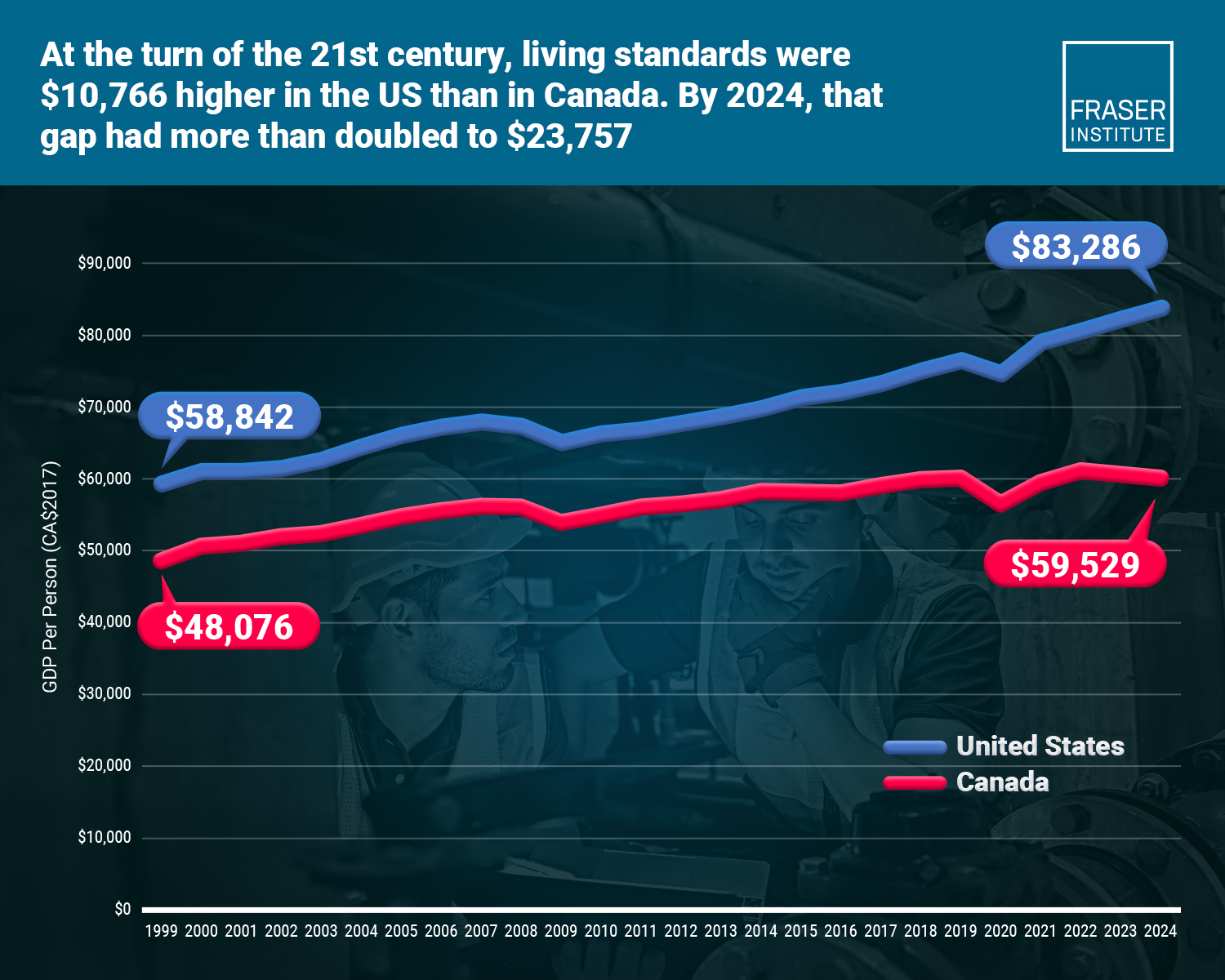
Its central finding is stark: the gap in inflation-adjusted GDP per person between the two countries has more than doubled since 1999.
In 1999, GDP per person in the United States was approximately C$10,766 higher than in Canada.
By 2024, the difference had grown to C$23,757.
The authors — Fraser Institute senior economist Joel Emes, senior policy analyst Grady Munro and director of fiscal studies Jake Fuss — argue that the deterioration cannot be explained by a single economic indicator.
Instead, Canada has fallen further behind across five broad areas examined by the study: living standards, employment income, employment, business investment and labour productivity.
The numbers behind the growing gap
The difference becomes particularly apparent when looking at inflation-adjusted GDP per person.
In 1999, Canada’s figure was approximately C$48,076, compared with C$58,842 in the United States.
By 2024, Canada’s figure had risen to C$59,529.
The American figure, meanwhile, had climbed to C$83,286.
That left the United States with an advantage of nearly C$24,000 per person.
The significance of the comparison is not that Americans necessarily have an additional $24,000 sitting in their bank accounts.
GDP per person is an economic measure rather than a direct measure of household income.
But the widening difference does provide an indication of how much more economic output is being generated per person in the United States — and, over time, that divergence can translate into differences in wages, investment, employment opportunities and government revenues.
For Canadians already dealing with high housing costs, taxes and other household expenses, the direction of the trend is particularly important.
The income gap is widening too
The difference isn’t confined to national economic output.
The study also examines inflation-adjusted median employment income.
In 2010, the earliest year for which the researchers say comparable data were available, median employment income in the United States was approximately C$6,126 higher than in Canada.
By 2024, that difference had increased to C$8,663.
That represents a growing gap in the amount of income earned by the typical worker.
For individual Canadians, that distinction can be much more tangible than GDP statistics.
Higher employment income can mean greater ability to save, invest, purchase housing, support a family or absorb rising living costs.
Canada’s private sector is shrinking as a share of employment
Another difference identified by the study involves the composition of employment.
Between 1999 and 2024, the share of Canadian employment accounted for by the private sector declined from 81.2 per cent to 78.5 per cent.
The authors say this reflects government-sector employment growing faster than private-sector employment.
The United States moved in the opposite direction.
Its private-sector share of employment increased from 85.8 per cent to 86.5 per cent over the same period.
The figures don’t mean that government employment itself is inherently bad or that every public-sector job comes at the expense of a private-sector job.
Rather, the researchers use the trend as one indicator of the different directions taken by the two economies.
A growing private sector can provide a broader base of businesses investing, producing goods and services and competing for workers.
Investment may be the bigger warning sign
Perhaps the most consequential finding concerns business investment.
Investment is important because businesses need machinery, technology, buildings, equipment and other capital to increase production and improve efficiency.
According to the Fraser Institute study, Canada’s business investment per worker has deteriorated significantly relative to the United States.
In 2007, Canadian investment per worker was equivalent to nearly 90 cents for every dollar invested per worker in the United States.
By 2024, that had fallen to just 54 cents.
In other words, for every dollar being invested per American worker, Canadian businesses were investing only about 54 cents.
That matters because today’s investment becomes tomorrow’s productive capacity.
A company that buys better equipment, adopts new technology or expands its facilities can potentially produce more with the same number of workers.
When investment remains weak for years, productivity growth can suffer.
And that’s precisely what the study says has happened.
Canada’s productivity problem
Labour productivity is one of the most important measures in the report.
The study finds that between 1999 and 2025, labour productivity increased by:
Canada: 26.7 per cent
United States: 67.9 per cent
The American increase was therefore more than twice Canada’s.
Productivity essentially measures how much economic output is produced from a given amount of labour.
It doesn’t mean Canadian workers are working less hard than American workers.
Rather, productivity is heavily influenced by the tools, technology, infrastructure, capital and processes available to workers.
A worker equipped with modern machinery and technology can potentially produce considerably more than a worker performing the same task with outdated equipment.
The Fraser Institute argues that Canada’s weak productivity growth is therefore closely connected to its weak investment performance.
Jake Fuss, one of the study’s authors, said the ability to transform inputs into goods and services increased by more than twice as much in the United States as in Canada over the period examined.
The turning point came after 2014
One of the more interesting aspects of the report is that the authors don’t argue Canada was always falling behind.
Instead, they identify 2014 as an important turning point.
According to the study, Canada generally kept pace with the United States — and in some cases exceeded it — across several economic measures before 2014.
The divergence became considerably more pronounced afterward.
The timing is significant.
In 2014, global oil prices began a dramatic decline, creating a major shock for Canada’s energy-producing provinces and reducing investment in Canada’s resource sector.
But the Fraser Institute’s argument is that the oil-price collapse alone does not explain Canada’s subsequent performance.
The broader problem, according to the researchers, is that Canada has struggled to create an economic environment capable of attracting sufficient investment and generating stronger productivity growth.
That interpretation is likely to generate debate.
What does this mean for British Columbia?
While the study compares Canada as a whole with the United States, its implications extend to British Columbia and Vancouver Island.
B.C.’s economy is heavily connected to the United States through trade, investment and tourism.
The province also faces many of the same issues identified in the report, including housing affordability, infrastructure requirements, labour shortages and questions about business investment.
For communities such as those on northern Vancouver Island, productivity and investment aren’t abstract concepts.
They can affect whether companies expand, whether new businesses open, whether major projects proceed and whether younger workers can find well-paying employment without leaving the region.
A national productivity problem can therefore eventually become a local economic-development problem.
Why the comparison matters
Canada and the United States are unusually useful countries to compare.
They share a continent, extensive trade relationships, similar legal and financial institutions and highly integrated economies.
Yet their economic performance has increasingly diverged.
The Fraser Institute study argues that the comparison should force Canadians to look beyond headline employment numbers and ask a more fundamental question:
Is the Canadian economy creating enough wealth and productive capacity to support rising living standards?
The report’s answer is no.
At least, not at the rate necessary to keep pace with the United States.
The policy debate
The Fraser Institute’s conclusions are likely to be controversial.
The organization is a free-market public-policy think tank and has long advocated policies emphasizing lower taxes, reduced regulatory barriers, greater competition and increased private investment.
Its researchers argue that Canada needs significant economic reforms to reverse the trend.
But the underlying economic measurements themselves extend beyond the Fraser Institute’s policy preferences.
The GDP, income, employment, investment and productivity figures are the basis for the report’s comparison, while the interpretation of why Canada has underperformed — and what governments should do about it — is where political and economic debate begins.
That distinction is worth keeping in mind.
The numbers tell one story.
The causes and solutions are more complicated.
A quarter-century of missed opportunity?
When the 21st century began, there was optimism that Canada could emerge as an increasingly prosperous economic power.
A quarter-century later, the Fraser Institute argues that the country has instead watched its economic position deteriorate relative to its largest neighbour.
The report’s title — “Squandering the Canadian Century” — deliberately frames the issue as a missed opportunity.
The authors argue that the first quarter of the century has already been lost and that policymakers now need to focus on reversing the trend rather than accepting slower growth as inevitable.
“After squandering the first quarter of the 21st century,” Munro said, policymakers need to enact reforms that can make the most of the remainder of the century.
Whether Canadians agree with the Fraser Institute’s diagnosis or its proposed solutions, the underlying comparison presents a difficult question for the country.
In 1999, Canada and the United States were already different economies, but the gap in GDP per person was relatively modest.
Twenty-five years later, the difference has more than doubled.
Canadian employment incomes have fallen further behind.
Business investment has weakened relative to the United States.
And American productivity has grown more than twice as quickly.
For Canadians, the most important question may therefore be less about how the country performed over the past 25 years and more about what happens next.
If the first quarter of the Canadian century was a missed opportunity, can Canada change course before the next quarter passes?
Source: Fraser Institute, Squandering the Canadian Century Part 1: Comparing Economic Performance in Canada and the United States, by Grady Munro, Jake Fuss and Joel Emes. The Fraser Institute’s original page was not directly accessible during research, so the article’s figures and findings were cross-checked against the Institute’s September 1 news release and multiple reproductions of the study summary.