
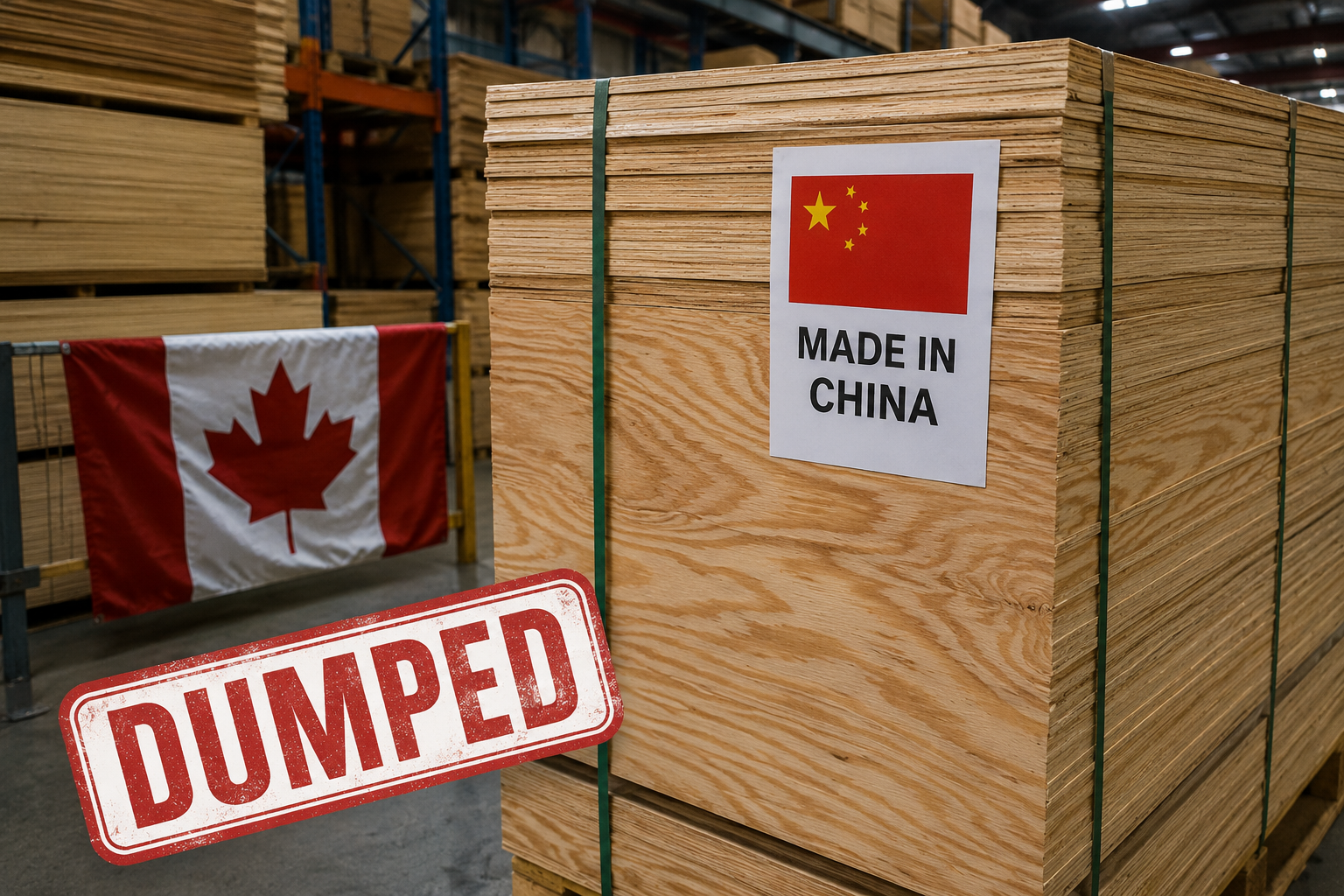
CBSA finds preliminary evidence of dumping and subsidization as Canadian producers report lost sales and declining market share
Canada has imposed provisional duties of up to 227.5 per cent on certain plywood imported from China after the Canada Border Services Agency (CBSA) made preliminary determinations that the products were being dumped and subsidized.
The measures took effect August 24 and apply to decorative and other non-structural plywood originating in or exported from China. The investigation remains ongoing, meaning the preliminary findings are not yet final.
The case began after Columbia Forest Products, along with the Canadian Hardwood Plywood and Veneer Association, filed a complaint with the CBSA in February alleging that increasing Chinese imports were being sold at unfair prices and were harming Canadian producers.
Two other Canadian manufacturers, Husky Plywood and Rockshield Engineered Woods Products, also supported the complaint.
Chinese imports gained ground in Canada
CBSA data indicates that China accounted for an increasing share of Canada’s decorative plywood imports between 2023 and 2025.
Chinese products represented approximately:
- 63.4 per cent of Canadian decorative plywood import value in 2023
- 61.4 per cent in 2024
- 67.5 per cent in 2025
Over the same period, the domestic industry’s share of the apparent Canadian market fell from 42.7 per cent to 37.3 per cent.
China’s share of the overall Canadian market increased from 36.3 per cent in 2023 to 42.4 per cent in 2025, according to CBSA estimates.
The figures are based on import value rather than physical volume, because the agency encountered inconsistencies in how imported plywood quantities were reported.
What is “dumping”?
Under Canada’s trade-remedy system, dumping generally occurs when a product is exported to Canada at a price below its applicable normal value.
Canadian producers alleged that Chinese plywood was being sold below fair market value while manufacturers also benefited from government subsidies.
The CBSA’s investigation found sufficient evidence to proceed with both dumping and subsidy investigations. The agency also said there was reasonable evidence that government influence could be affecting prices in China’s engineered-wood sector.
The CBSA estimated an overall dumping margin of 33.8 per cent during its investigation period.
Duties vary dramatically by exporter
The provisional duties are not the same for every Chinese exporter.
For example, CBSA’s preliminary determinations established provisional rates including:
| Exporter | Provisional duty |
|---|---|
| Dehua TB New Decoration Material | 43.3% |
| Feixian Jianhao Wood Factory | 172.1% |
| LinYi QianFeng Wood Factory | 82.8% |
| Shandong Baozhu International Trading | 173.6% |
| Suzhou Dongsheng Wood | 24.7% |
| Xuzhou Meibang Wood | 12.6% |
| All other exporters | 227.5% |
The rates combine applicable anti-dumping and countervailing duties. Some exporters had subsidy amounts below Canada’s threshold for imposing a provisional countervailing duty.
The 227.5 per cent figure therefore does not apply automatically to every Chinese plywood shipment. It applies to subject goods from exporters that have not received a specific provisional rate.
Canadian producers cite lost sales and jobs
The domestic producers told the CBSA that increasing Chinese imports were contributing to lost sales and market share.
The complaint included examples of sales lost to Chinese products, along with allegations of price undercutting, price depression and price suppression.
The producers also reported negative effects on financial performance, production levels, capacity utilization and employment.
After reviewing information supplied by the producers and its own customs data, the CBSA concluded there was a reasonable indication that the allegedly dumped and subsidized imports had caused injury to Canada’s domestic decorative plywood industry.
The Canadian International Trade Tribunal reached a similar preliminary conclusion in June, determining that there was a reasonable indication that dumping and subsidization had caused or threatened to cause injury to the domestic industry.
What products are affected?
The investigation covers decorative and other non-structural plywood, including certain multilayered plywood and veneered panels.
These products can be used in applications such as cabinetry, furniture and interior finishing.
The measures do not cover every type of plywood. CBSA specifically excludes certain structural plywood, finished plywood flooring products, specially shaped panels and several other products from the scope of the investigation.
Final decision still months away
The current duties are provisional rather than permanent.
The CBSA is scheduled to issue its final determinations on dumping and subsidization on November 23, 2026.
The Canadian International Trade Tribunal is conducting the separate final injury inquiry. Its current schedule calls for a finding on December 22, 2026, followed by reasons in January 2027.
If the Tribunal ultimately finds that the dumped or subsidized imports caused injury to Canadian producers, permanent anti-dumping and countervailing measures could follow.
If the required injury finding is not made, the proceedings would end and provisional duties could be refunded in accordance with Canada’s trade-remedy rules.
A broader trade issue
The plywood investigation comes as Canada is increasingly using its trade-remedy system to respond to concerns over heavily subsidized or low-priced imports from China.
For Canadian plywood manufacturers, the issue is particularly significant because the domestic industry’s share of the apparent market has declined while Chinese imports have expanded.
For importers and buyers, however, the immediate impact is the possibility of substantially higher costs on affected products as the federal investigation proceeds.
For now, the key distinction is that Canada has made preliminary findings of dumping and subsidization—not a final determination. The ultimate outcome will depend on the CBSA’s final investigation and the Tribunal’s determination of whether the imports caused injury to Canadian producers.
Sources: Canada Border Services Agency and Canadian International Trade Tribunal.