
New Business Credit Card Offers Unparalleled Flexibility And Rewards

Empowering Businesses with the Keep Mastercard

In the fast-paced world of business, having the right financial tools can make all the difference. Enter the Keep Mastercard—a game-changer for Canadian businesses looking to streamline their finances and unlock new opportunities. Designed with entrepreneurs in mind, this innovative corporate credit card offers a host of benefits that cater to the unique needs of modern businesses.

Unmatched Financial Flexibility

One of the standout features of the Keep Mastercard is its impressive credit limit, which can go up to $400,000. This provides businesses with the financial flexibility they need to manage cash flow, invest in growth, and handle unexpected expenses. Unlike traditional credit cards, the Keep Mastercard eliminates interest fees, annual fees, and foreign transaction costs, making it a cost-effective choice for businesses of all sizes.

Rewards That Work for You

The Keep Mastercard takes rewards to the next level, offering up to 4x the cashback compared to typical business credit cards. Every purchase becomes an opportunity to earn, helping businesses maximize their spending power. Whether it’s office supplies, travel expenses, or client dinners, the rewards add up quickly, providing tangible value to cardholders.

Advanced Features for Modern Businesses

Beyond its financial perks, the Keep Mastercard is packed with features that simplify business operations. From QuickBooks integration and automated expense tracking to spend controls and insights, this card is designed to save time and reduce administrative burdens. Additionally, unlimited virtual cards and employee accounts ensure that teams have the resources they need to succeed.

Security and Support You Can Trust

In today’s digital age, security is paramount. The Keep Mastercard offers 24/7 fraud monitoring, ID theft protection, and purchase protection, giving business owners peace of mind. Plus, with dedicated relationship managers and a user-friendly platform, Keep provides exceptional support to its customers.

Why Choose Keep?

Keep’s commitment to empowering businesses goes beyond its card features. By leveraging fintech to assess creditworthiness, Keep ensures that more businesses have access to the financial tools they need. The application process is straightforward and won’t impact your credit score, making it easy to get started.

In conclusion, the Keep Mastercard is more than just a credit card—it’s a partner in your business journey. With its unparalleled benefits, advanced features, and commitment to customer success, Keep is redefining what it means to support businesses. Ready to take your business to the next level? Discover the Keep Mastercard today and experience the difference for yourself.

Reward Your Business By Signing Up Now

We use the Keep Mastercard in our business operations. If you sign up for a Keep Mastercard from links in this article, we may receive compensation from Keep Mastercard.

Gasoline Prices Climbing Ahead Of Carbon Tax Hike

After a long period of price stability through the 2024 fall and winter, gasoline prices climbed eight cents mid-January from 1.669 to 1.749. This price increase hits consumer wallets mere months ahead of another scheduled increase to the Canadian carbon tax on April 1st. It remains to be seen if gas prices will continue increasing prior to the carbon tax hike, but either way this will put additional strain on many households already struggling to make ends meet in the midst of persistent high inflation.

With the Federal Government prorogued until March 24th, 2025, there is no chance of a change in tax policy to provide Canadians with essential financial relief before the carbon tax increase.

Liberal party leader hopefuls are trying to distance themselves from the disastrous carbon tax policy they have supported since 2019, with hopes of benefiting from long standing opposition talking points. Even in the unlikely event of a pause or reduction of the federal carbon tax policy, which would reduce the cost of living across Canada, British Columbia still manages a provincial carbon tax that would continue to impact fuel prices regardless of federal policy.

Canada Post Stamp Prices Increase 25 Percent After Strike Ends – Video And Customer Reaction

Canada Post has increased stamp prices due to growing financial challenges, effective Monday. The 25% price hike, proposed last year, affects domestic and international mail. Domestic letter stamps now cost $1.44, up from $1.15, while stamps in booklets, coils, or panes have risen from 99 cents to $1.24 each. Other products, including U.S., international letter-post, and domestic registered mail, also see a 25% increase.

The rates, proposed in September and approved in late November during a labor strike, aim to align stamp prices with the rising cost of providing letter mail services amidst declining letter volumes and inflation.

Canada Post estimates the price increase will impact Canadian households by $2.26 per year and small businesses by $42.17 annually. This comes after reporting a pre-tax loss of $315 million in Q3 2024, with parcel revenue dropping 5.8% and volumes decreasing by 9.6%.

Despite resuming full domestic services post-strike, Canada Post warns of ongoing delays for transaction, neighborhood, and international mail. The company expects another significant loss for 2024, marking its seventh consecutive annual loss.

We’ve Lost Christmas With Canada Post As Government Moves To Intervene

“Effectively, we’ve lost Christmas with Canada Post,” said Dan Kelly, president of the Canadian Federation of Independent Business, in an interview with Global News.

Those hoping to receive holiday gifts through Canada Post should not expect a Christmas miracle this year. Experts predict it could take up to a month to clear the backlog of parcels and letters.

“It’s not like starting your car after it’s been parked for three weeks. In some of the larger facilities, it could take up to five days just to begin processing items,” explained Fraser Johnson, a professor of operations management at Western University’s Ivey Business School, in an interview with the Toronto Star.

Reports indicate Canada Post missed delivering 12 million parcels in early December, according to the Financial Pos.

Johnson further clarified that for every day of delay in the supply chain, it could take about five additional days to clear the backlog.

“Canadian consumers need to brace for the reality that Christmas 2024, in terms of shipping capacity, has already hit its limit,” Kelly told Global News. He recommended shopping locally, saying, “Please visit your local businesses for gifts you can hand-deliver or purchase in-store.”

He also added, “Even if the strike were resolved today, Canada Post wouldn’t be able to clear the backlog in time to deliver packages before the holidays. For 2024, Canada Post is essentially out of commission. It’s not a viable option for small businesses this year.”

On Friday, Canada Post and its employees, represented by the Canadian Union of Postal Workers (CUPW), marked the 29th day of their strike. The 55,000 workers are demanding better wages, improved working conditions, the right to retire with dignity, and expanded services at public post offices. The strike began on November 15, after a year of unproductive bargaining.

Canada Post rejected the union’s latest offer, saying it would “add billions of dollars in unsustainable fixed costs,” according to a December 11 statement.

Jan Simpson, the union’s national president, urged workers to remain firm. “The pressure of public opinion, financial strain, and constant pushback can make even the most determined question this fight. But it’s important to remember why this strike matters. This isn’t just about pay or benefits—it’s about fairness, dignity, and recognizing the crucial role the work plays in connecting communities across the country,” Simpson said in a statement on Thursday.

She added, “Every letter, package, and cheque you handle plays an essential role in keeping communities connected and life running smoothly. Yet, this importance is often overlooked in the hustle and bustle of daily life.”

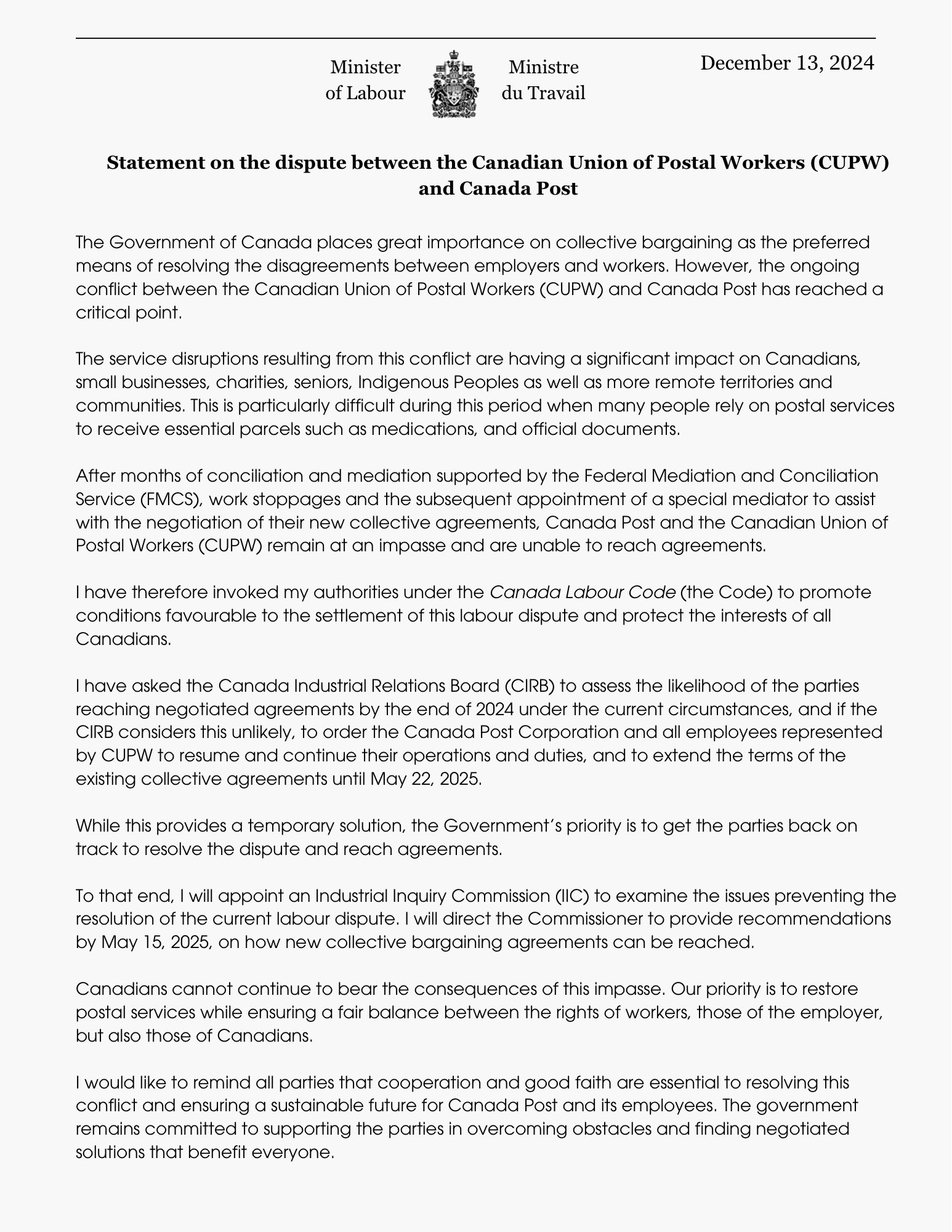
On Friday, Federal Labour Minister Steven MacKinnon requested the Canada Industrial Relations Board (CIRB) to assess the situation and potentially order workers back to their jobs if a deal is not reached.

In a post on X, MacKinnon stated that if CIRB determines a deal won’t be reached by the end of 2024, they should mandate union workers return to work and extend existing agreements until May 22, 2025. He also plans to appoint an Industrial Inquiry Commission (IIC) to examine the dispute and provide recommendations by May 15, 2025.

The union, however, issued a statement condemning the government’s intervention. “The Union strongly denounces this assault on our constitutionally protected right to collectively bargain and strike,” the statement read. “This order reflects a troubling pattern where the government uses its arbitrary powers to let employers off the hook, drag their feet, and refuse to bargain in good faith with workers and unions.”

The union also noted that the situation is “rapidly evolving” and they need more time to assess the details. “We are currently reviewing the order and considering all of our options moving forward,” said CUPW.

Kelly of the Canadian Federation of Independent Business added, “It seems the Canada Industrial Relations Board (CIRB) will have 72 hours to complete its work before issuing a back-to-work order on Monday.”

“This means Canada Post workers may return to their jobs as early as next week,” he said. CFIB estimates that small businesses are losing a combined $100 million every day due to the strike.

“This will be too late to save any part of the Christmas season for small businesses,” Kelly said. “With such a massive backlog, it will be nearly impossible for new shipments to reach Canadians before Christmas through Canada Post.”

Larry Savage, a labor professor at Brock University, discussed the strike’s impact, noting that public support for the union has been lukewarm. “As strikes drag on, they become harder to sustain, and if the public isn’t supporting you, it can be demoralizing for the union,” he told the Canadian Press. He added that it remains “unclear” who is winning the public’s favor.

A poll conducted in early December revealed that Canadians weren’t overly affected by the strike. “As the two sides exchange proposals, Canadians seem to sympathize with both perspectives. One-third (34%) believe Canada Post is justified in pushing back on demands and trying to change its business model due to financial struggles,” the survey showed. “A similar proportion (29%) supports the union’s demands. About one-quarter (23%) offer no sympathy, likely just wanting their packages delivered.”

Canadian Minister Of Labour Steven MacKinon Statement On Canada Post CUPW Dispute

Latest Expansion Of Trudeau’s Gun Ban Again Targets Law Abiding Owners, Fails To Address Skyrocketing Gang Violence

The Trudeau government has enacted another unexpected gun ban, immediately outlawing 324 types of firearms. Canadians who previously used these firearms for hunting or target shooting must now secure them or face severe penalties. The government also plans to seize these firearms through a buyback program and send some to Ukraine’s military.

As with previous bans targeting hundreds of firearms, this list raises questions about its alignment with public safety goals. It includes low-powered varmint rifles, rare antiques found only in museums, and firearms no more dangerous than many that remain legal. Contrary to Public Safety Minister Dominic LeBlanc’s assertion, many of these guns are not designed for the battlefield.

While any bullet can be lethal, the .22 caliber is among the least powerful. It is commonly used in varmint hunting and youth-target practice. Including .22 caliber firearms on a list ostensibly targeting battlefield weapons seems questionable.

One example is the GSG-16, a .22-caliber target shooting rifle sometimes sold in pink. The list also bans several guns designed to mimic military rifles in appearance but with non-military functionality, firing .22 bullets one at a time. For instance, the newly prohibited Mauser StG44 resembles the iconic Sturmgewehr 44 but lacks assault rifle characteristics.

The government’s criteria for assault-style rifles continue to be inconsistent. True assault rifles—already illegal in Canada—are defined by automatic firing and large-capacity magazines, neither of which are permitted under Canadian law. Long before Prime Minister Justin Trudeau’s tenure, rifles in Canada were limited to five rounds and semi-automatic firing (one shot per trigger pull).

The Trudeau government introduced the term assault-style in its Bill C-21, defining it as a semi-automatic rifle using centre-fire ammunition, designed post-2023, and originally intended to hold high-capacity magazines. Yet many banned firearms, including .22-caliber rimfire guns and pre-2023 models, do not fit this description.

The list also includes obscure historical weapons, such as the Browning M3 Aircraft machine gun from the 1930s, a mounted aircraft weapon already prohibited. Another example is the SaskSten, a WWII-era Sten gun modified for Canadian regulation, which sold for at least $4,000 before being banned. These weapons are rarely, if ever, involved in crimes.

The bans appear to target firearms based on appearance rather than functionality. For nearly every prohibited firearm, there are legal alternatives with similar power and firing rates. Notably, the SKS—a Soviet-era semi-automatic rifle—remains legal, likely because of its widespread use among Inuit and First Nations hunters.

The claim that banned firearms will aid Ukraine has been met with skepticism. Defense Minister Bill Blair suggested that some firearms on the list could be useful to Ukraine, but modern militaries prefer standardized equipment. Weapons chambered in .22 caliber or limited to five rounds are ill-suited for combat. Ukraine’s interest likely lies in a small subset of rifles chambered for high-powered cartridges like the .338 Lapua, suitable for sniping.

The timing of the ban coincides with the anniversary of the 1989 Montreal Massacre, in which a legally purchased Ruger Mini-14 was used to kill 14 women. The Mini-14 was included in a 2020 ban, yet firearms with comparable caliber and firing rates remain legal.

The ban also comes as police organizations criticize earlier gun control measures. In October, both the Toronto Police Association and Surrey Police Union denounced the government’s handgun freeze, noting that gun crime has surged since its implementation.

The reason is clear: most crime guns in Canada are illegally smuggled from the United States, making regulatory changes to legal gun ownership ineffective in curbing gun violence.

Essential Liquids Permitted On Airplanes In Quantities Greater Than 100mL

What do breast milk, liquid medication, and distilled water (for CPAP devices) have in common?

They are all considered essential liquids and can be carried through security screening in quantities exceeding the 100ml limit.

These items are exempt from the 100ml liquid limit and do not need to be placed in your 1L plastic bag. However, you must declare these items to the screening officer at the checkpoint and remove them from your carry-on bag for inspection.

Learn more about essential liquids here.