
BC Property Rights Under Scrutiny as Critics Say Government Response Falls Short

Private property rights in British Columbia are once again under intense scrutiny after a recent court ruling affirmed elements of Aboriginal title that overlap with privately owned land in Richmond. The decision has sparked political debate and legal uncertainty, with critics arguing that the provincial government’s response—ranging from legislative amendments to financial guarantees—falls short of resolving the confusion created by the ruling.

Background: Court Ruling and Its Impact

The controversy originates from a case in which the court recognized Aboriginal title claims over specific parcels of land, including some already held by private owners. The ruling has raised difficult questions about how Indigenous rights intersect with long‑established private property interests.

Homeowners in Richmond say they are already feeling the effects, reporting difficulties selling their homes, securing mortgages, and obtaining financing. Real estate experts warn that prolonged uncertainty could depress property values and deter investment or development in the affected area.

Government Response

Premier David Eby’s government has introduced proposed amendments to the Declaration on the Rights of Indigenous Peoples Act (DRIPA) and announced up to $154 million in financial assistance for impacted homeowners. The funding is intended to help residents navigate legal and financial complications stemming from the ruling.

Provincial officials describe the measures as an attempt to balance the protection of property owners with the province’s commitments to Indigenous reconciliation. They emphasize that DRIPA is part of B.C.’s broader effort to implement the United Nations Declaration on the Rights of Indigenous Peoples and ensure Indigenous rights are reflected in provincial law.

Criticism From Opposition

Opposition voices argue the government’s actions are insufficient. Steve Kooner, Conservative MLA for Richmond‑Queensborough and Opposition critic for the Attorney General, has dismissed the measures as “band‑aid solutions” that fail to address the underlying issues.

Kooner points to several concerns:

  • Many homeowners were unaware of potential legal implications until after the ruling.

  • The uncertainty is already disrupting property sales and financing in the region.

  • Decisions made when Eby served as Attorney General may have contributed to the current ambiguity around how Aboriginal title interacts with private land.

He contends that only sweeping legislative reform—including the possibility of revising or repealing DRIPA—would adequately safeguard private property rights while clarifying how they coexist with constitutionally protected Indigenous rights.

Legal and Policy Context

Legal scholars note that the issue sits at the intersection of provincial legislation, judicial interpretations of Aboriginal title, and constitutional protections for Indigenous rights. Because Aboriginal title is constitutionally recognized, courts must reconcile it with other land interests, including private ownership. This creates a complex legal landscape in which even long‑established property rights can be affected by newly affirmed Indigenous claims.

Broader Implications

The Richmond case is being closely monitored across the province. Many see it as a potential precedent for how B.C. will navigate the relationship between private property rights and Indigenous reconciliation. There is growing concern that similar disputes could arise elsewhere, with implications for development, housing markets, and investor confidence.

Political analysts expect the debate over DRIPA and property rights to remain a flashpoint in provincial politics. Homeowners are calling for clearer communication from the government and a more definitive legal framework that reconciles private property protections with constitutional obligations to Indigenous communities.

Next Steps

As legal proceedings continue, stakeholders are watching to see whether the government will pursue deeper legislative reforms or rely primarily on financial compensation for affected landowners. The decisions made in the coming months could shape how property rights and Indigenous title are balanced not only in British Columbia but potentially across Canada.
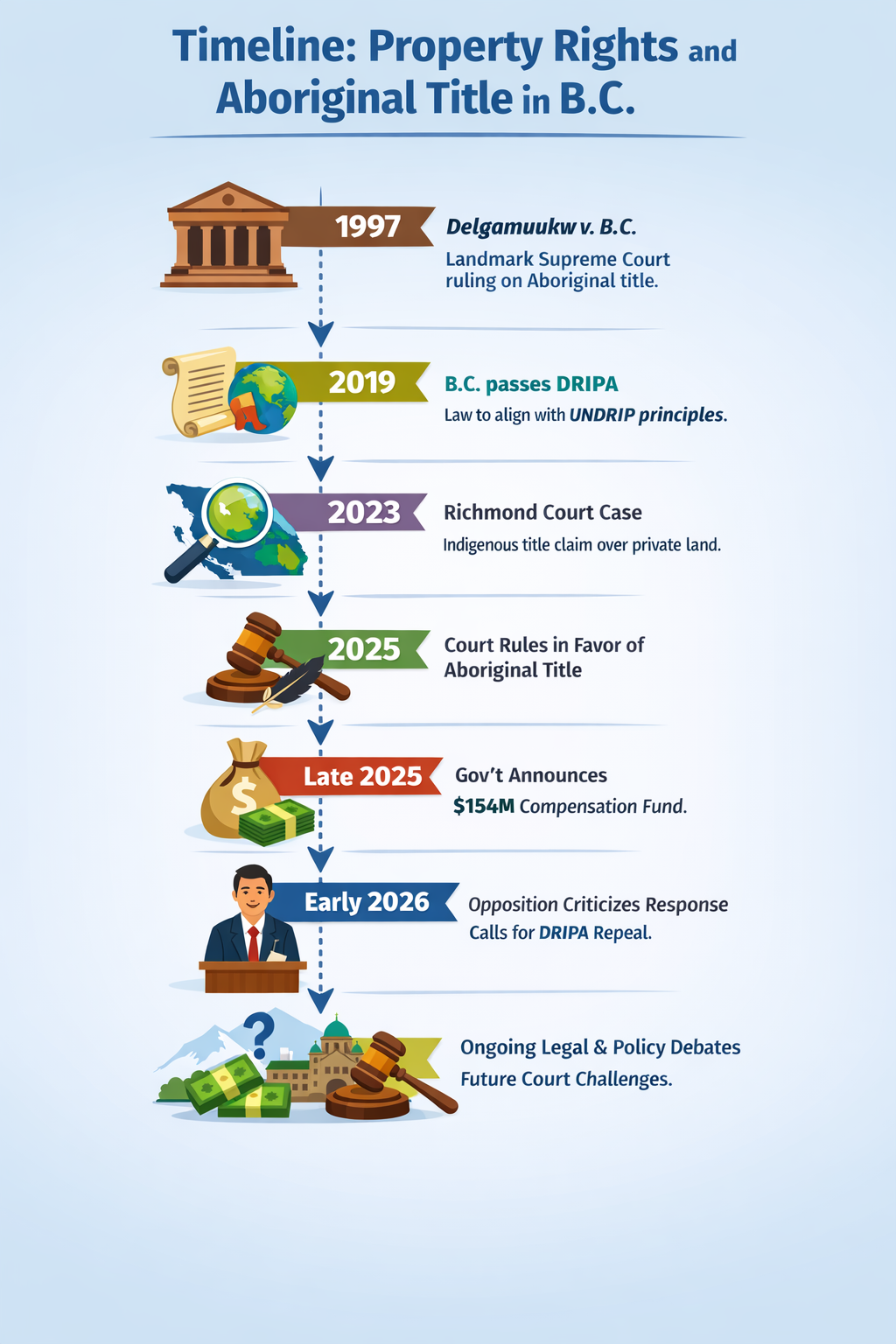
Timeline Property Rights and Aboriginal Title in BC

Timeline: Property Rights and Aboriginal Title in BC

Year Event Significance
1997 Delgamuukw v. British Columbia (Supreme Court of Canada) Landmark ruling establishing the legal framework for Aboriginal title in Canada. Recognized that Indigenous groups have constitutionally protected rights to their traditional lands.
2019 B.C. passes DRIPA (Declaration on the Rights of Indigenous Peoples Act) Requires provincial laws to be aligned with UNDRIP (United Nations Declaration on the Rights of Indigenous Peoples). Lays groundwork for reconciliation policies affecting land management.
2020–2022 Implementation and consultations on DRIPA Provincial government begins policy alignment; some private landowners raise concerns about potential impact on property rights.
2023 Court case filed in Richmond over Aboriginal title Indigenous groups claim title over areas including privately owned land; case raises questions about the intersection of Aboriginal title and private property.
2025 Court rules in favor of Indigenous title claim Confirms that Aboriginal title applies to some privately owned parcels; creates uncertainty for homeowners and developers.
Late 2025 Government announces financial compensation plan Premier Eby’s government proposes up to $154 million in financial guarantees to affected property owners.
Early 2026 MLA Steve Kooner and opposition criticize government response Opposition labels measures as “band-aid solutions” that do not fully protect private property rights. Calls for DRIPA reform or repeal continue.
2026 and beyond Ongoing legal and policy discussions Further court challenges and legislative revisions expected; potential precedent-setting impact for property rights and Indigenous reconciliation in B.C.

Possible Coastal Flooding This Weekend

Abnormally high tides combined with an approaching low‑pressure system may lead to minor to moderate coastal flooding this weekend.

Elevated water levels, strong winds, and increased wave action are expected to rise above the highest astronomical tides, heightening the risk of coastal impacts.

What: Coastal flooding is possible due to storm surge occurring at the same time as high tides.

When: This weekend, with the highest risk on Sunday.

Additional details: The South Coast is entering a period of very high astronomical tides as Earth reaches perihelion—its closest point to the Sun. At the same time, a low‑pressure system is forecast to move across the region. The associated drop in atmospheric pressure may push water levels even higher than predicted, increasing the potential for coastal flooding.

The exact path and timing of the low‑pressure centre remain uncertain, and wind strength will depend on its eventual track.

Moderate winds and storm surge may push debris ashore and contribute to coastal erosion. Minor to moderate flooding is expected along exposed or low‑lying shorelines, with the possibility of more significant localized flooding where onshore winds align with peak tides. Coastal roads and walkways may become difficult to navigate due to flooding and debris such as driftwood and rocks.

Example of how storm surge works

Storm Surge Explainer Graphic

Repeat Violent Offender Crimes Reduced By 50 Percent

A provincial program launched in May 2023 has significantly reduced police interactions with repeat violent offenders in British Columbia, cutting those encounters by about 50 percent.

The initiative targets individuals at high risk of violent offences, placing them under enhanced supervision. Through improved data‑sharing, police and probation services can flag repeat offenders and monitor their activities more closely.

Participants face stricter oversight, including frequent police contact and regular probation check‑ins. Probation teams also design tailored support plans to address root causes such as mental health challenges, substance use, housing instability, and other social factors linked to reoffending.

Better coordination between police and probation officers has enabled Crown counsel to act faster—laying charges more quickly, seeking longer detention when needed, and planning safer community releases.

Officials report fewer violent incidents, longer custody periods for high‑risk offenders, and stronger collaboration among police, prosecutors, and support services since the program began.

Encouraged by these results, the province is preparing to roll out a similar initiative focused on property crime.

BC Rents Drop Fastest in Canada Amid Cooling Market

Rent prices across Canada have continued to ease in recent months, with British Columbia recording some of the steepest declines. National rental market data shows average asking rents trending downward, and B.C. has outpaced most provinces in the scale of its drop.

Analysts cite several factors behind the cooling market: new housing completions boosting supply, slower population growth, and reduced demand. With more units available, renters now have greater choice and bargaining power, pushing average asking prices lower.

In B.C., the decline has been especially pronounced. Vancouver and surrounding communities—long among the most expensive rental markets in the country—have seen noticeable reductions compared with last year. Local conditions, including a competitive supply and shifting renter demand, have amplified the broader national trend.

Across Canada, average asking rents have fallen for consecutive months on a year‑over‑year basis, marking a sharp reversal from years of steady increases. While rents remain historically high compared with earlier levels, the recent downturn offers some relief to tenants struggling with affordability.

Provincial comparisons show B.C.’s declines leading the way, followed by Alberta and Ontario, which have also seen drops, though less severe. Other provinces have experienced only modest decreases, and in some cases, slight increases in certain market segments.

Experts caution that the current softening may not last indefinitely. Employment growth, immigration, and broader economic conditions could shift rental dynamics again. For now, however, the trend signals a notable change in Canada’s rental landscape—bringing short‑term relief for renters and heightened attention from landlords, policymakers, and housing advocates.

Ferry Sailings Cancelled as Powerful Gusts Hit Coastal BC

Strong winds sweeping across coastal British Columbia have forced multiple ferry cancellations, disrupting travel on several major BC Ferries routes and raising the possibility of further service interruptions.

BC Ferries confirmed sailings were cancelled due to unsafe marine conditions, with gusts in the Strait of Georgia and surrounding waterways making operations hazardous. Environment Canada issued wind warnings for much of the region, cautioning that conditions could remain challenging until the weather system passes.

Routes affected include Tsawwassen–Swartz Bay, Horseshoe Bay–Departure Bay, and Tsawwassen–Duke Point—some of the busiest connections between Vancouver Island and the Lower Mainland, serving thousands of passengers daily.

The company said cancellations were made out of an abundance of caution to protect passengers, crew, and vessels. High winds can compromise maneuverability, docking, and overall safety, making ferry operations highly weather‑dependent.

Customers with reservations are being contacted directly with options to rebook or receive refunds, while walk‑on passengers are advised to expect delays and possible further cancellations. BC Ferries urged travelers to check sailing status before heading to terminals and to allow extra time for their journeys.

The operator warned that additional sailings may be cancelled if conditions do not improve. Environment Canada noted strong winds are likely to persist in some coastal areas, advising motorists and travelers to remain flexible and exercise caution.

BC Ferries said updates will be provided as the situation evolves and thanked customers for their patience as crews work to resume service safely.

British Columbia Tsunami Notification Zones

Tsunamis are rare but potentially devastating events. While many areas along coastal B.C. could be at risk in the event of a tsunami, scientific and technical experts generally agree that Victoria, eastern Vancouver Island, Vancouver, and the Lower Mainland face a low level of risk.

To provide clear and consistent information for all B.C. communities, Emergency Management BC has divided the coast into five notification zones, identified by different colours on the accompanying map. All provincial tsunami alerts will refer to these five zones, each of which includes all islands and inlets within its described area.

BLUE = North Coast & Haida Gwaii

YELLOW = Central Coast and Northeast Vancouver Island Coast

RED = Outer West Coast of Vancouver Island

PURPLE = Juan de Fuca Strait

GREEN = Strait of Georgia