
Sayward Taxpayers Alliance — A Grassroots Push for Fiscal Reform and Local Governance Change

In the small Vancouver Island community of Sayward, British Columbia, a new grassroots movement—the Sayward Taxpayers Alliance—has become a prominent voice calling for fiscal restraint, government reform, and a fresh look at how local services are delivered. Formed by concerned residents, the Alliance reflects growing unease about rising municipal costs, increasing tax burdens, and the long‑term sustainability of Sayward’s current governance structure.

Origins and Purpose

The Sayward Taxpayers Alliance describes itself as “a grassroots alliance of citizens who are opposed to wasteful spending of taxpayer dollars.” Its mission is to push for stronger financial accountability at the municipal level and to ensure residents have a meaningful say in decisions that shape their taxes and community services.

A Bold Proposal: Dissolving the Village

Central to the Alliance’s platform is a significant and controversial idea: dissolving the Village of Sayward as an incorporated municipality and integrating it fully into the Strathcona Regional District (SRD). Supporters argue that this shift would streamline governance, reduce administrative overhead, and potentially deliver services more efficiently—ultimately easing the tax burden on property owners.

They contend that a small municipality like Sayward struggles to maintain a standalone council and administrative staff without duplicating services already available through the SRD. Dissolution, they say, is a practical response to the financial and operational pressures facing rural local governments across British Columbia.

Why Dissolution?

According to the Alliance, several potential benefits support the case for change:

  • Reduced Administrative Load: Sayward would no longer need its own council and municipal bureaucracy; instead, residents would be represented by an SRD director.
  • Stronger Governance Capacity: Regional administration, they argue, can offer more professional oversight and long‑term planning than a small, resource‑limited local council.
  • Possible Tax Relief: While not guaranteed, integrating services regionally could help stabilize or even lower property taxes over time.

These arguments echo concerns that have surfaced repeatedly in local news, including council dysfunction, resignations, and questions about financial planning and service delivery. For some residents, these issues signal that the village’s current governance model may no longer be viable.

Building Community Momentum

To advance the dissolution effort, the Alliance is organizing petition drives aimed at triggering a provincially guided governance review. Only eligible voters living within the Village of Sayward and aged 18 or older can sign. If the petition meets the required threshold, the process could lead to a formal review or even a community vote under the Local Government Act.

Beyond Governance: Life in Sayward

The Alliance’s work unfolds against the backdrop of a small rural community navigating broader challenges—from infrastructure needs to the cost of recreational services. Sayward relies on a mix of local, regional, and provincial supports, and debates about governance are intertwined with questions about long‑term sustainability and quality of life.

Looking Forward

As the Sayward Taxpayers Alliance continues its campaign, it has become a catalyst for deeper conversations about local democracy, financial stewardship, and the future of small municipalities in British Columbia. Whether dissolution ultimately moves forward remains uncertain, but the movement has already sparked a significant community dialogue about how to balance effective governance with affordability and local values.

Petition Form

Click on the petition to download a printable copy.
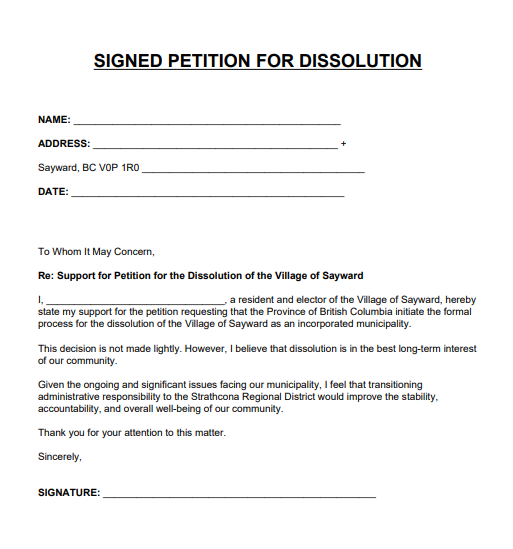
Petition

Request For Quotations – Sayward Fire Hall #1 Renovation

The Village of Sayward is seeking quotations from qualified vendors to complete FireSmart renovation work at Firehall #1, located at 620 Kelsey Way, Sayward, British Columbia.

Quotations must be clearly labeled “Firehall #1 – FireSmart Renovations” and submitted to:

Village of Sayward PO Box 29 652‑A H’Kusam Way Sayward, BC V0P 1R0

The submission deadline is 2:00 p.m. Pacific Time on Friday, February 27, 2026.

All pricing must be provided in Canadian dollars, with applicable taxes listed separately. Quoted prices must remain valid for at least 120 days from the closing date.

Vendors are solely responsible for ensuring their quotation is received by the Village of Sayward before the deadline.

Evaluation Criteria Quotations will be assessed based on: a) Ability to meet the timelines and requirements outlined in this RFQ b) Relevant experience and qualifications c) Lowest overall cost to the Village of Sayward

Inquiries All questions regarding this RFQ should be directed to: Shaun Koopman Phone: 250‑830‑6702 Email: skoopman@srd.ca

Any addenda issued for this RFQ will be posted on the Village of Sayward website and the BC Bid website. Verbal communications are not binding unless confirmed through written addenda.

Ottawa Poised To Severely Restrict Salmon Take For Recreational Fishery

Sport fishing on Vancouver Island — a long‑standing tradition and an economic anchor for communities like Sayward — is facing renewed uncertainty as the federal government moves ahead with major changes to salmon‑fisheries management.

Ottawa is rewriting salmon policy and regulations with a stronger focus on conservation and Indigenous‑led management. While many agree that protecting declining salmon stocks is essential, anglers, guides, and coastal communities worry the new approach could sharply restrict recreational fishing without addressing the deeper causes of salmon decline.

For Sayward, where sport fishing supports local businesses, tourism, and family traditions, the potential impacts reach far beyond the docks.

What’s Changing

The federal government has signalled that recreational salmon fishing could face tighter limits, shorter seasons, or expanded closures as part of a broader overhaul of fisheries management. These measures are intended to prioritize conservation and food fisheries, particularly for Indigenous communities. But critics say the approach risks sidelining the sport‑fishing sector.

Anglers note that recreational fishing already operates under strict rules — including size limits, seasonal openings, gear restrictions, and catch limits. Many feel additional restrictions unfairly target sport fishers while larger pressures on salmon — such as habitat loss, warming oceans, predation, and industrial impacts — remain insufficiently addressed.

Why It Matters to Sayward

In Sayward, sport fishing is more than a hobby. It supports charter operators, lodges, restaurants, fuel docks, marinas, and local retailers. Visiting anglers bring crucial seasonal income, especially during the summer months when tourism helps sustain small businesses.

Residents also rely on recreational fishing for food and as a way to stay connected to the water. For many families, fishing is part of their identity — a tradition passed down through generations.

Any reduction in fishing opportunities could ripple through the community, making it harder for businesses to stay afloat and for residents to maintain the coastal lifestyle that defines the region.

Conservation vs. Community Impacts

Most anglers in Sayward support conservation and recognize the serious pressures facing salmon stocks. But many question whether focusing on recreational fishing will meaningfully improve salmon returns if larger issues remain unresolved.

Habitat degradation, blocked fish passage, warming rivers, poor marine survival, and predation are often cited as more significant drivers of salmon decline. Critics argue that without stronger action in these areas, restricting sport fishing risks becoming symbolic rather than effective.

There is also concern about uneven impacts. While industrial activities and large‑scale pressures continue, small coastal communities fear they will bear the brunt of policy changes that reduce access to a resource they depend on.

Calls for Local Input and Balance

Fishing groups and coastal residents are urging Ottawa to slow down and consult more closely with communities like Sayward before finalizing new rules. They want decisions grounded in transparent science, local data, and a clear understanding of how policy changes affect rural economies.

Many are calling for a balanced approach — one that recognizes sport fishing as both a cultural tradition and an economic contributor, rather than treating it as expendable.

Looking Ahead

As Ottawa continues reshaping salmon management, Sayward residents will be watching closely. The outcome could determine not only the future of recreational fishing, but also the health of local businesses and the character of the community itself.

For many here, the message is clear: protecting salmon is essential — but conservation efforts must include the people and communities who have relied on these waters for generations. Decisions made far from the coast should not come at the expense of rural livelihoods unless there is clear evidence they will truly help salmon recover.

Governor General’s Salary Climbs Toward $400,000 While Sayward Families Face Mounting Expenses

The Governor General of Canada is poised to earn nearly $400,000 this year after receiving another automatic pay increase — a development drawing criticism from taxpayer advocates and residents in small communities like Sayward, where families continue to struggle with rising living costs.

Federal law mandates annual automatic salary adjustments for the Governor General, causing the position’s pay to steadily climb even as Canadians face higher prices for groceries, fuel, housing, and utilities.

In Sayward and other rural Vancouver Island communities, affordability pressures are often more intense than in urban centres. Transportation and supply challenges drive up the cost of basic goods, while wages tend to be lower and employment more seasonal. Against this backdrop, automatic raises for top federal officials strike many as out of touch with the financial realities facing rural households.

Taxpayer advocates note that the Governor General’s salary is several times higher than the average Canadian income. They argue that such increases are difficult to justify when families are cutting back on essentials and local governments are struggling to maintain services with limited resources.

Beyond the salary itself, the Governor General’s office includes a range of taxpayer‑funded benefits — from an official residence to extensive travel and additional allowances. Critics say these costs add to the burden on taxpayers, including those in small communities who may see little direct benefit from federal spending.

Long‑term expenses are also a concern. Former Governors General receive generous pensions and ongoing expense accounts, regardless of how long they served. Taxpayer groups argue that these commitments represent significant, decades‑long costs.

In Sayward, where many residents rely on fixed incomes or small local businesses, questions are growing about why senior federal officials continue to receive automatic raises while calls for fiscal restraint are often directed at municipalities and taxpayers. Some argue that public‑sector compensation should better reflect broader economic conditions, especially during periods of high inflation and affordability challenges.

Advocates are calling for reforms to end automatic pay increases for senior federal roles and to require greater transparency and accountability around compensation. They say that if governments expect Canadians to tighten their belts, the same expectations should apply to those in the highest offices.

Without changes, critics warn that widening pay gaps between federal officials and everyday Canadians will continue to fuel frustration — particularly in rural communities like Sayward, where rising costs and limited services already stretch household budgets.

North Island Film Seeks Sayward Locals For Extras

A feature film set to shoot on Northern Vancouver Island early next year is inviting local residents to get involved, bringing both community participation and an international story to the region.

The production, titled Exchange, will be filmed in Sayward, Campbell River and nearby locations from February 4 to 14, 2026. Casting is now underway for local background performers to appear in non-speaking roles such as students, townspeople and police officers. Applicants from their teens through middle age are welcome, and no previous acting experience is required.

Producers note that background performers are essential in creating authentic community environments throughout the movie. Although the roles do not involve dialogue, participants will be on set with professional cast and crew, gaining a close-up look at how a feature film is made. Scheduling will depend on the needs of each scene, with some individuals called for specific shoot days.

Exchange is described as a character-focused drama with strong thriller elements. The story follows an 18‑year‑old Thai exchange student who vanishes while studying in Canada. Her mother travels overseas to search for her, confronting cultural challenges, isolation and unsettling clues as she navigates an unfamiliar country. During her search, she forms a connection with a Thai teenager living in Canada, and together they work to uncover what happened. As the investigation deepens, tensions surrounding the exchange program and the student’s host family begin to surface.

Written and directed by Chatchai Hongsirikun, the film is being produced as a non‑union feature. Alongside background roles, the team has also been casting several speaking parts—such as police officers and local youth—with a focus on hiring Vancouver Island talent whenever possible.

The production is expected to bring economic benefits to Northern Vancouver Island, including increased demand for accommodations, local services and short-term employment. Community participation is also a key priority, helping highlight the region’s landscapes and small-town character on screen.

Residents interested in appearing as background performers are asked to send their name, age, a recent photo, availability during the filming window and contact details to sublunarcasting@gmail.com.

The production team encourages anyone curious about the filmmaking process to apply, emphasizing that enthusiasm and local involvement are just as valuable as experience.