
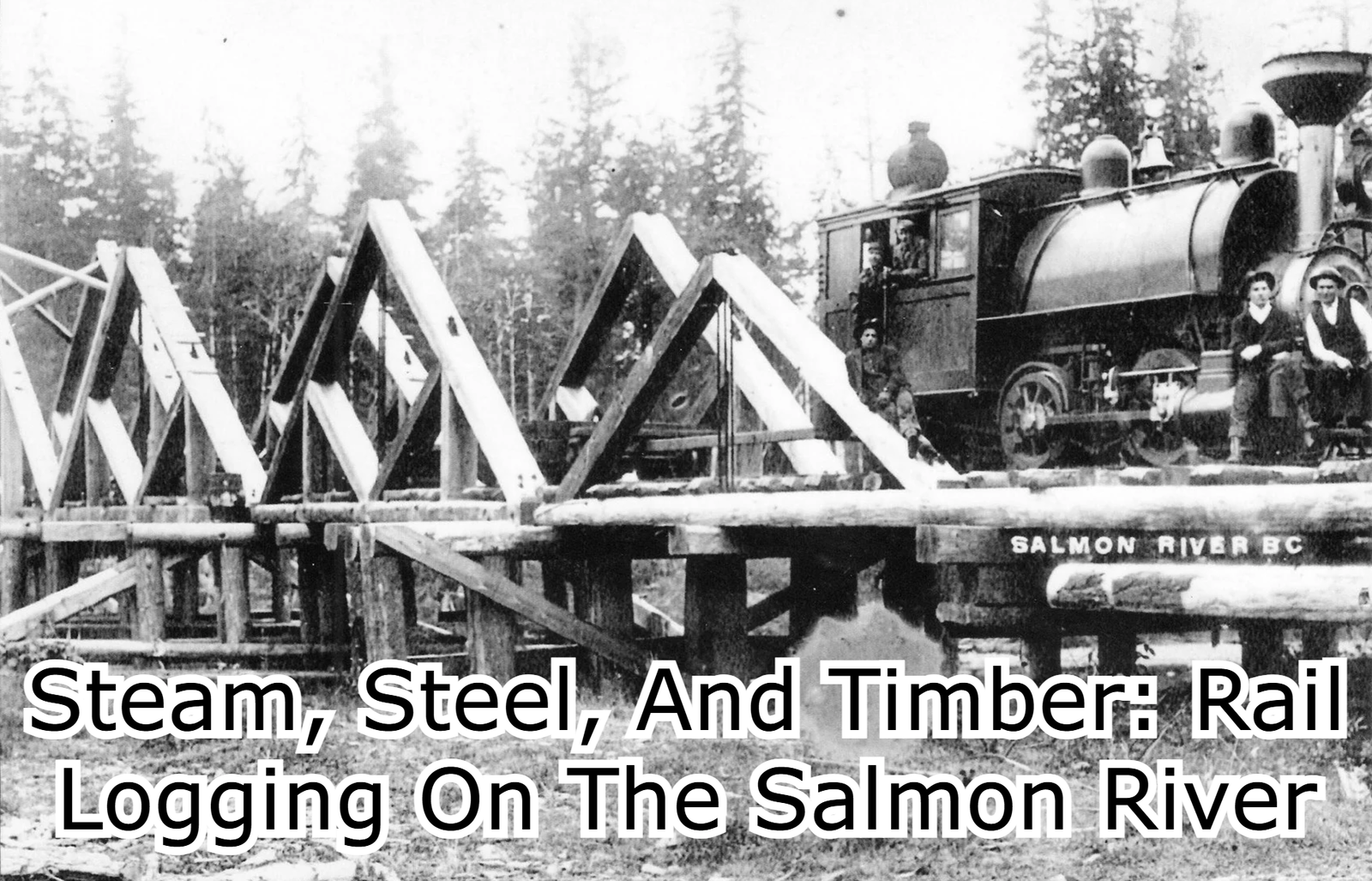
In this striking historical photograph from the Salmon River, a small steam locomotive carefully crosses a rugged wooden trestle, its crew perched on the engine as it inches forward over the river below. The image captures more than just a moment—it tells the story of an industry that helped shape coastal communities and the landscape of northern Vancouver Island.
Rail logging was once the backbone of the forest economy in this region. Before modern highways and logging trucks, companies relied on narrow-gauge railways to penetrate deep into dense forests. These temporary rail lines were often built quickly and economically, using locally sourced timber to construct trestles like the one shown here. The zig-zagging bracing beneath the tracks reveals the ingenuity—and urgency—of early logging operations, where speed often took priority over permanence.
The locomotive itself is a compact but powerful steam engine, designed for tight turns and rough terrain. Crews worked long hours in challenging conditions, navigating steep grades, unstable tracks, and unpredictable weather. Safety standards were minimal by today’s measures, and crossings like this one required both skill and nerve.
At the Salmon River, rail logging opened access to vast stands of old-growth timber. Logs were hauled from the cutblocks to booming grounds or mills, feeding a growing demand for lumber across British Columbia and beyond. These operations were often temporary—once an area was logged, the rails would be pulled up and moved deeper into the forest, leaving little behind but stumps and stories.
Yet, despite their transient nature, these railways played a lasting role in the development of communities like Sayward. They brought jobs, infrastructure, and a connection to the wider world. The echoes of steam whistles and clattering rails may be gone, but their impact remains embedded in the region’s history.
Today, images like this offer a window into that era—one of grit, innovation, and transformation. The Salmon River crossing stands as a reminder of how far logging practices have come, and how deeply they are woven into the identity of coastal British Columbia.