
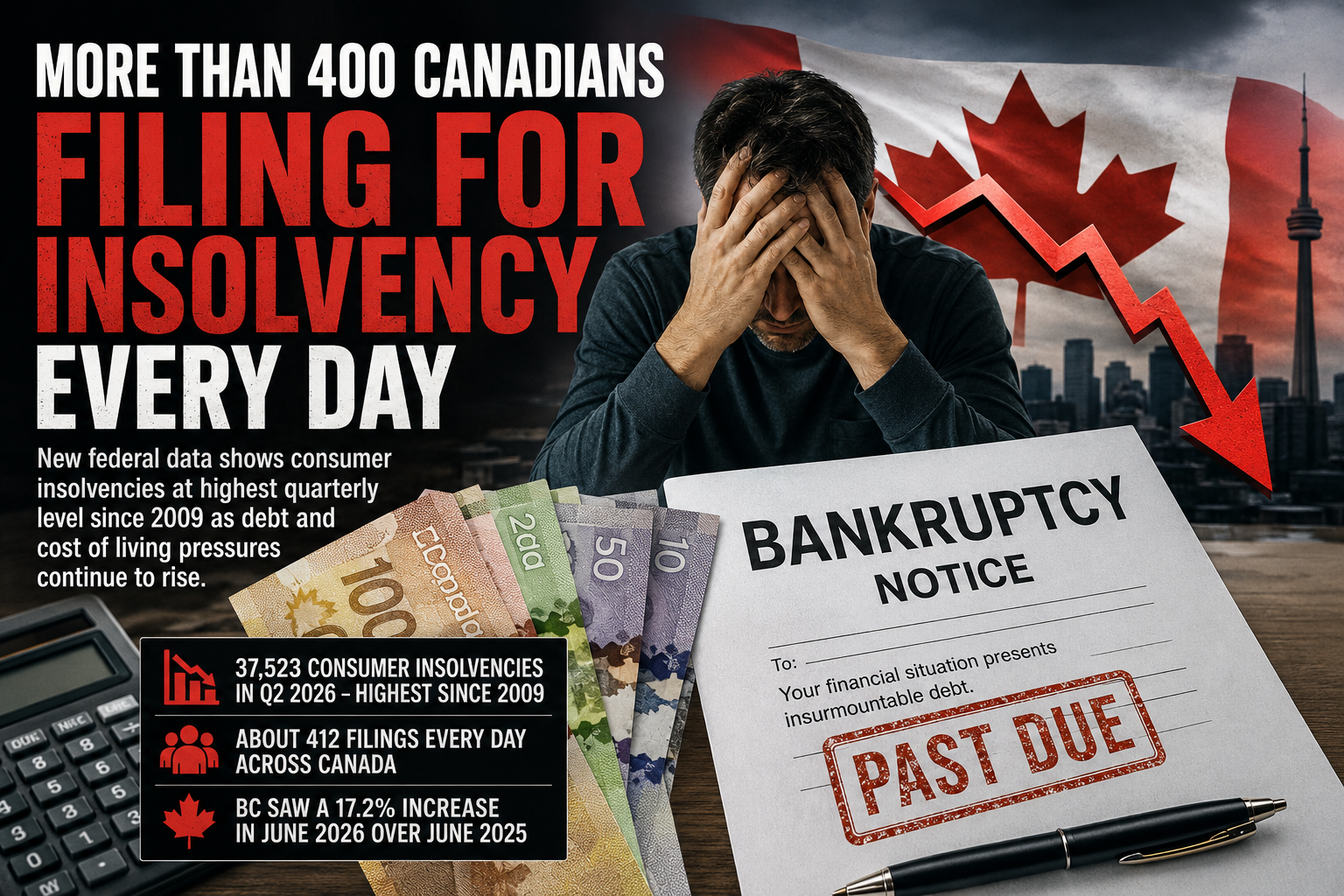
Canadian households are continuing to face mounting financial pressure, with new federal data showing consumer insolvencies have reached their highest quarterly level since the aftermath of the 2008 financial crisis.
More than 37,500 Canadian consumers filed for insolvency during the second quarter of 2026, according to the latest figures from the Office of the Superintendent of Bankruptcy (OSB).
The 37,523 consumer insolvencies recorded between April and June represented a 6.9% increase from the same period in 2025 and a 1.1% increase from the first quarter of this year. It was the highest quarterly total since 2009.
That works out to approximately 412 consumer insolvency filings every day, or roughly 17 every hour.
The figures provide fresh evidence that a growing number of Canadians are struggling to keep up with household debt, even as some broader economic indicators have shown signs of improvement.
Bankruptcy Is Only Part Of The Picture
The term “bankruptcy” is frequently used to describe the current increase, but the federal data distinguishes between bankruptcies and other forms of insolvency.
Of the 37,523 consumer insolvencies recorded in the second quarter, approximately 8,600 were actual bankruptcies. The majority involved consumer proposals, which allow individuals to negotiate a formal settlement with creditors while avoiding bankruptcy.
The distinction is significant. The current pace of roughly 412 consumer insolvencies per day should not be interpreted as 412 people declaring bankruptcy every day.
Nevertheless, the increase in both categories points to growing financial stress.
Federal statistics show that consumer bankruptcies were up 10.3% year-over-year in the second quarter, while consumer insolvencies overall increased 6.9%.
British Columbia Among The Harder-Hit Provinces
British Columbia is experiencing an especially sharp increase.
OSB data shows 1,506 consumer insolvencies were recorded in B.C. in June 2026, up 17.2% from June 2025.
Over the 12 months ending June 30, B.C. recorded 16,609 consumer insolvencies, an increase of 14.3% compared with the previous 12-month period.
That total included 2,712 consumer bankruptcies, up 8.5%, and 13,897 consumer proposals, up 15.5%.
B.C.’s increase was considerably larger than the national 12-month increase of 5.9%.
For residents of communities throughout the province, including smaller communities on Vancouver Island, the numbers offer a broader indication of the financial pressures being experienced by households.
Debt And The Cost Of Living
The rise in insolvencies comes against a backdrop of elevated household debt.
The household debt burden has remained substantial, while Canadians continue to contend with housing, food, transportation, insurance and other everyday expenses.
A report published earlier this year citing TransUnion data put Canadian household debt across credit products at approximately $2.6 trillion at the end of 2025. The same report noted that mortgage delinquency rates had risen to 0.24%, their highest level since 2021.
The Bank of Canada has also acknowledged that financial stress among households has increased, although it says the overall Canadian financial system remains resilient.
In its 2025 Financial Stability Report, the central bank said household debt relative to disposable income had declined over the previous year, but warned that some heavily indebted households remained vulnerable to economic shocks.
Mortgage Payments Are Still A Concern
Mortgage renewals remain another potential source of pressure for Canadian households.
Many borrowers who obtained mortgages at exceptionally low interest rates during the pandemic have been required to renew at higher rates. While interest rates have subsequently fallen from their peak, some homeowners are still facing substantially higher borrowing costs than they were accustomed to.
The Bank of Canada has said mortgage holders have generally shown resilience, but some households have had to reduce spending, extend amortizations or make other financial adjustments to accommodate higher payments.
The pressure is not limited to mortgage holders. Canadians carrying credit-card balances, lines of credit, vehicle loans and other forms of consumer debt can also be affected when household budgets become increasingly constrained.
The Trend Was Already Visible Earlier In 2026
The second-quarter figures build on an increase that was already evident during the first three months of the year.
In the first quarter, 37,121 Canadian consumers filed for insolvency, an 8.5% increase from the same quarter of 2025 and the highest quarterly total since 2009 at the time.
The Canadian Association of Insolvency and Restructuring Professionals described the result as equivalent to approximately 17 consumer insolvency filings every hour.
By the end of June, the number had climbed again.
The federal data shows that consumer insolvencies during the 12 months ending June 30 increased 5.9% from the previous year. Consumer bankruptcies rose 8.4%, while consumer proposals increased 5.2%.
Businesses Face Pressure Too
Households are not the only borrowers experiencing financial strain.
During the first quarter of 2026, 1,232 Canadian businesses filed for insolvency, according to figures cited by Rebel News. Business insolvencies were lower than a year earlier but increased nearly 10% from the preceding quarter.
The picture is mixed in the latest annual data.
OSB figures show business insolvencies declined 9.7% during the 12 months ending June 30 compared with the previous year. However, some sectors continued to experience increases, including accommodation and food services, mining, quarrying and oil and gas extraction, and management of companies and enterprises.
Separate analysis of May data found 405 business insolvency filings that month, the second-highest May total in more than a decade.
Not Everyone In Financial Trouble Is Filing
The official insolvency numbers also don’t capture every financially distressed household or business.
An individual can be struggling with debt without filing for bankruptcy or a consumer proposal. Similarly, businesses can close, liquidate assets or simply wind down without entering formal insolvency proceedings.
That means insolvency statistics provide an important measure of financial distress, but they are not a complete accounting of every Canadian household experiencing financial hardship.
The Bank of Canada has likewise emphasized that financial stress remains concentrated among certain households rather than representing a systemic failure of Canada’s banking system.
A Warning Sign For Canadian Households
The latest numbers do not mean Canada is experiencing another 2008-style financial crisis.
Canada’s banking system remains substantially more resilient than it was during previous periods of severe financial stress, and the vast majority of Canadians are continuing to meet their debt obligations.
But the insolvency figures are nevertheless significant.
With 37,523 consumer insolvencies in just three months, the country is seeing its highest quarterly level since 2009. B.C. is recording an even faster increase than the national average, while consumer bankruptcies are rising at a faster rate than overall consumer insolvencies.
For households already operating with little financial room, continued pressure from debt payments and the cost of everyday necessities could make the next several months increasingly difficult.
The numbers suggest that while Canada’s broader financial system may remain stable, a growing number of individual Canadians are finding that their own household finances are anything but comfortable.