
Nestled along the rugged shoreline of Johnstone Strait, the historic Kelsey Bay Beach Logging Camp once served as one of the busiest industrial hubs in the Sayward Valley during Vancouver Island’s great logging era.
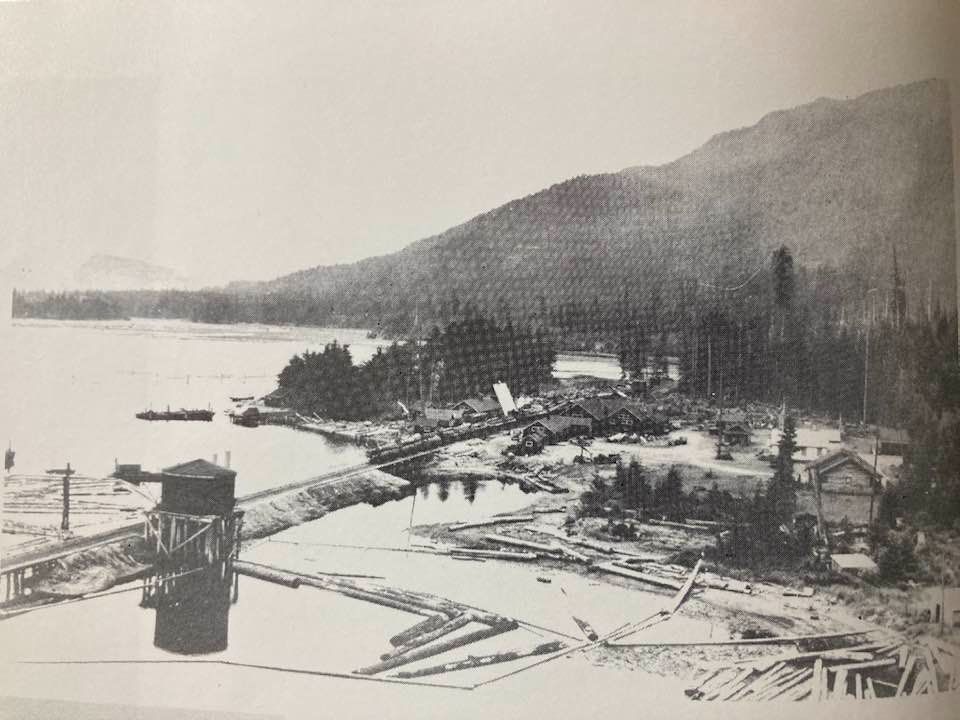
The photograph above, believed to date to approximately 1937, captures Kelsey Bay during a time when coastal logging operations dominated the economy of northern Vancouver Island. Before highways connected the region to the rest of the island, communities like Kelsey Bay existed primarily because of the forest industry.
At its peak, Kelsey Bay was much more than a small waterfront settlement. It was a thriving company town built around logging, rail transport, booming grounds, and marine shipping operations. Timber harvested deep within the Sayward Valley was transported by logging railway from inland camps to the waterfront at Kelsey Bay, where logs were sorted, stored, and loaded for shipment to coastal mills and export markets.
The image reveals several defining features of the early beach logging camp. Floating log booms crowd the sheltered water in the foreground while a wooden wharf and industrial structures extend into the bay. Small bunkhouses and work buildings line the shoreline beneath the steep forested mountains that tower behind the settlement.
Life at the beach camp revolved around hard labour and strict schedules. Workers maintained rail equipment, operated steam donkeys, sorted logs in the booming grounds, repaired machinery, and loaded timber onto ships. The camp itself was largely self-contained, with bunkhouses, kitchens, maintenance buildings, and offices supporting hundreds of workers connected to the operation.
The logging railroad was the lifeline of the operation. Trains hauled massive logs from remote inland camps around Alice Lake and the upper Sayward Valley down to the coast. The sight and sound of loaded logging trains descending toward Kelsey Bay became a familiar part of daily life for decades.
Over time, advancements in trucking, road building, and mechanized logging gradually replaced the old railway and beach camp systems. By the latter half of the 20th century, many of the original camp structures disappeared as the industry evolved and operations modernized.