
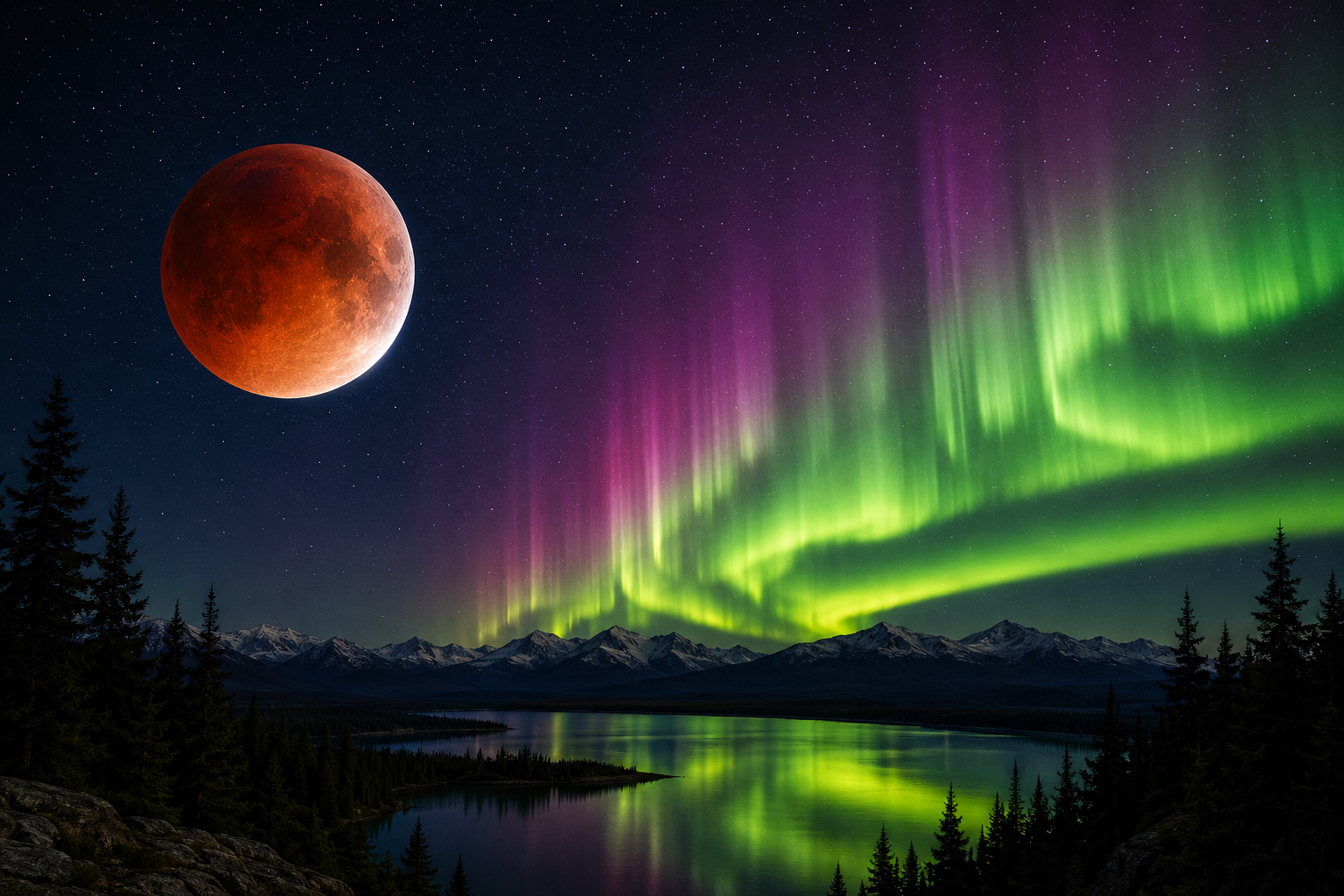
Skywatchers across Canada could be in for an unusually dramatic night as two very different celestial events potentially unfold at the same time: a deep partial lunar eclipse and an outburst of the northern lights.
On the night of Thursday, August 27, into the early hours of Friday, August 28, the full Sturgeon Moon will move through Earth’s shadow. At the eclipse’s maximum, roughly 96 per cent of the Moon will be immersed in Earth’s darkest shadow, leaving only a small portion of the lunar surface directly illuminated.
At the same time, increased activity from the Sun is creating the possibility of auroras across much of Canada.
If skies are clear and geomagnetic activity develops as forecast, observers could potentially see a reddish, eclipsed Moon in one part of the sky while green, red or purple auroral light shimmers elsewhere.
A nearly total “blood moon”
Although this week’s event is technically a partial lunar eclipse, it will be an unusually deep one.
At maximum eclipse, about 96 per cent of the Moon will be inside Earth’s umbra — the darkest central portion of the planet’s shadow. That leaves only a thin section of the lunar disk directly illuminated by sunlight.
As the Moon moves deeper into the umbra, much of its surface can take on a copper, orange or reddish appearance. The effect happens because some sunlight passes through Earth’s atmosphere before reaching the Moon. Earth’s atmosphere scatters more of the shorter blue wavelengths, while allowing more red and orange light to continue through.
That’s the same basic phenomenon responsible for the reddish appearance of a total lunar eclipse.
This event doesn’t quite reach totality, but the difference will be difficult to appreciate at a glance. With almost the entire lunar disk immersed in Earth’s shadow, the Moon should have a distinctly different appearance from an ordinary full Moon.
The event is also significant because it will be the deepest partial lunar eclipse visible from North America for several years. A total lunar eclipse on New Year’s Eve in 2028 will provide the next major opportunity for a fully eclipsed Moon.
The Sun is adding another ingredient
The lunar eclipse isn’t the only reason to look up.
Solar activity has increased in recent days, with a powerful solar flare from sunspot region 4513 accompanied by coronal mass ejections (CMEs). A CME is a massive cloud of magnetized plasma expelled from the Sun that can travel through interplanetary space and interact with Earth’s magnetic field.
A separate high-speed stream of solar wind is also expected to increase geomagnetic activity.
Those disturbances are important for aurora watchers because they can energize particles trapped around Earth and drive them into the upper atmosphere. When those particles collide with atmospheric gases, they produce the glowing curtains and arcs known as the aurora borealis.
NOAA’s Space Weather Prediction Center has forecast the possibility of minor geomagnetic storm conditions around Thursday, with stronger G2-level conditions possible Friday as additional solar activity reaches Earth.
Forecasts are never a guarantee of an aurora display, however. The strength and timing of the incoming solar material — particularly the orientation of its magnetic field — can determine whether a storm produces a spectacular show or a much more subdued display.
Why the eclipse could actually help aurora watchers
There is an interesting twist to having the northern lights appear during a full Moon.
Normally, a bright full Moon can make an aurora harder to see. The Moon illuminates the surrounding sky, reducing the contrast between relatively faint auroral light and the darkness around it.
Tonight, however, the Moon will spend much of the most interesting part of the evening moving through Earth’s shadow.
As the lunar disk darkens, the surrounding sky becomes noticeably darker. That could improve the contrast between the aurora and the night sky, particularly for observers under otherwise dark conditions.
It doesn’t make an aurora more likely to occur. Instead, it may make an existing aurora easier to notice.
That distinction is important because an aurora forecast and an eclipse forecast are describing two completely independent phenomena.
Where could Canadians see the northern lights?
The aurora’s visibility will depend heavily on how far south geomagnetic activity reaches.
Northern and central Canada generally have the best odds, while a stronger-than-expected geomagnetic response could push the auroral oval farther south.
Recent forecasts have indicated the possibility of aurora visibility extending into portions of the northern United States, which means many Canadians farther south could also have an opportunity if the storm strengthens.
For Canadian observers, the best strategy is to get away from city lights and find a location with a broad, unobstructed view toward the northern horizon.
And don’t rely exclusively on what the aurora looks like to the naked eye.
A camera or modern smartphone can sometimes record colours and structure that are difficult to see directly, particularly when the aurora is faint. Night or astrophotography modes can make a substantial difference.
The eclipse won’t look identical across Canada
Where you live will make a significant difference.
Eastern Canada has an advantage because the Moon will already be above the horizon as the eclipse progresses through its most dramatic stages.
In much of western Canada, however, the Moon rises while the eclipse is already underway.
For example, in British Columbia the Moon rises shortly before the eclipse’s darker stages, meaning observers there won’t see the entire event from beginning to end. The same issue affects parts of Alberta and Saskatchewan.
The maximum eclipse occurs at different local times across the country:
– British Columbia: about 9:12 p.m. PDT
– Alberta: about 10:12 p.m. MDT
– Saskatchewan: about 10:12 p.m. CST
– Manitoba: about 11:12 p.m. CDT
– Ontario and Quebec: about 12:12 a.m. EDT
– Atlantic Canada: about 1:12 a.m. ADT
– Newfoundland: about 1:42 a.m. NDT
The exact visibility also depends on the Moon’s position above the local horizon and, of course, the weather.
How to watch both events
You don’t need specialized astronomical equipment.
For the lunar eclipse, simply find a location with a clear view of the Moon. Lunar eclipses are safe to observe directly with the naked eye. Binoculars or a telescope can reveal additional detail in the Moon’s changing surface and shadow.
For the aurora, darkness is much more important.
Move away from bright urban areas if possible and give your eyes time to adjust. Look toward the northern sky, although a strong aurora can spread much farther across the sky.
Ideally, choose a location where you can see both a large portion of the sky and the horizon rather than standing beneath trees or beside tall buildings.
And keep checking the forecast throughout the evening.
Auroral activity can change rapidly, so a forecast several hours earlier doesn’t necessarily tell you what will happen when you actually step outside.
A rare combination — but don’t expect a guaranteed spectacle
The most important word for tonight is potential.
The lunar eclipse is predictable: Earth’s shadow will cross the Moon on schedule.
The aurora is different.
Solar-wind conditions can change quickly, and even when a geomagnetic storm is forecast, the resulting aurora may be faint, localized or occur at a different time than expected.
That makes the possibility of seeing both phenomena together especially intriguing.
At maximum eclipse, the Moon could appear as a dark copper-red disk, while an auroral glow develops along the northern horizon. In a particularly favourable location, a camera could potentially capture both phenomena in the same wide-angle image.
Even if the northern lights don’t cooperate, the eclipse itself is worth watching.
And if the geomagnetic storm arrives at the right time, Thursday night could offer something considerably more unusual: a darkened, reddish Moon sharing the sky with the northern lights.
For anyone with clear skies across Canada, it may be worth stepping outside and looking up.