
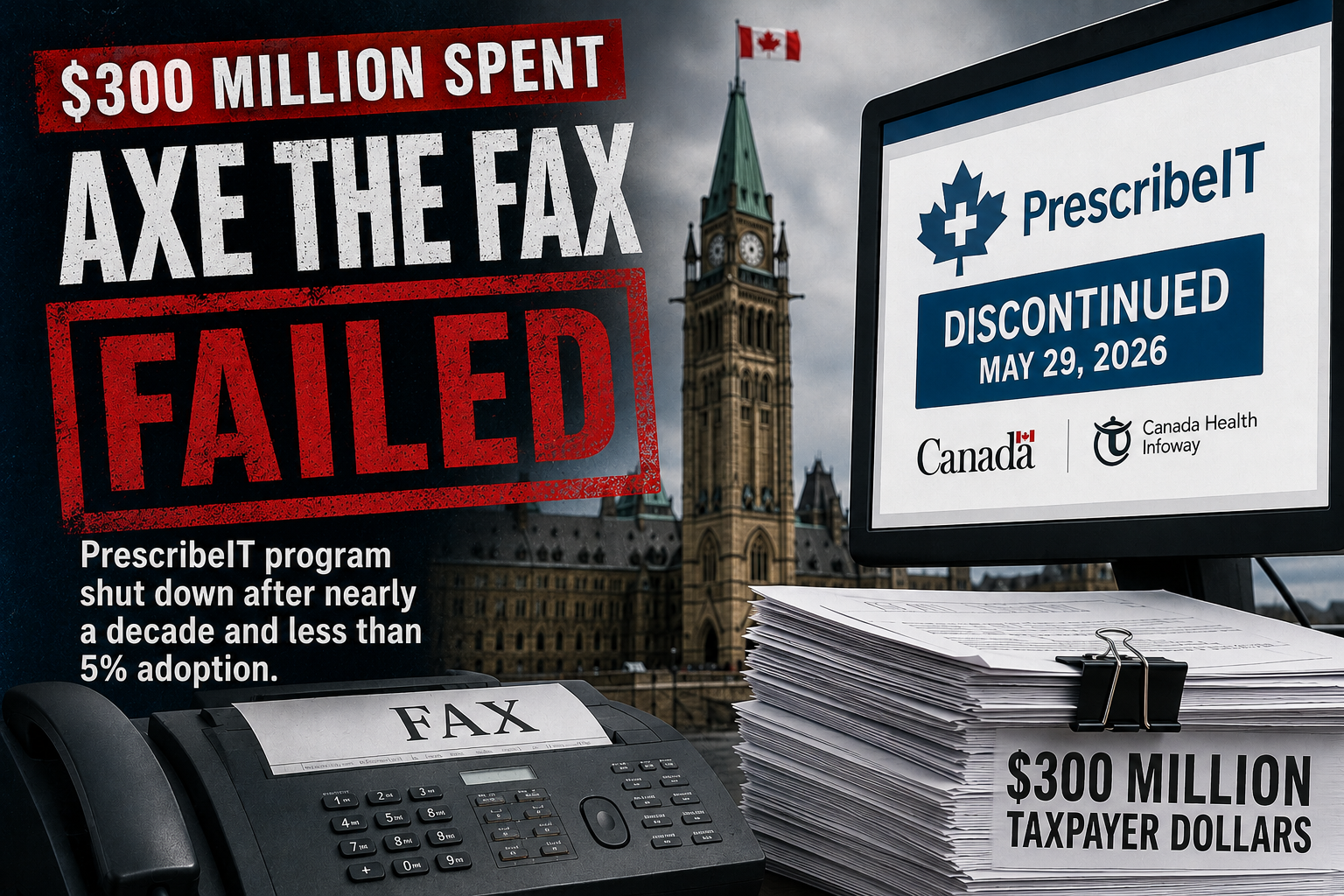
PrescribeIT was intended to modernize prescription delivery across Canada. After years of development and limited adoption, the national e-prescribing service has been discontinued, prompting new questions about how the money was spent.
A federal effort to replace fax machines in Canada’s health-care system has come to an end after nearly a decade, with the program having received close to $300 million in federal funding and accounting for less than five per cent of prescriptions nationwide.
The program, known as PrescribeIT, was created to provide doctors and other prescribers with a secure electronic method of sending prescriptions directly to pharmacies. Instead of printing, faxing or manually entering prescriptions, the system was intended to allow information to move electronically from a health-care provider’s electronic medical record into pharmacy software.
The goal was straightforward: modernize a system that had become increasingly out of step with the rest of the digital economy.
Instead, PrescribeIT was shut down on May 29, 2026, after failing to achieve widespread adoption.
From a $40-million plan to nearly $300 million
PrescribeIT was announced in 2016 with an initial federal commitment of approximately $40 million. Canada Health Infoway, a federally funded not-for-profit organization, subsequently developed and operated the service.
Over the following decade, federal spending grew dramatically.
Health Canada has acknowledged federal spending of more than $290 million on the program, while some parliamentary discussions have referred to the figure as approximately $300 million.
The investment was intended to create a national digital infrastructure for prescriptions, with the long-term expectation that the system would eventually become financially self-sustaining.
That did not happen.
By the time PrescribeIT was discontinued, fewer than five per cent of prescriptions were being processed through the platform.
According to testimony before the House of Commons Standing Committee on Health, approximately 11 million prescriptions were fulfilled using PrescribeIT in the previous year — but that represented only about five per cent of prescriptions across Canada.
The vast majority continued to move through traditional systems, including fax and paper.
Why did adoption remain so low?
The problems surrounding PrescribeIT appear to have been more complicated than simply convincing doctors to stop using fax machines.
Canada Health Infoway’s leadership told parliamentary committees that adoption among physicians and other prescribers was lower than expected. The Canadian Pharmacists Association also raised concerns about the financial model surrounding the service.
In 2025, pharmacies began being charged 20 cents per prescription processed through PrescribeIT after federal funding was reduced.
Rather than encouraging greater participation, the fee became another source of concern for pharmacies already operating under financial pressure.
The program also faced the challenge of convincing provinces and health-care organizations to take responsibility for its continuing operating costs.
Ultimately, provinces did not take on those costs, and Canada Health Infoway announced that PrescribeIT would be discontinued.
The organization said it would instead move toward an open-standards approach, rather than continuing to operate a centralized national network.
Telus Health and the question of intellectual property
Another issue attracting parliamentary attention is the relationship between Canada Health Infoway and TELUS Health, which served as the program’s primary technology vendor.
Approximately $98 million reportedly went to Telus Health in connection with the program. Parliamentary and other reporting has also raised questions about ownership of the intellectual property developed through the project.
One report cited by parliamentary watchdogs says Telus retained approximately 85 per cent of the underlying intellectual property, while the federal government did not retain ownership of the platform itself.
That arrangement has prompted MPs to ask a basic question: after hundreds of millions of dollars in public funding, what assets ultimately remained under public control?
Those questions remain part of the broader examination of PrescribeIT.
Parliamentary scrutiny increases
The program’s failure has attracted increasing attention on Parliament Hill.
Members of the House of Commons Standing Committee on Health have sought access to documents relating to the program, including contribution agreements, information about intellectual property, annual adoption figures and revenue generated by the prescription fees.
During committee proceedings, MPs questioned Canada Health Infoway executives about the program’s cost, performance and governance.
Conservative MPs have also called for an investigation by the Auditor General, arguing that Canadians deserve a clearer accounting of how the money was spent and why the program failed to achieve its central objective.
The political debate has become particularly contentious because the program was ultimately unable to deliver the nationwide transition away from fax-based prescriptions that it was created to achieve.
An audit is now being pursued
The federal government announced in June that it would conduct an audit and broader review of Canada Health Infoway.
The review is expected to examine not only the PrescribeIT program but also issues involving governance, operations and executive compensation.
On August 26, the federal government posted a request for proposals seeking an outside contractor to audit contribution funding provided to Canada Health Infoway.
The proposed audit is expected to continue through the end of 2026.
That means Canadians may have to wait considerably longer for a complete accounting of the program’s finances and the reasons behind its failure.
The bigger issue: modernizing health care
The failure of PrescribeIT raises questions that extend beyond fax machines.
Electronic prescriptions are hardly a new concept. Digital prescribing systems are used in health-care systems around the world, making Canada’s continued reliance on paper and fax particularly notable.
For patients, the technology behind a prescription may seem like a minor detail. But outdated communication systems can contribute to delays, transcription problems and additional administrative work for health-care professionals.
That makes the objective behind PrescribeIT difficult to dispute.
The question is whether the federal government chose the right approach — and whether the project was adequately managed once problems with adoption became apparent.
After nearly a decade and hundreds of millions of dollars in public spending, the country has effectively returned to the starting point in many parts of the health-care system.
The federal program intended to “axe the fax” is gone, while faxing remains.
For Canadians watching the cost of government programs, the next important question is no longer whether the technology can replace the fax.
It is why nearly $300 million was spent attempting to do so without achieving widespread adoption — and what can be learned before another national health-care technology project is launched.
The forthcoming audit should provide at least some of those answers.
GoSayward.com has summarized and independently contextualized reporting and publicly available parliamentary records concerning the PrescribeIT program. Claims regarding political responsibility and alleged misconduct remain matters of debate and should not be treated as established findings unless supported by evidence.
Sources: Parliamentary records and reporting on Canada Health Infoway and PrescribeIT, including House of Commons committee proceedings and recent reporting on the federal audit.