We’ve Lost Christmas With Canada Post As Government Moves To Intervene
“Effectively, we’ve lost Christmas with Canada Post,” said Dan Kelly, president of the Canadian Federation of Independent Business, in an interview with Global News.
Those hoping to receive holiday gifts through Canada Post should not expect a Christmas miracle this year. Experts predict it could take up to a month to clear the backlog of parcels and letters.
“It’s not like starting your car after it’s been parked for three weeks. In some of the larger facilities, it could take up to five days just to begin processing items,” explained Fraser Johnson, a professor of operations management at Western University’s Ivey Business School, in an interview with the Toronto Star.
Reports indicate Canada Post missed delivering 12 million parcels in early December, according to the Financial Pos.
Johnson further clarified that for every day of delay in the supply chain, it could take about five additional days to clear the backlog.
“Canadian consumers need to brace for the reality that Christmas 2024, in terms of shipping capacity, has already hit its limit,” Kelly told Global News. He recommended shopping locally, saying, “Please visit your local businesses for gifts you can hand-deliver or purchase in-store.”
He also added, “Even if the strike were resolved today, Canada Post wouldn’t be able to clear the backlog in time to deliver packages before the holidays. For 2024, Canada Post is essentially out of commission. It’s not a viable option for small businesses this year.”
On Friday, Canada Post and its employees, represented by the Canadian Union of Postal Workers (CUPW), marked the 29th day of their strike. The 55,000 workers are demanding better wages, improved working conditions, the right to retire with dignity, and expanded services at public post offices. The strike began on November 15, after a year of unproductive bargaining.
Canada Post rejected the union’s latest offer, saying it would “add billions of dollars in unsustainable fixed costs,” according to a December 11 statement.
Jan Simpson, the union’s national president, urged workers to remain firm. “The pressure of public opinion, financial strain, and constant pushback can make even the most determined question this fight. But it’s important to remember why this strike matters. This isn’t just about pay or benefits—it’s about fairness, dignity, and recognizing the crucial role the work plays in connecting communities across the country,” Simpson said in a statement on Thursday.
She added, “Every letter, package, and cheque you handle plays an essential role in keeping communities connected and life running smoothly. Yet, this importance is often overlooked in the hustle and bustle of daily life.”
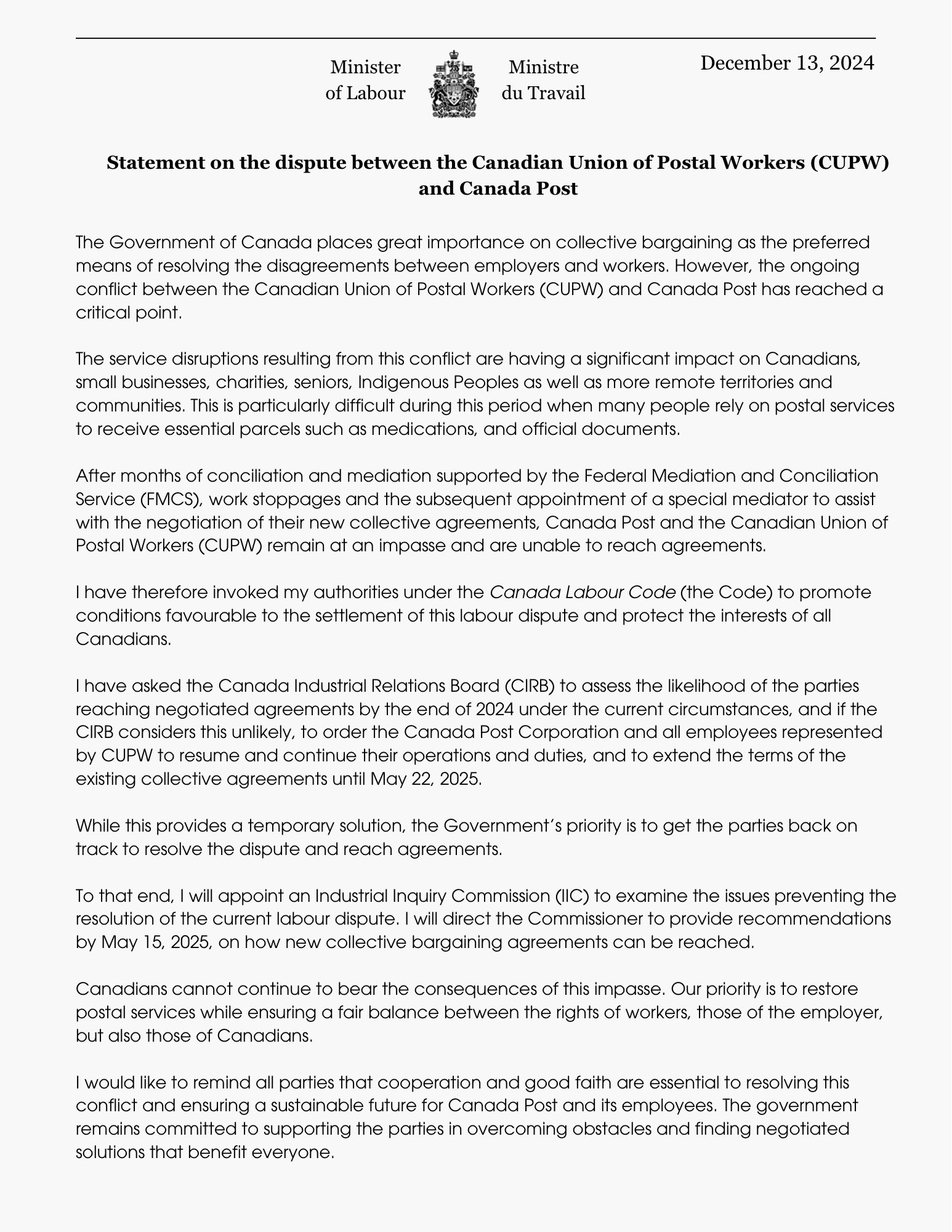
On Friday, Federal Labour Minister Steven MacKinnon requested the Canada Industrial Relations Board (CIRB) to assess the situation and potentially order workers back to their jobs if a deal is not reached.
In a post on X, MacKinnon stated that if CIRB determines a deal won’t be reached by the end of 2024, they should mandate union workers return to work and extend existing agreements until May 22, 2025. He also plans to appoint an Industrial Inquiry Commission (IIC) to examine the dispute and provide recommendations by May 15, 2025.
The union, however, issued a statement condemning the government’s intervention. “The Union strongly denounces this assault on our constitutionally protected right to collectively bargain and strike,” the statement read. “This order reflects a troubling pattern where the government uses its arbitrary powers to let employers off the hook, drag their feet, and refuse to bargain in good faith with workers and unions.”
The union also noted that the situation is “rapidly evolving” and they need more time to assess the details. “We are currently reviewing the order and considering all of our options moving forward,” said CUPW.
Kelly of the Canadian Federation of Independent Business added, “It seems the Canada Industrial Relations Board (CIRB) will have 72 hours to complete its work before issuing a back-to-work order on Monday.”
“This means Canada Post workers may return to their jobs as early as next week,” he said. CFIB estimates that small businesses are losing a combined $100 million every day due to the strike.
“This will be too late to save any part of the Christmas season for small businesses,” Kelly said. “With such a massive backlog, it will be nearly impossible for new shipments to reach Canadians before Christmas through Canada Post.”
Larry Savage, a labor professor at Brock University, discussed the strike’s impact, noting that public support for the union has been lukewarm. “As strikes drag on, they become harder to sustain, and if the public isn’t supporting you, it can be demoralizing for the union,” he told the Canadian Press. He added that it remains “unclear” who is winning the public’s favor.
A poll conducted in early December revealed that Canadians weren’t overly affected by the strike. “As the two sides exchange proposals, Canadians seem to sympathize with both perspectives. One-third (34%) believe Canada Post is justified in pushing back on demands and trying to change its business model due to financial struggles,” the survey showed. “A similar proportion (29%) supports the union’s demands. About one-quarter (23%) offer no sympathy, likely just wanting their packages delivered.”