Mt. Cain Snowfall Update February 24th

While much of Vancouver Island focused on the fresh snow piling up at Mount Washington Alpine Resort, Mt. Cain’s conditions have followed their own pattern:

Recent snowfall: Mt. Cain picked up a solid refresh, with the latest report showing 47 cm (19 inches) in 48 hours, including 10 cm on Saturday, Feb. 21.

Forecast: Weather models point to a light dusting ahead — roughly 0.7 cm, mainly Wednesday night. Temperatures are expected to stay cold and below freezing, which helps preserve the mountain’s existing powder.

Operations: According to the resort’s snow report, a couple of lifts are spinning, and there’s plenty of untouched powder off-piste. As always, official run counts and patrol updates can shift throughout the season.

Sayward Taxpayers Alliance — A Grassroots Push for Fiscal Reform and Local Governance Change

In the small Vancouver Island community of Sayward, British Columbia, a new grassroots movement—the Sayward Taxpayers Alliance—has become a prominent voice calling for fiscal restraint, government reform, and a fresh look at how local services are delivered. Formed by concerned residents, the Alliance reflects growing unease about rising municipal costs, increasing tax burdens, and the long‑term sustainability of Sayward’s current governance structure.

Origins and Purpose

The Sayward Taxpayers Alliance describes itself as “a grassroots alliance of citizens who are opposed to wasteful spending of taxpayer dollars.” Its mission is to push for stronger financial accountability at the municipal level and to ensure residents have a meaningful say in decisions that shape their taxes and community services.

A Bold Proposal: Dissolving the Village

Central to the Alliance’s platform is a significant and controversial idea: dissolving the Village of Sayward as an incorporated municipality and integrating it fully into the Strathcona Regional District (SRD). Supporters argue that this shift would streamline governance, reduce administrative overhead, and potentially deliver services more efficiently—ultimately easing the tax burden on property owners.

They contend that a small municipality like Sayward struggles to maintain a standalone council and administrative staff without duplicating services already available through the SRD. Dissolution, they say, is a practical response to the financial and operational pressures facing rural local governments across British Columbia.

Why Dissolution?

According to the Alliance, several potential benefits support the case for change:

  • Reduced Administrative Load: Sayward would no longer need its own council and municipal bureaucracy; instead, residents would be represented by an SRD director.
  • Stronger Governance Capacity: Regional administration, they argue, can offer more professional oversight and long‑term planning than a small, resource‑limited local council.
  • Possible Tax Relief: While not guaranteed, integrating services regionally could help stabilize or even lower property taxes over time.

These arguments echo concerns that have surfaced repeatedly in local news, including council dysfunction, resignations, and questions about financial planning and service delivery. For some residents, these issues signal that the village’s current governance model may no longer be viable.

Building Community Momentum

To advance the dissolution effort, the Alliance is organizing petition drives aimed at triggering a provincially guided governance review. Only eligible voters living within the Village of Sayward and aged 18 or older can sign. If the petition meets the required threshold, the process could lead to a formal review or even a community vote under the Local Government Act.

Beyond Governance: Life in Sayward

The Alliance’s work unfolds against the backdrop of a small rural community navigating broader challenges—from infrastructure needs to the cost of recreational services. Sayward relies on a mix of local, regional, and provincial supports, and debates about governance are intertwined with questions about long‑term sustainability and quality of life.

Looking Forward

As the Sayward Taxpayers Alliance continues its campaign, it has become a catalyst for deeper conversations about local democracy, financial stewardship, and the future of small municipalities in British Columbia. Whether dissolution ultimately moves forward remains uncertain, but the movement has already sparked a significant community dialogue about how to balance effective governance with affordability and local values.

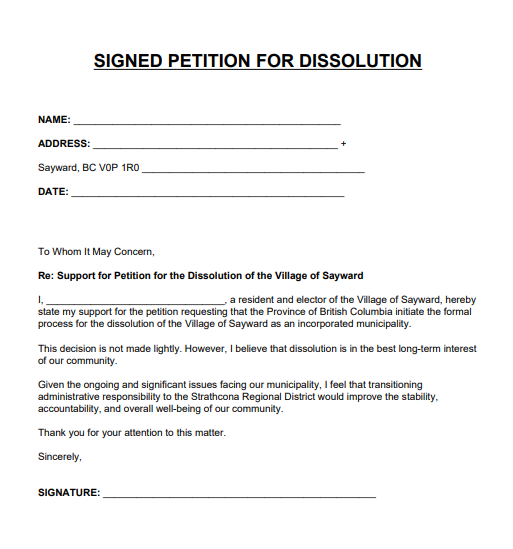
Petition Form

Click on the petition to download a printable copy.

Petition

Village Of Sayward Residents Face 42% Tax Increase With Dysfunctional Council

The Village of Sayward is preparing for a steep 42% increase in property taxes under its draft 2026–2030 financial plan — a dramatic shift for a community of fewer than 400 residents and one that underscores the severity of its financial challenges. The plan is expected to be finalized in April, but the scale of the proposed increase has already sparked concern, debate, and renewed scrutiny of the village’s governance.

At a Feb. 17 committee meeting, village CPA Jeannie Bradburne walked council through the draft budget and laid out the structural issues that have brought Sayward to this point. For years, she explained, the village’s expenditures have consistently exceeded its revenues. Rather than raising taxes or cutting services earlier, the village relied heavily on reserve funds to cover annual shortfalls. Those reserves, once a buffer against financial instability, are now nearly depleted.

With no meaningful surplus left to draw from, Bradburne said the village has reached a legal and practical limit: the only remaining tool to balance the budget is a substantial increase in property taxes. Even after implementing cost-saving measures — including cancelling programs and closing the Kelsey Recreation Centre, a facility that once served as a community hub — the gap between what the village spends and what it brings in remains significant.

The first draft of the budget projected a nearly 50% tax increase, but subsequent adjustments and recalculations brought the figure down to approximately 42%. For the average household, that means an annual increase of about $725, or roughly $60 per month. Sewer and water fees are also slated to rise, while solid waste fees will remain unchanged. Taken together, the total estimated monthly impact for residents is expected to be around $72.

The financial discussion quickly intersected with ongoing political tensions. During the meeting, Councillor Scott Burchett criticized the village’s high legal expenses in 2025, noting that a large portion of those costs stemmed from litigation involving himself and Councillor Sue Poulsen. The village is reportedly considering censure and potential legal action against the two councillors, and has applied to the province to reduce the required council quorum from three members to two — a move intended to ensure council can continue functioning despite persistent conflict and absences.

Sayward’s council has been mired in turmoil since the last municipal election. Two councillors resigned in 2024, citing dysfunction and an inability to work effectively within the current political climate. Their departures left the remaining council members struggling to maintain quorum and make decisions, further complicating efforts to address the village’s financial problems.

At the Feb. 17 meeting, Councillor Debbie Coates urged her colleagues to undertake a detailed, line-by-line review of the budget in search of additional savings. She argued that residents deserve assurance that every possible cost-saving measure has been explored before council approves such a significant tax increase. Village CAO Andrew Young added that declining provincial grants, rising operational costs, and long-term structural challenges have all contributed to Sayward’s precarious fiscal position.

The village’s difficulties have not gone unnoticed by residents. Some, frustrated by both the financial strain and the ongoing governance issues, have launched the Sayward Taxpayers Alliance, and a petition calling for the dissolution of the Village of Sayward and its integration into the Strathcona Regional District. Supporters of the petition argue that joining the regional district could provide a broader tax base, more stable service delivery, and relief from the political turmoil that has plagued the village.

Sayward Taxpayers Alliance Logo

Council is expected to reconvene in March to continue budget deliberations and explore whether the proposed tax increase can be reduced before the financial plan is finalized. For now, Sayward faces a pivotal moment — one that will shape not only its finances but also its future as an independent municipality.

Request For Quotations – Sayward Fire Hall #1 Renovation

The Village of Sayward is seeking quotations from qualified vendors to complete FireSmart renovation work at Firehall #1, located at 620 Kelsey Way, Sayward, British Columbia.

Quotations must be clearly labeled “Firehall #1 – FireSmart Renovations” and submitted to:

Village of Sayward PO Box 29 652‑A H’Kusam Way Sayward, BC V0P 1R0

The submission deadline is 2:00 p.m. Pacific Time on Friday, February 27, 2026.

All pricing must be provided in Canadian dollars, with applicable taxes listed separately. Quoted prices must remain valid for at least 120 days from the closing date.

Vendors are solely responsible for ensuring their quotation is received by the Village of Sayward before the deadline.

Evaluation Criteria Quotations will be assessed based on: a) Ability to meet the timelines and requirements outlined in this RFQ b) Relevant experience and qualifications c) Lowest overall cost to the Village of Sayward

Inquiries All questions regarding this RFQ should be directed to: Shaun Koopman Phone: 250‑830‑6702 Email: skoopman@srd.ca

Any addenda issued for this RFQ will be posted on the Village of Sayward website and the BC Bid website. Verbal communications are not binding unless confirmed through written addenda.

Community Radon Testing Shows Low Risk Across Strathcona Regional District

Results from a regional radon testing initiative in the Strathcona Regional District show that most participating homes recorded low indoor radon levels, a positive finding given the gas’s link to long‑term lung cancer risk. Even so, health officials are encouraging residents to continue testing regularly to ensure their homes remain safe.

During the winter of 2024–2025, the Strathcona Regional District partnered with the national Take Action on Radon campaign through the 100 Radon Test Kit Challenge. Volunteers from communities including Campbell River, Oyster River, Tahsis, and Zeballos placed long‑term test kits in their homes to measure radon concentrations over several months.

Of the 117 homes tested, 96 per cent recorded radon levels below 100 becquerels per cubic metre (Bq/m³), well under Health Canada’s guideline of 200 Bq/m³. A small number of homes showed elevated readings: about 2 per cent fell between 100 and 200 Bq/m³, and roughly 2 per cent exceeded the national guideline, with the highest result measuring around 214 Bq/m³.

Radon is an invisible, odourless radioactive gas produced by the natural decay of uranium in soil and rock. It can seep into buildings through cracks and gaps in foundations, accumulating indoors at levels that pose health risks over time. Health Canada identifies radon as the second leading cause of lung cancer after smoking, and the leading cause among non‑smokers.

While the Strathcona results are reassuring, officials emphasize that radon levels can vary widely from one building to the next — even between neighbouring homes. Soil conditions, weather patterns, and how tightly a home is sealed all influence indoor concentrations. Because of this variability, testing remains the only reliable way for homeowners to understand their exposure.

Local leaders are urging residents to maintain awareness and test their homes every three to five years, or after major renovations that affect a building’s structure or ventilation. Long‑term tests, typically conducted over the winter when homes are sealed and radon levels tend to be higher, provide the most accurate picture of average exposure.

For households that discover elevated levels, effective mitigation options are available. Certified radon professionals can install systems that vent the gas safely outdoors, often reducing concentrations significantly. Although costs vary, experts agree that mitigation can greatly reduce long‑term health risks.

Information on radon testing and how to obtain test kits is available through the Strathcona Regional District and Health Canada, and homeowners can find additional resources online to help protect their families from this often‑overlooked indoor hazard.

Critically Low Snowpack on North Island Sparks Water Worries

Snowpack levels on Vancouver Island are currently the lowest in British Columbia, with conditions on the North Island already raising concerns about water availability for communities such as Sayward and nearby rural areas.

Provincial monitoring shows that high‑elevation snowpack — the natural reservoir that feeds rivers, creeks, and water systems through spring and summer — is well below normal across much of the island. On the North Island, where many communities depend on small, sensitive watersheds rather than large storage reservoirs, a weak snowpack can quickly translate into reduced streamflows once temperatures rise.

According to the B.C. Ministry of Water, Land and Resource Stewardship, several snow‑monitoring stations on Vancouver Island are reporting some of the lowest mid‑winter levels ever recorded. In many locations, snow accumulation is only a fraction of what is typically expected at this point in the season.

Warmer‑than‑average temperatures are a key driver. Precipitation that would normally fall as snow has arrived as rain, especially at mid‑elevations. While rainfall can temporarily boost stream levels, it runs off quickly and lacks the slow, sustained release that snowmelt provides.

For North Island communities like Sayward, this raises early questions about late‑summer water security. Local creeks and rivers that supply drinking water, support fish habitat, and provide recreational opportunities rely heavily on snowmelt to maintain flows through the dry months. Low snowpack increases the likelihood of earlier‑than‑normal low water levels, particularly if spring rainfall is limited.

Reduced flows also pose risks for salmon and other fish species that depend on cool, oxygen‑rich streams. Shallow, slow‑moving water warms more quickly, increasing stress during migration and spawning.

Although winter is not yet over — and late‑season storms could still improve conditions — officials caution that recovering from the current deficit would require sustained cold weather and significant snowfall.