
BC Tax Expansion Faces Growing Opposition as October 1st Deadline Nears

New Leger poll finds two-thirds of British Columbians want planned PST expansion cancelled, while businesses warn of higher costs and a legislative committee calls for repeal

British Columbia’s planned expansion of the provincial sales tax is facing mounting opposition from taxpayers, businesses, industry organizations and a multi-party legislative committee, with the new tax rules scheduled to take effect October 1.

A new Leger poll commissioned by the Canadian Taxpayers Federation (CTF) found that 66 per cent of British Columbians want the provincial government to cancel the expansion, compared with 15 per cent who support proceeding with it. Another 19 per cent were undecided. Among respondents who expressed an opinion, 82 per cent favoured cancelling the changes.

The polling comes less than two months before the expanded tax is scheduled to take effect and shortly after the B.C. legislature’s Select Standing Committee on Finance and Government Services recommended that the government repeal the planned expansion.

Despite the recommendation, Finance Minister Brenda Bailey has said the government intends to proceed.

What is changing October 1?

The B.C. government’s 2026 budget expands the province’s 7 per cent PST to several professional and commercial services that have historically been exempt.

Beginning October 1, PST will generally apply to:

  • Accounting and bookkeeping services
  • Architectural services
  • Engineering and geoscience services
  • Security and private investigation services
  • Non-residential real estate services, including certain property and strata management services

There are special rules for architectural, engineering and geoscience services. Rather than applying the 7 per cent tax to the entire purchase price, PST generally applies to 30 per cent of the value, producing an effective tax rate of 2.1 per cent on those services.

The province is also removing or narrowing some existing exemptions affecting products and services including clothing repair materials, clothing and footwear-related services, basic cable television and landline telephone services.

The government says the changes bring B.C.’s tax treatment more closely into line with other provinces.

Poll shows broad opposition

The Leger survey commissioned by the CTF suggests opposition is not concentrated in one particular political, demographic or geographic group.

According to the CTF, opponents of the expansion form a majority across gender, age and regional categories.

Vancouver Island residents, women and British Columbians aged 55 and older recorded the strongest opposition, according to the organization’s release.

The headline results were:

ResponseBritish Columbians
Cancel the PST expansion66%
Proceed with the expansion15%
Unsure19%

Because the poll was commissioned by the Canadian Taxpayers Federation, the results should be understood as commissioned polling rather than a government survey. Nevertheless, the findings add another data point to a debate that has already generated significant opposition from business organizations.

Businesses have been warning about higher prices

The Canadian Federation of Independent Business conducted its own survey earlier this year involving 439 B.C. business owners.

The February survey found that 80 per cent of respondents opposed expanding the 7 per cent PST to professional services.

Even more significantly, 72 per cent said they were likely to pass some or all of the additional tax costs on to customers.

The CFIB said accounting and bookkeeping services were identified as the professional services most likely to negatively affect small businesses, followed by property management, security and architectural, engineering and geoscience services.

The implication is straightforward: while the tax may technically be charged to a business purchasing a service, the eventual economic cost can be distributed through the broader economy.

A business paying PST on accounting, security, engineering or property-management services may incorporate those additional expenses into its operating costs, potentially affecting prices charged to customers.

Security services become taxable

The inclusion of security services has generated particular criticism from businesses in communities dealing with property crime.

The Business Improvement Areas of B.C. has argued that the expansion effectively taxes businesses for purchasing security services they increasingly consider necessary to protect employees, customers and property.

In Kelowna, local business representatives told Global News that businesses were already spending heavily on security because of repeated property crime and other safety concerns.

That creates an unusual policy tension: governments and communities encourage businesses to invest in security, while the provincial tax system is simultaneously adding a 7 per cent tax to many of those services.

The issue has become one of the central arguments made by opponents of the expansion.

Business groups launch “Stop the Squeeze” campaign

The Greater Vancouver Board of Trade has organized a campaign called Stop the Squeeze, arguing that the tax expansion will increase the cost of doing business at a time when B.C. companies are already facing high operating costs.

The organization says the expanded PST could affect the cost of building homes, operating businesses, maintaining security and attracting investment.

The campaign has attracted support from a wider coalition of business organizations.

The Business Council of British Columbia has also called for the expansion to be scrapped, arguing that the tax increases input costs and could weaken B.C.’s competitive position.

The B.C. Chamber of Commerce has taken a similar position, while advocating for a longer-term move toward a value-added tax system rather than expanding the existing PST.

Why businesses object to the PST structure

One of the more technical arguments against the expansion involves the way B.C.’s PST works.

Unlike a value-added tax such as the GST/HST, the PST generally does not provide businesses with broad input-tax credits.

That means taxes paid on business inputs can become part of the cost of producing another good or service.

The Business Council of B.C. argues this can cause taxation to compound through supply chains and contribute to higher effective costs for investment.

The B.C. Chamber has made a similar argument, saying the province should consider moving toward a value-added tax with input tax credits rather than expanding the current PST.

The distinction is important because opponents aren’t necessarily arguing that sales taxes should never apply to professional services.

Some are instead arguing that the structure of the tax is the problem.

Accountants warn of implementation complications

The accounting profession has also raised concerns about how the new rules will work.

The Chartered Professional Accountants of British Columbia says the final regulations released in July provided additional clarity regarding issues such as multi-jurisdictional work, corporate-group services and resale arrangements.

Under the new rules, accounting services performed in B.C. will generally become subject to the 7 per cent PST unless a specific exemption applies.

CPABC has advocated for longer-term sales-tax modernization, including consideration of a value-added tax model with general input tax credits.

That position is significant because it demonstrates that opposition to the government’s approach extends beyond organizations that simply oppose taxation.

Some professional organizations are instead arguing for a different tax structure that they believe would be less distortive.

Housing industry joins the opposition

The B.C. real estate industry has also warned that expanding the PST could work against the province’s housing objectives.

The British Columbia Real Estate Association recommended that the province not proceed with the PST expansion, arguing that taxation policy can affect the financial viability of development projects and ultimately the pace at which new housing reaches the market.

This adds another dimension to the debate.

The province is simultaneously attempting to increase housing supply while imposing additional taxes on some of the professional services involved in developing and managing that housing.

Architects, engineers, property managers and other professionals can all play a role in construction and development projects.

Critics argue that additional taxes on those inputs could ultimately become another cost incorporated into development budgets.

Legislative committee calls for repeal

Perhaps the most politically significant development came from the B.C. legislature’s Select Standing Committee on Finance and Government Services.

Following its 2027 budget consultation, the multi-party committee recommended that the provincial government repeal the planned PST expansion to professional services.

The committee’s recommendation was framed partly around simplifying and streamlining the province’s taxation system.

The committee includes MLAs from government and opposition parties, making the recommendation notable even though it does not itself force the government to change policy.

The recommendation was welcomed by organizations including the CFIB and Greater Vancouver Board of Trade.

Ottawa isn’t responsible for this tax

The debate is entirely provincial.

The PST is administered by the Government of British Columbia, not Ottawa.

The upcoming changes were included in B.C.’s 2026 budget and are being implemented through provincial tax legislation and regulations.

That distinction matters because the argument over the expansion is ultimately about how the B.C. government chooses to raise revenue and structure its tax system.

The government’s case

The B.C. government has defended the expansion as part of its broader approach to taxation and public services.

The province says expanding PST to professional services generally brings B.C. more closely into line with how other provinces treat those services.

The government is also dealing with a significant fiscal challenge.

B.C.’s 2026 budget projected a $13.3-billion deficit for 2026-27, while the new tax measures are expected to generate approximately $1.4 billion over three years, according to government figures reported in connection with the budget.

The government’s argument is that additional revenue is necessary to help maintain core public services, including health care and education.

Finance Minister Brenda Bailey has indicated that the government is not planning to reverse the expansion, despite the legislative committee’s recommendation.

That puts the government directly at odds with both the committee recommendation and several major business organizations.

A $1.5-billion tax question

The CTF estimates that the PST expansion will cost British Columbians nearly $1.5 billion over three years, while government budget reporting has put the expected revenue at approximately $1.4 billion over the same period.

The difference illustrates one of the fundamental disagreements in the debate.

The province views the expansion primarily as a source of revenue.

Opponents view it as a cost that will be absorbed by businesses, consumers and the broader economy.

Both can occur simultaneously: government can collect additional revenue while businesses and households bear additional costs.

The economic question is therefore what happens to that money after it moves through the tax system—and whether the resulting public-service benefits outweigh the economic costs associated with higher prices and business inputs.

October 1 deadline approaches

With the implementation date now less than a month away, businesses providing or purchasing affected services are preparing for the changes.

The province has released detailed guidance covering accounting, architectural, engineering and geoscience, security and non-residential real estate services.

Businesses affected by the changes may need to determine whether they must register for PST, collect the tax, remit it to the province or self-assess tax on certain purchases.

That makes the issue more than a political debate.

For affected businesses, the October 1 date represents a concrete change to invoices, accounting systems and operating costs.

The larger issue: how should B.C. tax business?

The disagreement over the PST expansion ultimately goes beyond the individual services being taxed.

It raises a broader question about how British Columbia should structure its tax system while attempting to improve productivity, increase housing supply, attract investment and maintain public services.

The CTF says the answer is to cancel the expansion.

Business groups have called for its repeal and, in some cases, a longer-term transition toward a value-added tax.

The B.C. government argues the expansion broadens the tax base and provides revenue for essential public services.

Meanwhile, the province’s own multi-party finance committee has recommended that the expansion be repealed.

And according to the new Leger poll commissioned by the CTF, 66 per cent of British Columbians surveyed want the government to cancel the changes, compared with 15 per cent who want them to proceed.

Unless the government changes course, however, the new rules remain scheduled to take effect October 1, 2026.

For British Columbians, the debate is now moving from whether the tax expansion is a good idea to a much more immediate question:

Will the province proceed with a tax increase that its own legislative finance committee has recommended cancelling, despite growing opposition from taxpayers and the business community?

Ottawa Extends Federal Fuel Tax Relief Into 2027

Canadian Taxpayers Federation welcomes extension but calls on the government to make the fuel-tax cut permanent

The federal government is extending its temporary suspension of the federal fuel excise tax on gasoline and diesel, keeping the full tax reduction in place through January 31, 2027.

The announcement comes as the government had been scheduled to restore the federal fuel excise tax on September 8. Under the extension, gasoline and diesel will continue to benefit from the temporary tax relief through January, followed by a phased return to the regular rates beginning in February.

The Canadian Taxpayers Federation (CTF) welcomed the extension but said Ottawa should go further and make the reduction permanent.

Gasoline tax remains at zero

The federal excise tax on gasoline is normally 10 cents per litre, while the federal excise tax on diesel is normally 4 cents per litre.

Those rates were reduced to zero beginning April 20, 2026, as part of the government’s response to elevated fuel prices and international energy-market disruptions.

The temporary suspension was originally scheduled to end September 7, with the full tax returning the following day.

The new proposal extends the zero-rate period through January 31, 2027. Beginning February 1, the government plans to restore half of the regular federal excise tax until March 31.

That means the federal rates would temporarily become:

  • 5 cents per litre on gasoline
  • 5.5 cents per litre on leaded aviation gasoline
  • 2 cents per litre on diesel
  • 2 cents per litre on other aviation fuel

The full rates are scheduled to return April 1, 2027.

Taxpayers federation calls for permanent cut

The Canadian Taxpayers Federation praised the extension, arguing that lower fuel taxes can benefit both drivers and businesses.

Franco Terrazzano, the organization’s federal director, said the CTF had been advocating for fuel-tax relief and that extending the measure would provide additional assistance to Canadians facing higher costs.

The organization is now calling on Prime Minister Mark Carney’s government to make the reduction permanent rather than allowing the tax to return to its previous level.

Kris Sims, the CTF’s Alberta director, similarly argued that Ottawa should reduce government spending to make permanent tax relief possible without increasing government debt.

Poll finds opposition to restoring the tax

The CTF said a Léger poll it commissioned found significant opposition to restoring the federal fuel tax at its previous level.

According to the organization, 63 per cent of Canadians surveyed opposed increasing the gas tax in September. Among respondents who had made a decision on the question, the opposition rate was 71 per cent.

The CTF said opposition was recorded across demographic groups, including different age groups, genders and provinces.

The poll was commissioned by the CTF, meaning its results should be considered in that context rather than as a government survey.

Ottawa says the measure is temporary

The federal government has presented the fuel-tax suspension as a temporary affordability measure.

When the original reduction was announced in April, Finance Canada said eliminating the federal excise tax would save motorists up to 10 cents per litre on gasoline and 4 cents per litre on diesel. The government estimated the initial suspension would provide more than $2.4 billion in tax relief during 2026.

The measure applies to the federal excise tax. It does not eliminate provincial fuel taxes or other charges that can affect the price motorists see at the pump.

The government also continues to apply sales taxes to fuel.

Different from the former carbon price

The fuel-tax suspension should also be distinguished from the federal consumer carbon price.

Ottawa permanently removed the federal consumer fuel charge from legislation earlier this year. That measure eliminated the federal consumer-facing carbon price, while the current gasoline and diesel excise-tax suspension is a separate measure.

The distinction matters because the two taxes have different purposes and operate through different parts of Canada’s tax system.

What happens next?

The government’s September 2026 legislative proposal would keep federal fuel excise taxes at zero through January and then restore them gradually.

The proposed timeline is:

April 20, 2026 – January 31, 2027:
Federal gasoline and diesel excise taxes remain at zero.

February 1 – March 31, 2027:
Half the normal excise-tax rates apply.

April 1, 2027:
Regular federal excise-tax rates are scheduled to return.

The Department of Finance’s legislation confirms that the extension is designed around this staged return.

For motorists, the immediate result is that the federal portion of fuel taxation will remain suspended beyond the original September deadline.

For the Canadian Taxpayers Federation, however, the extension doesn’t go far enough.

The organization argues that if Ottawa can temporarily eliminate the tax while maintaining government operations, it should look for permanent spending reductions that would allow Canadians to keep the tax savings.

The federal government, meanwhile, continues to characterize the measure as temporary relief.

The debate has therefore shifted from whether Canadians should receive a fuel-tax break to whether the reduction should become a permanent part of Canada’s tax system.

Sources: Canadian Taxpayers Federation and Department of Finance Canada. The CTF’s statements and polling claims are attributed to the organization, while the tax rates and implementation timeline have been cross-checked against the federal government’s legislative proposal.

Canada Imposes Temporary Duties on Chinese Plywood After Dumping Investigation

CBSA finds preliminary evidence of dumping and subsidization as Canadian producers report lost sales and declining market share

Canada has imposed provisional duties of up to 227.5 per cent on certain plywood imported from China after the Canada Border Services Agency (CBSA) made preliminary determinations that the products were being dumped and subsidized.

The measures took effect August 24 and apply to decorative and other non-structural plywood originating in or exported from China. The investigation remains ongoing, meaning the preliminary findings are not yet final.

The case began after Columbia Forest Products, along with the Canadian Hardwood Plywood and Veneer Association, filed a complaint with the CBSA in February alleging that increasing Chinese imports were being sold at unfair prices and were harming Canadian producers.

Two other Canadian manufacturers, Husky Plywood and Rockshield Engineered Woods Products, also supported the complaint.

Chinese imports gained ground in Canada

CBSA data indicates that China accounted for an increasing share of Canada’s decorative plywood imports between 2023 and 2025.

Chinese products represented approximately:

  • 63.4 per cent of Canadian decorative plywood import value in 2023
  • 61.4 per cent in 2024
  • 67.5 per cent in 2025

Over the same period, the domestic industry’s share of the apparent Canadian market fell from 42.7 per cent to 37.3 per cent.

China’s share of the overall Canadian market increased from 36.3 per cent in 2023 to 42.4 per cent in 2025, according to CBSA estimates.

The figures are based on import value rather than physical volume, because the agency encountered inconsistencies in how imported plywood quantities were reported.

What is “dumping”?

Under Canada’s trade-remedy system, dumping generally occurs when a product is exported to Canada at a price below its applicable normal value.

Canadian producers alleged that Chinese plywood was being sold below fair market value while manufacturers also benefited from government subsidies.

The CBSA’s investigation found sufficient evidence to proceed with both dumping and subsidy investigations. The agency also said there was reasonable evidence that government influence could be affecting prices in China’s engineered-wood sector.

The CBSA estimated an overall dumping margin of 33.8 per cent during its investigation period.

Duties vary dramatically by exporter

The provisional duties are not the same for every Chinese exporter.

For example, CBSA’s preliminary determinations established provisional rates including:

ExporterProvisional duty
Dehua TB New Decoration Material43.3%
Feixian Jianhao Wood Factory172.1%
LinYi QianFeng Wood Factory82.8%
Shandong Baozhu International Trading173.6%
Suzhou Dongsheng Wood24.7%
Xuzhou Meibang Wood12.6%
All other exporters227.5%

The rates combine applicable anti-dumping and countervailing duties. Some exporters had subsidy amounts below Canada’s threshold for imposing a provisional countervailing duty.

The 227.5 per cent figure therefore does not apply automatically to every Chinese plywood shipment. It applies to subject goods from exporters that have not received a specific provisional rate.

Canadian producers cite lost sales and jobs

The domestic producers told the CBSA that increasing Chinese imports were contributing to lost sales and market share.

The complaint included examples of sales lost to Chinese products, along with allegations of price undercutting, price depression and price suppression.

The producers also reported negative effects on financial performance, production levels, capacity utilization and employment.

After reviewing information supplied by the producers and its own customs data, the CBSA concluded there was a reasonable indication that the allegedly dumped and subsidized imports had caused injury to Canada’s domestic decorative plywood industry.

The Canadian International Trade Tribunal reached a similar preliminary conclusion in June, determining that there was a reasonable indication that dumping and subsidization had caused or threatened to cause injury to the domestic industry.

What products are affected?

The investigation covers decorative and other non-structural plywood, including certain multilayered plywood and veneered panels.

These products can be used in applications such as cabinetry, furniture and interior finishing.

The measures do not cover every type of plywood. CBSA specifically excludes certain structural plywood, finished plywood flooring products, specially shaped panels and several other products from the scope of the investigation.

Final decision still months away

The current duties are provisional rather than permanent.

The CBSA is scheduled to issue its final determinations on dumping and subsidization on November 23, 2026.

The Canadian International Trade Tribunal is conducting the separate final injury inquiry. Its current schedule calls for a finding on December 22, 2026, followed by reasons in January 2027.

If the Tribunal ultimately finds that the dumped or subsidized imports caused injury to Canadian producers, permanent anti-dumping and countervailing measures could follow.

If the required injury finding is not made, the proceedings would end and provisional duties could be refunded in accordance with Canada’s trade-remedy rules.

A broader trade issue

The plywood investigation comes as Canada is increasingly using its trade-remedy system to respond to concerns over heavily subsidized or low-priced imports from China.

For Canadian plywood manufacturers, the issue is particularly significant because the domestic industry’s share of the apparent market has declined while Chinese imports have expanded.

For importers and buyers, however, the immediate impact is the possibility of substantially higher costs on affected products as the federal investigation proceeds.

For now, the key distinction is that Canada has made preliminary findings of dumping and subsidization—not a final determination. The ultimate outcome will depend on the CBSA’s final investigation and the Tribunal’s determination of whether the imports caused injury to Canadian producers.

Sources: Canada Border Services Agency and Canadian International Trade Tribunal. 

Federal Report Questions Financial Case for Rooftop Solar in Canada

Natural Resources Canada memo estimates residential solar systems can take 10 to 30 years to recover their costs, depending on location and circumstances

A federal Natural Resources Canada memo is raising questions about the financial case for residential rooftop solar in much of the country, estimating that homeowners may need between 10 and 30 years to recover the cost of a solar installation.

The May 20 memorandum, prepared for Natural Resources Minister Tim Hodgson and obtained by Blacklock’s Reporter, concludes that the economic case for widespread residential rooftop photovoltaic systems remains limited in most Canadian jurisdictions compared with some international markets.

According to the document, residential systems can cost between approximately $10,000 and $45,000, including associated debt-servicing costs. The length of time required to recover that investment varies depending on electricity prices, installation costs, solar production and other local factors.

Economics vary across Canada

Natural Resources Canada attributes part of the challenge to the economics of the Canadian electricity market.

The department notes that residential solar can be less financially competitive in Canada than in countries such as Australia, where electricity prices are generally higher. Canadian homeowners also face comparatively high installation labour costs, according to the memorandum.

That combination can make the electricity generated by a rooftop system worth less relative to the cost of installing it.

The memo therefore characterizes rooftop solar as an option that is more accessible to homeowners who have the financial capacity to absorb significant upfront costs or take on financing.

Federal incentives helped, but adoption remained limited

Government subsidies can improve the economics of rooftop solar by reducing the homeowner’s initial investment.

The former Canada Greener Homes Grant provided up to $5,000 for eligible home improvements. The program is now closed to new applicants, with applications having ended in February 2024 and final documentation due by the end of 2025.

Natural Resources Canada’s latest program figures show that 38,500 households received grants for solar panels through the initiative. That put solar behind heat pumps, windows and doors, insulation and air sealing among the program’s most common retrofit categories.

The federal memo cited the relatively limited participation as part of the broader challenge facing residential solar.

Solar can provide benefits beyond the homeowner

The department’s assessment does not argue that rooftop solar has no value.

Officials noted that distributed generation could potentially reduce pressure on large-scale electricity infrastructure by producing power closer to where it is consumed.

However, the memorandum also cautioned that determining the value of those broader system benefits is highly dependent on local circumstances and is difficult to apply consistently across the country.

That distinction is important because the financial return experienced by an individual homeowner is not necessarily the same as the broader economic value of distributed electricity generation.

A history of subsidizing renewable energy

The rooftop-solar assessment also echoes conclusions from an earlier federal evaluation of the Renewable Energy Deployment Program.

A 2021 Natural Resources Canada evaluation examined the $1.5-billion program, which provided financial support for renewable-energy projects including wind, solar and geothermal generation.

The evaluation found that the supported projects generally would not have been profitable without the program’s funding. The program provided producers with a direct subsidy of one cent per kilowatt-hour of electricity generated.

The comparison illustrates a recurring issue in renewable-energy policy: projects can deliver environmental or energy-system benefits while still requiring financial support to make their economics attractive to investors or consumers.

The 30-year question

A 30-year payback period is particularly significant for homeowners considering solar as a financial investment.

A system that takes decades to recover its initial cost leaves homeowners exposed to changes in electricity prices, financing costs, equipment performance and maintenance requirements over the life of the installation.

That does not necessarily mean rooftop solar is uneconomic everywhere. The federal assessment itself points to substantial differences between jurisdictions, and the economics can change considerably depending on local electricity rates, solar conditions, installation costs and available incentives.

For some households, those factors can produce a substantially shorter payback period.

The central finding of the federal memorandum is narrower: Canada’s current economic conditions do not make widespread residential rooftop solar financially compelling in most jurisdictions without considering additional benefits or government support.

Solar remains part of Canada’s energy transition

Despite the financial concerns outlined in the memorandum, rooftop solar continues to be part of Canada’s broader effort to expand renewable electricity.

Natural Resources Canada’s final Greener Homes figures show that tens of thousands of Canadian households chose solar through the federal program, while provincial utilities continue to develop their own incentives.

For example, Hydro-Québec introduced a 2026 solar grant providing up to $1,000 per kilowatt installed and covering as much as 40 per cent of eligible costs. The utility said the incentive was intended to reduce current solar payback periods of roughly 25 to 30 years to approximately 10 to 12 years for eligible customers.

The result is a complicated picture for Canadian homeowners: solar technology is becoming increasingly common, but whether installing it makes financial sense remains highly dependent on where a homeowner lives, how much electricity they use, what the installation costs and what incentives are available.

For many Canadians, the question may therefore be less about whether rooftop solar works—and more about whether the numbers work for their particular home.

Source: Natural Resources Canada memorandum. The payback estimates are federal departmental assessments, not guarantees applicable to every household. The Canada Greener Homes figures are independently confirmed by Natural Resources Canada.

Canada’s Economic Gap With the United States Has More Than Doubled

New Fraser Institute study finds Canada has fallen behind the United States on living standards, incomes, investment, employment and productivity since the beginning of the century

VANCOUVER — Canadians are increasingly falling behind their American counterparts on some of the economic measures that most directly affect household prosperity, according to a new study examining the economic performance of Canada and the United States over the first quarter of the 21st century.

The report, “Squandering the Canadian Century: Part 1 — Comparing Economic Performance in Canada and the United States,” was published by the Fraser Institute on September 1.

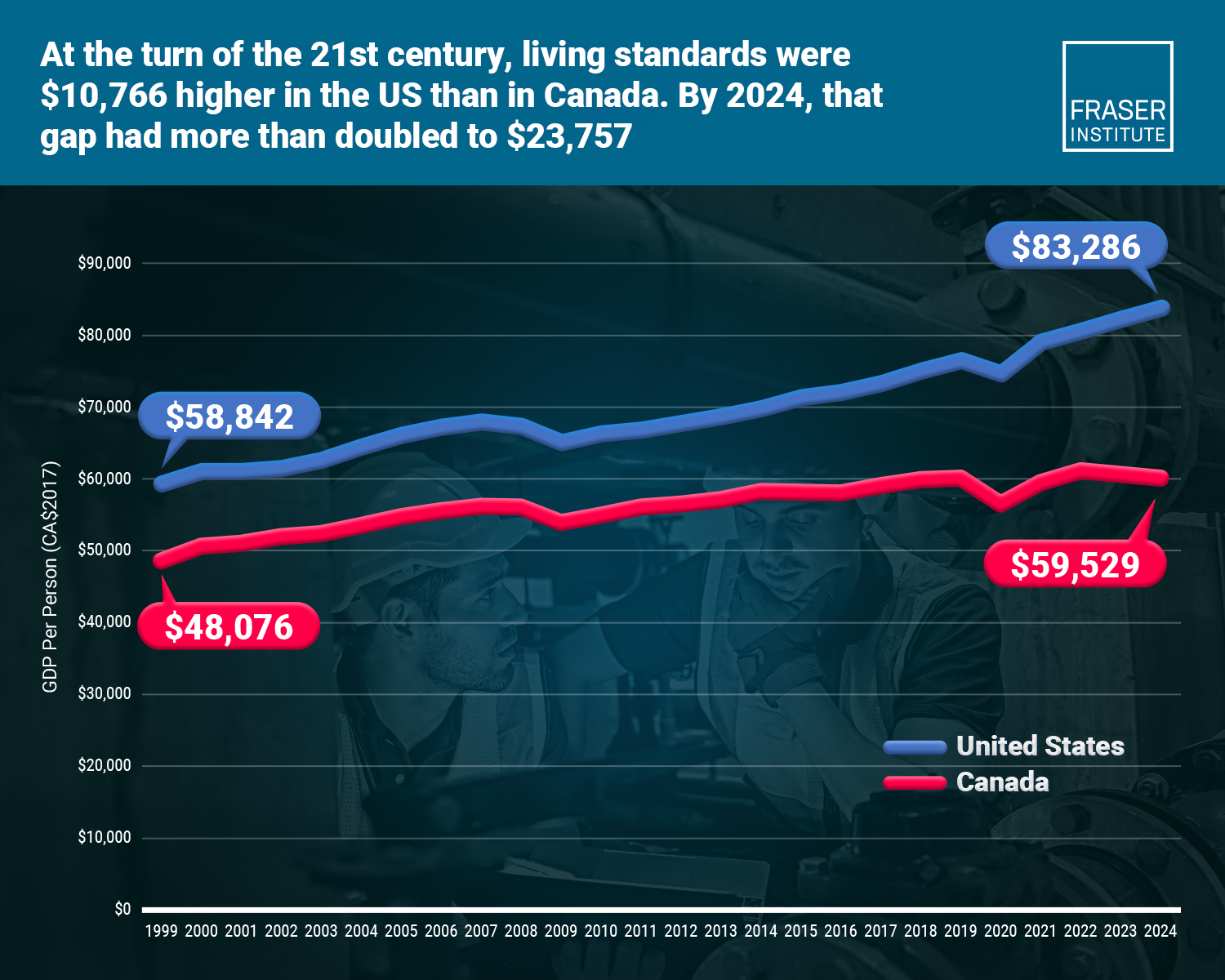
Its central finding is stark: the gap in inflation-adjusted GDP per person between the two countries has more than doubled since 1999.

In 1999, GDP per person in the United States was approximately C$10,766 higher than in Canada.

By 2024, the difference had grown to C$23,757.

The authors — Fraser Institute senior economist Joel Emes, senior policy analyst Grady Munro and director of fiscal studies Jake Fuss — argue that the deterioration cannot be explained by a single economic indicator.

Instead, Canada has fallen further behind across five broad areas examined by the study: living standards, employment income, employment, business investment and labour productivity.

The numbers behind the growing gap

The difference becomes particularly apparent when looking at inflation-adjusted GDP per person.

In 1999, Canada’s figure was approximately C$48,076, compared with C$58,842 in the United States.

By 2024, Canada’s figure had risen to C$59,529.

The American figure, meanwhile, had climbed to C$83,286.

That left the United States with an advantage of nearly C$24,000 per person.

The significance of the comparison is not that Americans necessarily have an additional $24,000 sitting in their bank accounts.

GDP per person is an economic measure rather than a direct measure of household income.

But the widening difference does provide an indication of how much more economic output is being generated per person in the United States — and, over time, that divergence can translate into differences in wages, investment, employment opportunities and government revenues.

For Canadians already dealing with high housing costs, taxes and other household expenses, the direction of the trend is particularly important.

The income gap is widening too

The difference isn’t confined to national economic output.

The study also examines inflation-adjusted median employment income.

In 2010, the earliest year for which the researchers say comparable data were available, median employment income in the United States was approximately C$6,126 higher than in Canada.

By 2024, that difference had increased to C$8,663.

That represents a growing gap in the amount of income earned by the typical worker.

For individual Canadians, that distinction can be much more tangible than GDP statistics.

Higher employment income can mean greater ability to save, invest, purchase housing, support a family or absorb rising living costs.

Canada’s private sector is shrinking as a share of employment

Another difference identified by the study involves the composition of employment.

Between 1999 and 2024, the share of Canadian employment accounted for by the private sector declined from 81.2 per cent to 78.5 per cent.

The authors say this reflects government-sector employment growing faster than private-sector employment.

The United States moved in the opposite direction.

Its private-sector share of employment increased from 85.8 per cent to 86.5 per cent over the same period.

The figures don’t mean that government employment itself is inherently bad or that every public-sector job comes at the expense of a private-sector job.

Rather, the researchers use the trend as one indicator of the different directions taken by the two economies.

A growing private sector can provide a broader base of businesses investing, producing goods and services and competing for workers.

Investment may be the bigger warning sign

Perhaps the most consequential finding concerns business investment.

Investment is important because businesses need machinery, technology, buildings, equipment and other capital to increase production and improve efficiency.

According to the Fraser Institute study, Canada’s business investment per worker has deteriorated significantly relative to the United States.

In 2007, Canadian investment per worker was equivalent to nearly 90 cents for every dollar invested per worker in the United States.

By 2024, that had fallen to just 54 cents.

In other words, for every dollar being invested per American worker, Canadian businesses were investing only about 54 cents.

That matters because today’s investment becomes tomorrow’s productive capacity.

A company that buys better equipment, adopts new technology or expands its facilities can potentially produce more with the same number of workers.

When investment remains weak for years, productivity growth can suffer.

And that’s precisely what the study says has happened.

Canada’s productivity problem

Labour productivity is one of the most important measures in the report.

The study finds that between 1999 and 2025, labour productivity increased by:

Canada: 26.7 per cent

United States: 67.9 per cent

The American increase was therefore more than twice Canada’s.

Productivity essentially measures how much economic output is produced from a given amount of labour.

It doesn’t mean Canadian workers are working less hard than American workers.

Rather, productivity is heavily influenced by the tools, technology, infrastructure, capital and processes available to workers.

A worker equipped with modern machinery and technology can potentially produce considerably more than a worker performing the same task with outdated equipment.

The Fraser Institute argues that Canada’s weak productivity growth is therefore closely connected to its weak investment performance.

Jake Fuss, one of the study’s authors, said the ability to transform inputs into goods and services increased by more than twice as much in the United States as in Canada over the period examined.

The turning point came after 2014

One of the more interesting aspects of the report is that the authors don’t argue Canada was always falling behind.

Instead, they identify 2014 as an important turning point.

According to the study, Canada generally kept pace with the United States — and in some cases exceeded it — across several economic measures before 2014.

The divergence became considerably more pronounced afterward.

The timing is significant.

In 2014, global oil prices began a dramatic decline, creating a major shock for Canada’s energy-producing provinces and reducing investment in Canada’s resource sector.

But the Fraser Institute’s argument is that the oil-price collapse alone does not explain Canada’s subsequent performance.

The broader problem, according to the researchers, is that Canada has struggled to create an economic environment capable of attracting sufficient investment and generating stronger productivity growth.

That interpretation is likely to generate debate.

What does this mean for British Columbia?

While the study compares Canada as a whole with the United States, its implications extend to British Columbia and Vancouver Island.

B.C.’s economy is heavily connected to the United States through trade, investment and tourism.

The province also faces many of the same issues identified in the report, including housing affordability, infrastructure requirements, labour shortages and questions about business investment.

For communities such as those on northern Vancouver Island, productivity and investment aren’t abstract concepts.

They can affect whether companies expand, whether new businesses open, whether major projects proceed and whether younger workers can find well-paying employment without leaving the region.

A national productivity problem can therefore eventually become a local economic-development problem.

Why the comparison matters

Canada and the United States are unusually useful countries to compare.

They share a continent, extensive trade relationships, similar legal and financial institutions and highly integrated economies.

Yet their economic performance has increasingly diverged.

The Fraser Institute study argues that the comparison should force Canadians to look beyond headline employment numbers and ask a more fundamental question:

Is the Canadian economy creating enough wealth and productive capacity to support rising living standards?

The report’s answer is no.

At least, not at the rate necessary to keep pace with the United States.

The policy debate

The Fraser Institute’s conclusions are likely to be controversial.

The organization is a free-market public-policy think tank and has long advocated policies emphasizing lower taxes, reduced regulatory barriers, greater competition and increased private investment.

Its researchers argue that Canada needs significant economic reforms to reverse the trend.

But the underlying economic measurements themselves extend beyond the Fraser Institute’s policy preferences.

The GDP, income, employment, investment and productivity figures are the basis for the report’s comparison, while the interpretation of why Canada has underperformed — and what governments should do about it — is where political and economic debate begins.

That distinction is worth keeping in mind.

The numbers tell one story.

The causes and solutions are more complicated.

A quarter-century of missed opportunity?

When the 21st century began, there was optimism that Canada could emerge as an increasingly prosperous economic power.

A quarter-century later, the Fraser Institute argues that the country has instead watched its economic position deteriorate relative to its largest neighbour.

The report’s title — “Squandering the Canadian Century” — deliberately frames the issue as a missed opportunity.

The authors argue that the first quarter of the century has already been lost and that policymakers now need to focus on reversing the trend rather than accepting slower growth as inevitable.

“After squandering the first quarter of the 21st century,” Munro said, policymakers need to enact reforms that can make the most of the remainder of the century.

Whether Canadians agree with the Fraser Institute’s diagnosis or its proposed solutions, the underlying comparison presents a difficult question for the country.

In 1999, Canada and the United States were already different economies, but the gap in GDP per person was relatively modest.

Twenty-five years later, the difference has more than doubled.

Canadian employment incomes have fallen further behind.

Business investment has weakened relative to the United States.

And American productivity has grown more than twice as quickly.

For Canadians, the most important question may therefore be less about how the country performed over the past 25 years and more about what happens next.

If the first quarter of the Canadian century was a missed opportunity, can Canada change course before the next quarter passes?

Source: Fraser Institute, Squandering the Canadian Century Part 1: Comparing Economic Performance in Canada and the United States, by Grady Munro, Jake Fuss and Joel Emes. The Fraser Institute’s original page was not directly accessible during research, so the article’s figures and findings were cross-checked against the Institute’s September 1 news release and multiple reproductions of the study summary.

Fraser Institute — Squandering the Canadian Century, Part 1

Squandering cdn century pt1 comparing econ performance canada and us infographic

Ottawa Defends Federal Prison Gender Policy as Constitutional Challenge Moves Forward

Government acknowledges sexual-assault charges and other complaints involving transgender inmates in women’s institutions while maintaining that its placement policy does not violate the rights of female prisoners

OTTAWA, ON — The federal government is defending its policy governing the placement of transgender inmates in federal correctional institutions, even as court documents acknowledge sexual-assault charges and other complaints involving transgender inmates housed in women’s facilities.

The issue is now before the Federal Court as part of a constitutional challenge brought by Canadian Women’s Sex-Based Rights (CAWSBAR).

The Justice Centre for Constitutional Freedoms, which is funding lawyers representing CAWSBAR, announced this week that the federal government has filed its Statement of Defence in the case. The government is asking the court to dismiss the challenge.

At the centre of the dispute is Correctional Service Canada’s Commissioner’s Directive 100, which establishes the federal government’s approach to gender-diverse offenders.

Under the policy, an inmate can request placement in a men’s or women’s institution according to their gender identity or expression. Requests involving a move between institution types are assessed individually and include consideration of security classification, risks and potential health and safety concerns.

The government maintains that the system provides appropriate safeguards.

CAWSBAR argues that it does not.

What the government acknowledges

The federal Statement of Defence contains details about several incidents that have become central to the case.

According to the JCCF’s summary of the government’s court filing, an inmate identified in the documents as S/M was charged with one count of sexual assault and one count of criminal harassment in May 2020 following a complaint by a female inmate.

A second inmate, identified as KF/R, was charged with two counts of sexual assault after a complaint by a female inmate in October 2024.

The government’s Defence also acknowledges other complaints involving transgender inmates in women’s institutions.

Those include a 2018 complaint that resulted in a police investigation but no charges, a 2021 complaint alleging sexual and physical assault at Fraser Valley Institution, and a 2019 report of sexual assault at Okimaw Ohci Healing Lodge.

It is important to distinguish between complaints, charges and convictions. The existence of a criminal charge does not establish guilt, and allegations that did not result in charges have not been proven in court.

The federal government’s position is also clear: it denies that the alleged harms were caused by the implementation of Directive 100.

Ottawa says safety remains a consideration

Correctional Service Canada says its policy is intended to balance the rights, dignity and safety of gender-diverse offenders with the safety of other inmates and staff.

The government’s published policy says offenders requesting placement in an institution that does not correspond with their sex can be placed according to their gender identity or expression unless there are overriding health or safety concerns that cannot be resolved.

Transfer decisions are not supposed to be automatic.

According to Directive 100, each request requires an assessment that considers security classification, risks, health and safety concerns and possible mitigation measures.

CSC has also told Parliament that safety is a priority and that a placement or transfer request can be denied where overriding health or safety concerns cannot be effectively mitigated.

How many inmates are involved?

The number of transgender inmates involved in the federal correctional system is relatively small compared with the overall inmate population.

CSC reported that gender-diverse individuals represented 0.83 per cent of its offender population at the end of fiscal year 2024–25.

Between 2017–18 and 2024–25, CSC received 129 requests from 57 people assigned male at birth seeking placement or transfer to a women’s institution.

Of those requests:

  • 35 were approved
  • 72 were denied
  • 22 were withdrawn

As of October 2025, CSC reported that there were 90 self-identified transgender women in federal correctional institutions. Seventy-three were housed in men’s institutions and 17 were housed in women’s institutions.

Those figures provide important context to the debate.

The policy does not mean that every transgender inmate who requests placement in a women’s institution is transferred there.

The policy dates back to changes following Bill C-16

The current policy framework developed following Parliament’s 2017 passage of Bill C-16, which added gender identity and gender expression to the prohibited grounds of discrimination under the Canadian Human Rights Act and made corresponding changes to the Corrections and Conditional Release Act.

Correctional Service Canada subsequently developed policies governing gender-diverse offenders.

The current Commissioner’s Directive 100 took effect on May 9, 2022.

Under the directive, placement decisions are based on a combination of the offender’s expressed gender identity or expression and an individualized assessment of security and safety considerations.

A constitutional challenge

CAWSBAR launched its Federal Court challenge in April 2025.

The organization argues that housing transgender inmates who are biologically male in women’s federal prisons can expose female inmates to physical and psychological harm and violates their rights under the Canadian Charter of Rights and Freedoms.

Among the provisions cited in the lawsuit are sections 7, 12 and 15, dealing with life, liberty and security of the person, protection from cruel and unusual treatment, and equality rights.

The federal government attempted to have the case struck before it proceeded to a full hearing.

That effort failed.

In May 2026, the Federal Court rejected the government’s motion to strike the lawsuit and granted CAWSBAR public-interest standing, allowing the organization to pursue the constitutional challenge on behalf of federally incarcerated women.

The court did not rule that CAWSBAR’s allegations were proven.

Rather, the ruling allowed the constitutional arguments to proceed for consideration on their merits.

Why public-interest standing matters

The court’s decision on standing is significant because individual federal inmates can face practical barriers to bringing constitutional litigation themselves.

CAWSBAR argued that incarcerated women could be reluctant to challenge the policy because of concerns about their treatment within the correctional system or possible consequences for their incarceration and parole.

The Federal Court concluded that CAWSBAR could pursue the case as a public-interest litigant.

That means the court will now have an opportunity to examine the underlying constitutional questions rather than ending the case at an early procedural stage.

Ottawa’s position

The federal government disputes the central premise of CAWSBAR’s lawsuit.

According to the JCCF’s account of the Statement of Defence, Ottawa denies that the alleged harm to female inmates resulted from Directive 100.

The government maintains that its individualized assessment process and safeguards provide an appropriate framework for managing the risks associated with gender-diverse offenders.

That distinction will likely be important as the case develops.

The court is not simply being asked whether incidents have occurred.

It will ultimately have to consider whether the government’s policy itself violates constitutional rights and, if so, whether the government’s approach can be legally justified.

A debate that reaches beyond prisons

The case touches on a much broader Canadian debate over how governments should balance sex-based protections, gender identity, individual rights and institutional safety.

Federal prisons present an especially complicated environment because inmates cannot simply choose to leave if they feel uncomfortable or unsafe.

The government therefore has competing responsibilities: it must protect inmates, maintain institutional security, comply with the Charter and accommodate gender-related needs.

The challenge brought by CAWSBAR asks the court to determine whether the balance struck by the federal government is constitutionally acceptable.

The government says it is.

CAWSBAR says it is not.

The case continues

The latest Statement of Defence does not resolve the dispute.

Instead, it adds the government’s formal position to a case that has already survived an attempt to have it dismissed at the preliminary stage.

The court will now have to consider evidence and legal arguments surrounding Directive 100, institutional placement, inmate safety and the Charter rights asserted by CAWSBAR.

For now, the federal government’s position remains that its individualized placement process provides adequate safeguards and that the incidents identified in its Defence do not demonstrate that Directive 100 itself caused the alleged harm.

CAWSBAR, meanwhile, maintains that women in federal custody should not be required to share correctional institutions with transgender inmates who are biologically male where doing so creates unacceptable risks to their safety and constitutional rights.

The Federal Court has not yet decided the underlying constitutional questions.

The case is therefore far from over.

What began as a challenge to a federal correctional policy is now positioned to become a significant test of how Canadian law balances gender identity, sex-based rights and safety inside the country’s federal prison system.

GoSayward.com has independently summarized the publicly available court and government material. Allegations and complaints described in the proceedings should not be interpreted as findings of guilt or judicial findings that the government’s policy caused the alleged incidents.

Sources: Justice Centre for Constitutional Freedoms — case information and Statement of Defence summary; Correctional Service Canada — Commissioner’s Directive 100; Correctional Service Canada — 2026 parliamentary briefing material; Department of Justice Canada — transition material on the constitutional challenge