Building Across the Wild – The Adam River Crossing Logging Bridge

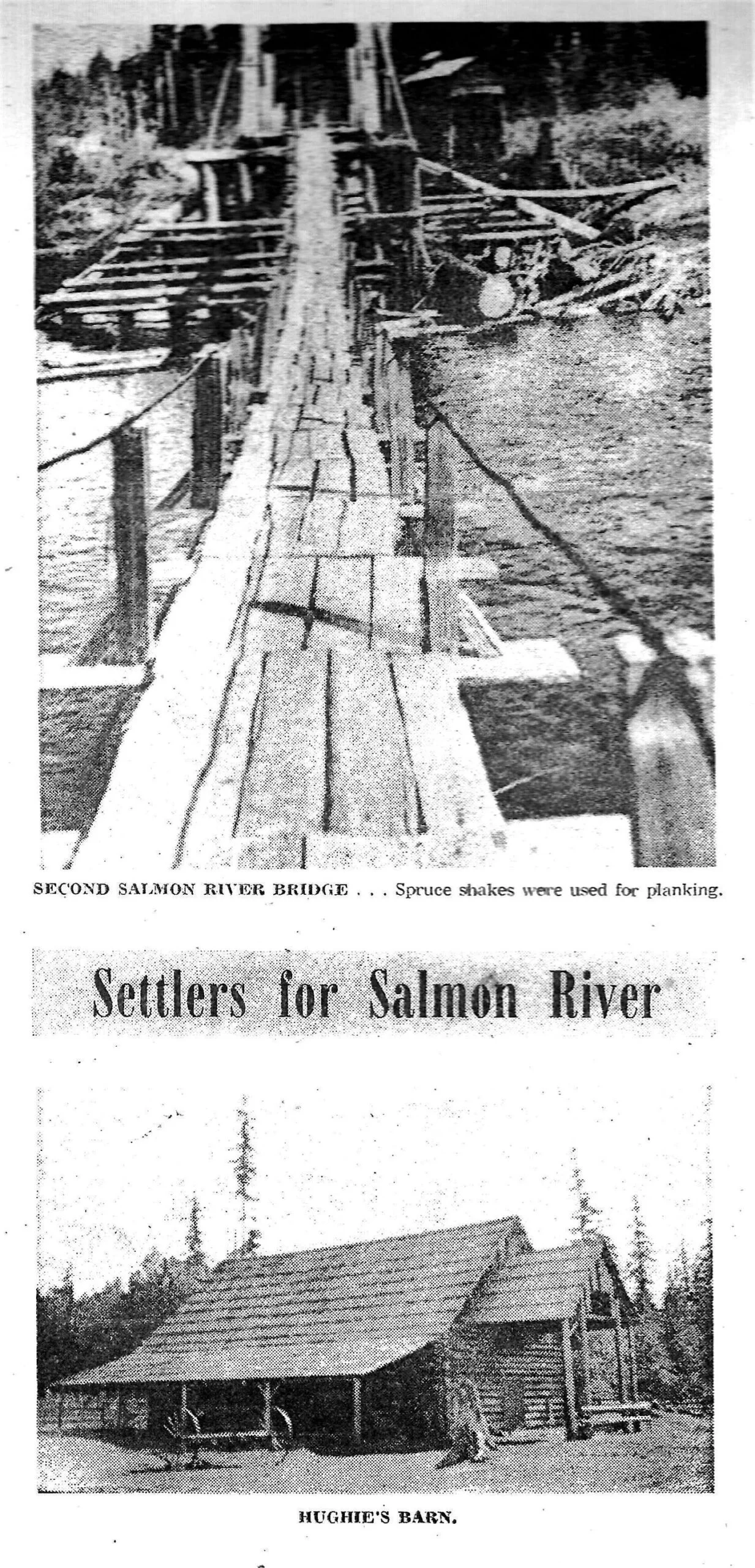
In the rugged backcountry, where rivers cut through dense forest and the terrain resists easy passage, necessity has always driven ingenuity. This striking photograph captures one such moment—an early-stage logging bridge under construction at the Adam River crossing, where raw materials and human effort come together in a careful balance of practicality and risk.

At first glance, the scene looks deceptively simple: a series of long, stripped logs laid side by side across a narrow span. But a closer look reveals the complexity behind this structure. Each log has been placed with intention, aligned to distribute weight evenly and anchored with crosspieces and cables. Beneath them, a foundation of stacked timber supports the approach, elevating the roadway above uneven ground and guiding loads safely onto the bridge.

This type of bridge wasn’t built for elegance—it was built for survival. Logging operations depended on reliable crossings to move heavy timber out of remote areas. Steel and concrete were often unavailable or too costly to transport, so crews relied on what the forest provided. Trees became beams, braces, and decking, shaped with hand tools and muscle power. Every decision—spacing, anchoring, reinforcement—had immediate consequences for safety.

Notice the cables and rigging suspended near the center. These likely played a role in positioning the logs, acting as both lifting aids and stabilizers during construction. The workers, though difficult to make out clearly, would have operated in close quarters with heavy materials, often above rushing water. It was dangerous, exacting work that demanded both coordination and trust.

The surrounding environment tells its own story. Fallen branches, uneven banks, and dense vegetation frame the crossing, emphasizing how isolated these projects often were. There were no roads leading in—this bridge was the road. Before its completion, everything had to be carried or dragged into place.

What stands out most is the resourcefulness. Without modern machinery, crews engineered durable solutions using simple principles: load distribution, redundancy, and friction. The logs act like parallel beams, spreading the weight of wagons or early trucks. Cross-bracing prevents shifting, while the stacked base absorbs impact and stabilizes the structure against erosion.

Bridges like this were temporary by design, yet many lasted far longer than expected. They bore the weight of countless loads, endured seasonal floods, and stood as quiet testaments to the craftsmanship of the people who built them.

Today, images like this remind us that infrastructure doesn’t always begin with blueprints and cranes. Sometimes, it begins with an axe, a rope, and a clear understanding of how to make the land work with you—not against you.

The Adam River crossing is more than a bridge—it’s a snapshot of resilience, adaptation, and the relentless push to connect even the most remote corners of the landscape.
Building A Lifeline – The Story Of Sayward’s 1918 Swing Bridge

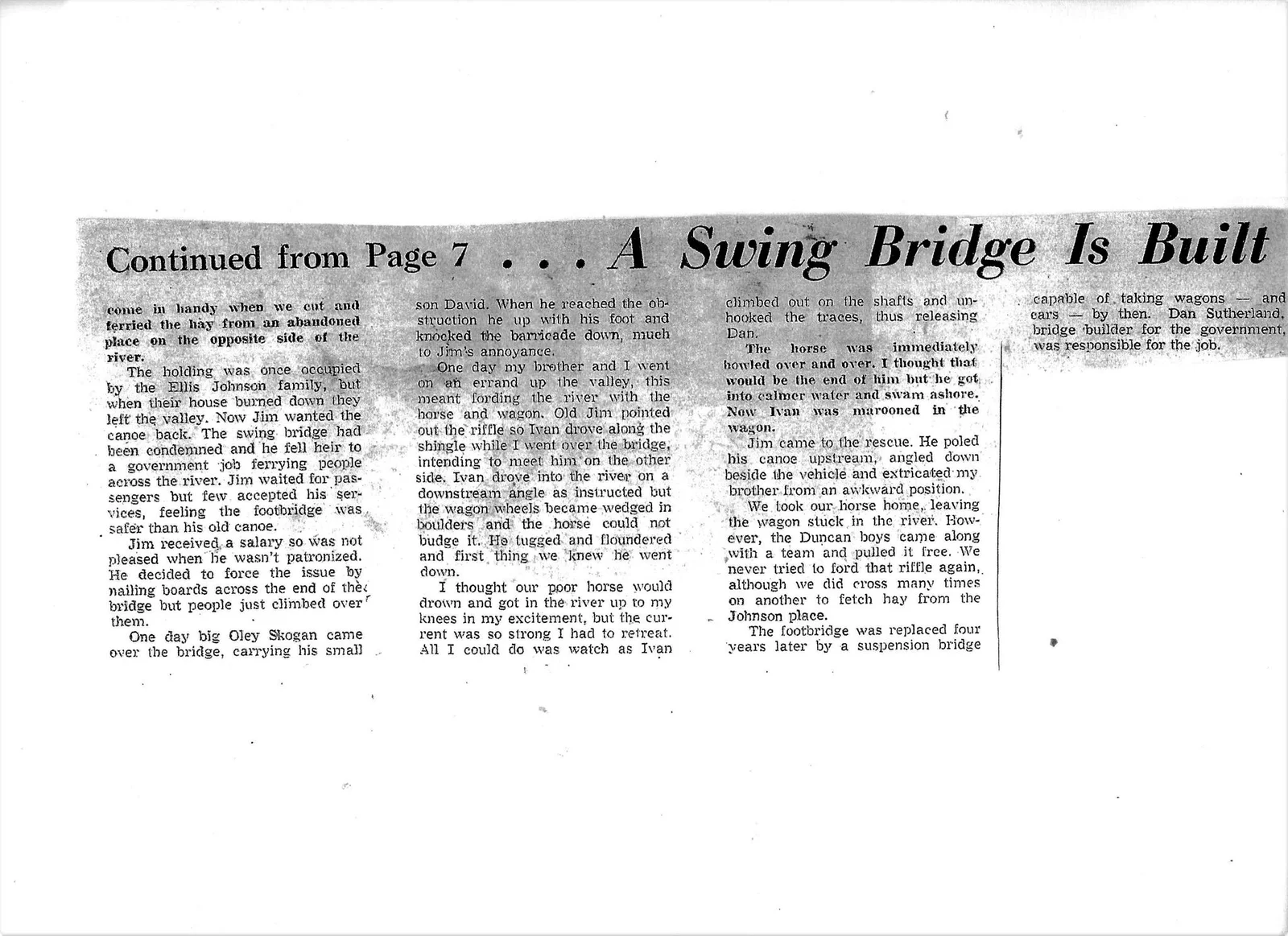
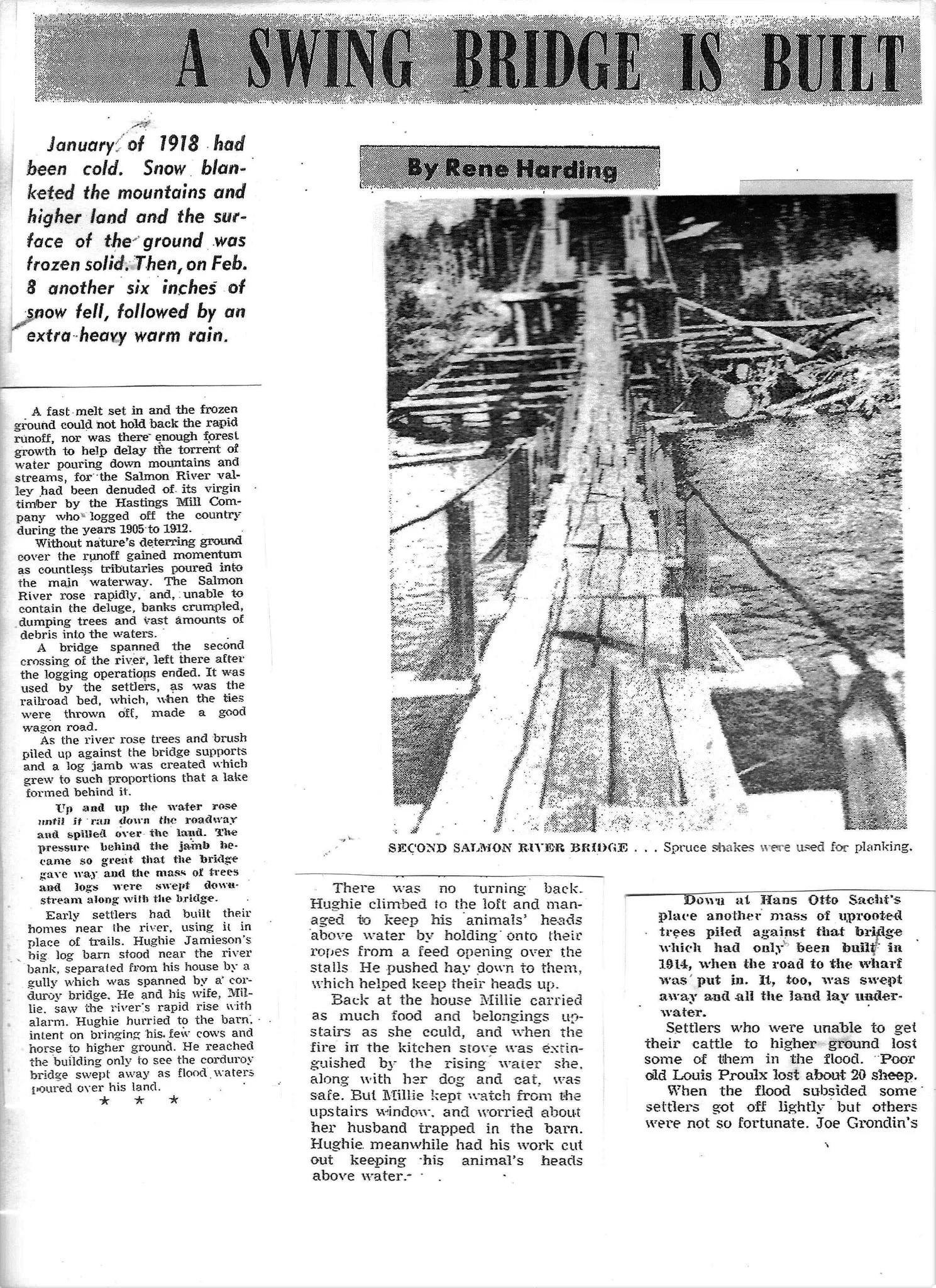
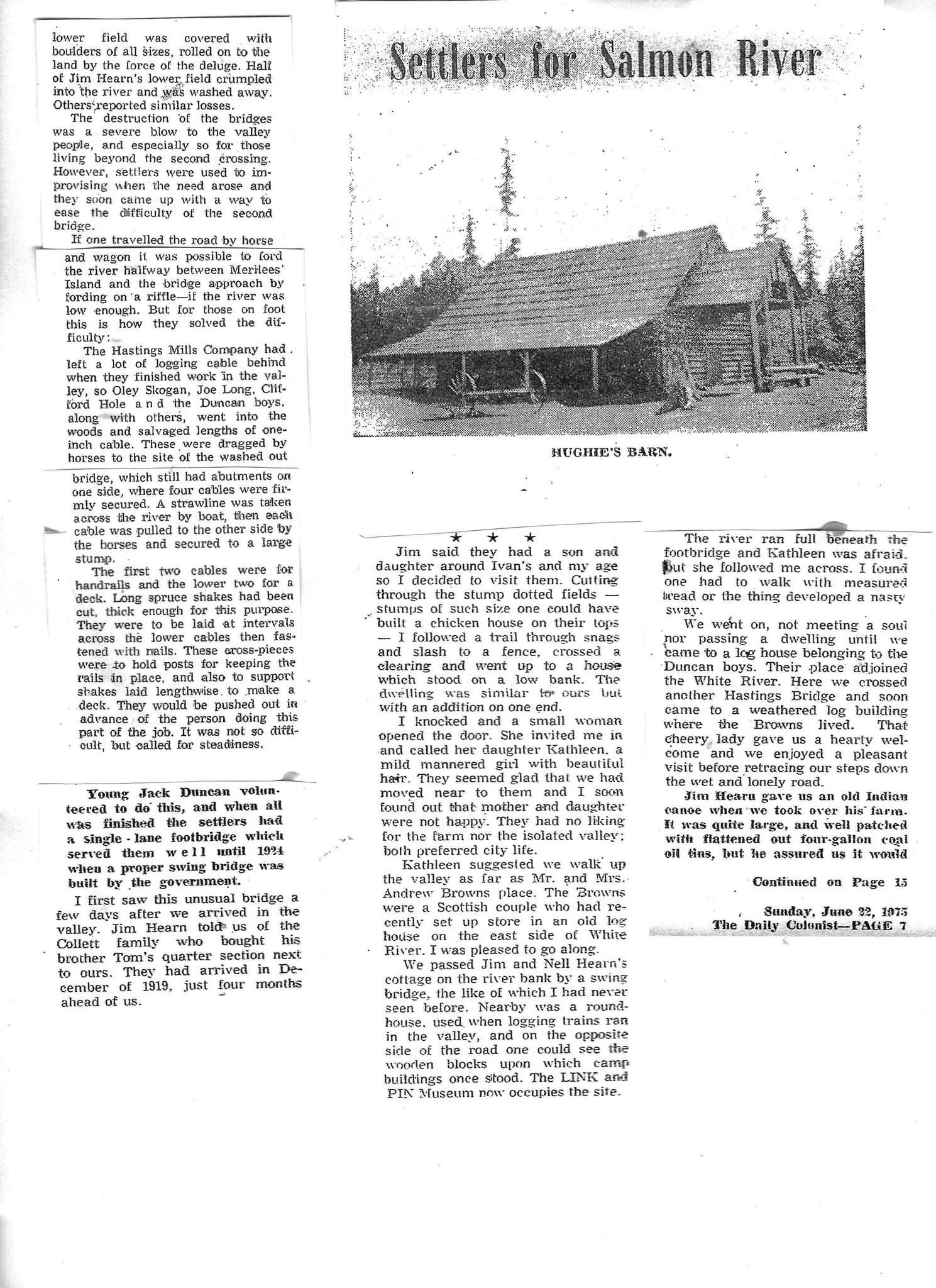
In the early 20th century, life in the remote communities of northern Vancouver Island was defined by isolation, ingenuity, and determination. A fascinating glimpse into that era comes from a Times Colonist newspaper account by Rene Harding, preserved by the Sayward Historical Society. Her recounting of a swing bridge built around 1918 captures a pivotal moment in the development of the Salmon River valley.

A Community Divided by Water

At the time, the Salmon River was both a lifeline and a barrier. It supported logging operations and transportation, but crossing it was a constant challenge for settlers, workers, and supplies moving through the rugged landscape. Without a reliable bridge, travel depended on boats, makeshift crossings, or risky seasonal routes.

The need for a permanent crossing became increasingly urgent as logging activity expanded and more people arrived in the region. Communities like Sayward and nearby camps were growing, but infrastructure lagged behind.

Engineering Meets Necessity

The solution came in the form of a swing bridge—a practical and widely used design in Canada during that era. Swing bridges could pivot open to allow boats, logs, and river traffic to pass through, then close again for foot or rail travel.

For a logging region like Sayward, this design made perfect sense. Rivers were not just obstacles; they were highways for floating timber. A fixed bridge would have blocked that movement, but a swing span allowed both land and water traffic to coexist.

Building Against the Odds

Harding’s account highlights the sheer effort required to construct such a structure in a remote, undeveloped area. Materials had to be transported over long distances, often by water or rough trails. Labour was intensive, and conditions were unforgiving.

This was not just a construction project—it was a feat of coordination and perseverance. Workers had to contend with weather, terrain, and limited equipment, all while building a structure that needed to be both strong and adaptable.

More Than a Bridge

When completed, the swing bridge did more than span the Salmon River—it transformed daily life.

  • Improved access: Travel between settlements became faster and safer.
  • Economic growth: Logging operations could expand more efficiently.
  • Community connection: Families, workers, and goods could move with greater ease.

In many ways, the bridge symbolized a turning point. It marked the transition from isolation to connection, from temporary solutions to lasting infrastructure.

A Lasting Legacy

Today, the original 1918 swing bridge may no longer stand, but its impact remains part of Sayward’s story. Through historical records and images preserved by the Sayward Historical Society, we can still appreciate the ingenuity and resilience that defined the region’s early development.

The story of the swing bridge is a reminder that even modest structures can play an outsized role in shaping a community. Built out of necessity, it became a symbol of progress—linking not just two sides of a river, but a growing region to its future.