Feds Introduce Accelerated Immigration Pathway To Foreign Nationals Through Military Service

Canada Expands Express Entry to Address Defence and Strategic Skill Shortages

Canada has introduced new category‑based selection priorities within its Express Entry immigration system, adding certain defence‑related occupations to a broader list of critical skill sectors targeted for permanent residency. The change does not open the Canadian Armed Forces (CAF) to foreign nationals. Instead, it creates faster immigration pathways for individuals who already possess specialized training in fields the federal government considers strategically important. These updates fall under Immigration, Refugees and Citizenship Canada’s (IRCC) authority to conduct targeted draws from the Express Entry pool.

What’s Changing

Express Entry manages applications for the Federal Skilled Worker Program, the Federal Skilled Trades Program, and the Canadian Experience Class. Under the revised framework, Canada can prioritize candidates in specific occupational categories when issuing Invitations to Apply (ITAs) for permanent residence.

New or expanded priority categories include healthcare professionals, transportation workers (including aviation specialists), STEM professionals, skilled trades, agriculture and food sector workers, and select defence‑related occupations. The defence category focuses on individuals with technical or specialized expertise relevant to Canada’s defence and national‑security ecosystem—not on direct military recruitment.

Defence‑Related Occupations: What It Means

The inclusion of defence‑linked roles aims to address shortages in highly technical military‑adjacent fields, strengthen aerospace and defence manufacturing, support research and development capacity, and enhance logistics, aviation, and technical support infrastructure. Foreign‑trained military doctors, engineers, pilots, and logistics specialists may qualify for priority selection if they meet standard immigration criteria. However, permanent residency does not guarantee eligibility for the CAF. Enlistment still requires meeting citizenship rules (where applicable), fitness standards, and stringent security vetting. Security screening remains especially important for roles connected to national defence.

Government Rationale

Federal officials describe the policy as part of a broader economic and workforce strategy focused on filling shortages in high‑demand sectors, supporting defence modernization, boosting productivity in advanced industries, and aligning immigration with economic priorities. Canada faces persistent gaps in healthcare, skilled trades, and aviation. Rising global security tensions and NATO commitments have also increased pressure to strengthen defence‑related capacity. At the same time, public debate over housing, infrastructure, and immigration levels has prompted the government to moderate overall intake targets while refining selection criteria.

Political and Public Debate

Reactions across Canada have been mixed. Supporters argue that targeted immigration improves economic competitiveness, that Canada benefits from attracting global expertise, and that defence readiness requires specialized technical talent. Critics contend that immigration levels remain too high amid housing shortages, that prioritizing foreign‑trained defence personnel raises security questions, and that domestic workforce development should take precedence. Some commentators have also questioned how security screening will be managed and whether sensitive defence‑related roles should rely on permanent residents rather than citizens.

Broader Context

Canada has increasingly shifted toward category‑based immigration draws to better match labor market needs. This marks a move away from a purely points‑based ranking system toward a more targeted, strategic selection model. The new defence‑related category fits within that broader recalibration, reflecting both economic priorities and evolving geopolitical realities.

Security Implications of Prioritizing Defence‑Related Immigration

1. Rigorous Screening and National Security Safeguards

Canada maintains that foreign nationals prioritized for defence‑related occupations through Express Entry will still undergo full security vetting, including background checks, credential verification, and any military‑specific requirements set by the Canadian Armed Forces. These measures are intended to prevent individuals with concerning affiliations or vulnerabilities from entering sensitive environments.

Even so, analysts note that expanding immigration pathways tied to defence roles naturally raises questions about how intelligence assessments, security clearances, and access to controlled information will be managed. Permanent residency does not automatically confer the trust profile associated with citizenship, making robust screening processes essential to mitigating potential risks.

2. Dual‑Use Skills and Industrial Security

Many of the targeted occupations—such as engineers, pilots, and researchers—possess dual‑use capabilities that are valuable in both civilian industries and defence infrastructure. Skilled newcomers in these fields could strengthen Canada’s aerospace, logistics, cyber, and advanced manufacturing sectors. At the same time, safeguarding intellectual property, sensitive technologies, and classified research will require careful balancing of openness with industrial security protections.

Canada’s broader Defence Industrial Strategy underscores this approach, emphasizing domestic defence production, resilient supply chains, and expanded research and development capacity. The immigration changes align with these strategic economic objectives.

3. Geopolitical Context and Strategic Autonomy

The policy also reflects Canada’s effort to build greater strategic autonomy in areas tied to national security and critical infrastructure. By prioritizing immigrants with defence‑relevant expertise, Ottawa aims to reduce reliance on external partners and strengthen its own capabilities. Achieving this will require strong integration mechanisms, including training on Canadian security protocols, NATO commitments, and relevant legal frameworks.

4. Public Perception and Social Cohesion

Public debate around defence‑linked immigration intersects with broader conversations about citizenship, national identity, and social cohesion. Critics—particularly among opposition voices—argue that linking immigration to defence roles heightens concerns about loyalty, security, and eligibility criteria. As immigration policy overlaps with national security narratives, these discussions tend to become more charged and politically sensitive.

Political Framing: How Major Canadian Parties Are Positioning This Policy

The Liberal government, led by Prime Minister Mark Carney, presents the policy as a strategic modernization of Canada’s immigration system. Their framing emphasizes labour shortages, defence readiness, and national competitiveness. They argue that targeted immigration strengthens Canada’s sovereignty and ensures newcomers can contribute immediately. The policy is also tied to broader federal initiatives involving domestic research and development, defence exports, and industrial capacity.

The Conservative Party, under Pierre Poilievre, generally advocates for tighter immigration controls and stronger security measures. While Conservatives sometimes support aligning immigration with labour market needs, they argue for a more selective system with enhanced background checks and lower overall immigration levels. Their messaging highlights concerns about public safety, fraud prevention, and the strain immigration may place on housing, social services, and the justice system. They tend to prioritize citizenship and security considerations over expanding pathways for non‑citizens in sensitive sectors.

The New Democratic Party supports immigration policies that address labour market needs but places strong emphasis on fairness, settlement supports, and family reunification. Their approach focuses more on worker protections and newcomer integration than on linking immigration to national security objectives. They may welcome the recruitment of skilled workers while also calling for expanded services and safeguards for vulnerable migrants.

The Green Party typically frames immigration through the lens of social justice, sustainability, and humanitarian commitments. They prioritize inclusive pathways and family reunification, and their positions on defence‑linked immigration are less central to their platform compared with the major federal parties.

The Bloc Québécois and certain provincial parties, such as the Coalition Avenir Québec, emphasize greater provincial authority over immigration and integration. Their focus often centres on protecting regional cultural and linguistic priorities. From this perspective, federal initiatives involving defence‑linked immigration may be met with caution if they do not align with provincial labour needs or cultural objectives.

Summary: Where Policy Meets Politics

Prioritizing defence‑related skills through immigration can strengthen Canada’s strategic workforce and industrial capacity, but it also requires rigorous screening and safeguards to manage risks associated with sensitive roles and dual‑use technologies. Politically, the Liberal government highlights strategic economic and security benefits; the Conservative Party stresses the need for tighter controls; the NDP and Green Party focus on inclusivity, labour needs, and newcomer supports; and regional parties emphasize provincial control and cultural considerations.


Canadian’s Face Another Tax Hike With Alcohol Tax Set To Increase On April 1st

The federal government has confirmed that alcohol excise taxes will rise again on April 1, 2026, as part of the automatic annual increase applied to beer, wine, and spirits.

This built‑in adjustment — commonly known as the alcohol escalator tax — raises excise duties each year based on inflation, without requiring a separate vote in Parliament. The upcoming increase amounts to two per cent, a change industry estimates suggest will generate roughly $41 million in additional federal revenue for 2026–27.

First introduced in the 2017 federal budget, the escalator mechanism ties alcohol taxes to the Consumer Price Index. Since then, industry data indicates these automatic hikes have added about $1.6 billion to federal excise revenues.

Reaction to the latest increase is mixed. Brewers, distillers, and hospitality groups have long warned that repeated tax hikes compound pressures on producers already dealing with rising input costs, tariffs, and economic uncertainty. Some say ongoing increases could influence pricing and production decisions.

Observers also note that excise duties are only one component of alcohol pricing in Canada, with provincial markups and retail rules playing a major role. Because the federal increase is automatic, it continues to fuel debate over whether annual tax changes should require parliamentary approval.

The scheduled hike comes at a time when Canadians are already facing significant cost‑of‑living pressures, with rising prices across many sectors of the economy.

Almost All Federal Executives Received Bonuses Despite Mixed Performance Results

Nearly all senior federal executives received taxpayer‑funded bonuses last year, even though government departments achieved just over half of their own performance targets, according to newly released federal data.

Access‑to‑information records obtained by the Canadian Taxpayers Federation show that about 98 per cent of federal executives were awarded bonuses or performance pay in the 2024–25 fiscal year, amounting to roughly $201 million.

Departments and agencies evaluate their performance using targets laid out in their annual plans. In the same year that bonuses were distributed almost universally, government figures indicate that departments collectively met only about 54 per cent of those targets.

The bonus system includes a range of incentive payments — such as performance awards, “at‑risk” pay, and other allowances — intended to reward executives for meeting or exceeding objectives. Critics argue that these payments are being handed out broadly even when organizational goals fall short.

The Canadian Taxpayers Federation’s federal director said the high rate of bonuses raises questions about how performance is being measured and rewarded, noting that such payments are supposed to recognize strong results.

Records also indicate that executive bonuses are part of a long‑standing pattern of substantial compensation for senior public servants. Over the past decade, federal bonus payments — including performance‑linked pay — have totaled billions of dollars, even as some public services face staffing shortages and operational pressures.

Separate federal data from a Treasury Board report shows that performance pay has become standard across the core public service, with nearly all executives receiving some form of variable compensation in recent years. This reflects a system in which portions of executive pay are tied to both individual and organizational outcomes.

Supporters of performance‑based pay argue that it helps attract and retain skilled leaders and aligns compensation with responsibility. They also note that performance targets for complex programs can be affected by factors outside an executive’s direct control.

Still, the widespread distribution of bonuses has drawn public scrutiny at a time when many Canadians are concerned about government spending and service delivery. Some analysts say the situation underscores the need to reassess how performance outcomes are defined and measured, and whether the current bonus framework effectively drives improvements in public service results.

BC Property Rights Under Scrutiny as Critics Say Government Response Falls Short

Private property rights in British Columbia are once again under intense scrutiny after a recent court ruling affirmed elements of Aboriginal title that overlap with privately owned land in Richmond. The decision has sparked political debate and legal uncertainty, with critics arguing that the provincial government’s response—ranging from legislative amendments to financial guarantees—falls short of resolving the confusion created by the ruling.

Background: Court Ruling and Its Impact

The controversy originates from a case in which the court recognized Aboriginal title claims over specific parcels of land, including some already held by private owners. The ruling has raised difficult questions about how Indigenous rights intersect with long‑established private property interests.

Homeowners in Richmond say they are already feeling the effects, reporting difficulties selling their homes, securing mortgages, and obtaining financing. Real estate experts warn that prolonged uncertainty could depress property values and deter investment or development in the affected area.

Government Response

Premier David Eby’s government has introduced proposed amendments to the Declaration on the Rights of Indigenous Peoples Act (DRIPA) and announced up to $154 million in financial assistance for impacted homeowners. The funding is intended to help residents navigate legal and financial complications stemming from the ruling.

Provincial officials describe the measures as an attempt to balance the protection of property owners with the province’s commitments to Indigenous reconciliation. They emphasize that DRIPA is part of B.C.’s broader effort to implement the United Nations Declaration on the Rights of Indigenous Peoples and ensure Indigenous rights are reflected in provincial law.

Criticism From Opposition

Opposition voices argue the government’s actions are insufficient. Steve Kooner, Conservative MLA for Richmond‑Queensborough and Opposition critic for the Attorney General, has dismissed the measures as “band‑aid solutions” that fail to address the underlying issues.

Kooner points to several concerns:

  • Many homeowners were unaware of potential legal implications until after the ruling.

  • The uncertainty is already disrupting property sales and financing in the region.

  • Decisions made when Eby served as Attorney General may have contributed to the current ambiguity around how Aboriginal title interacts with private land.

He contends that only sweeping legislative reform—including the possibility of revising or repealing DRIPA—would adequately safeguard private property rights while clarifying how they coexist with constitutionally protected Indigenous rights.

Legal and Policy Context

Legal scholars note that the issue sits at the intersection of provincial legislation, judicial interpretations of Aboriginal title, and constitutional protections for Indigenous rights. Because Aboriginal title is constitutionally recognized, courts must reconcile it with other land interests, including private ownership. This creates a complex legal landscape in which even long‑established property rights can be affected by newly affirmed Indigenous claims.

Broader Implications

The Richmond case is being closely monitored across the province. Many see it as a potential precedent for how B.C. will navigate the relationship between private property rights and Indigenous reconciliation. There is growing concern that similar disputes could arise elsewhere, with implications for development, housing markets, and investor confidence.

Political analysts expect the debate over DRIPA and property rights to remain a flashpoint in provincial politics. Homeowners are calling for clearer communication from the government and a more definitive legal framework that reconciles private property protections with constitutional obligations to Indigenous communities.

Next Steps

As legal proceedings continue, stakeholders are watching to see whether the government will pursue deeper legislative reforms or rely primarily on financial compensation for affected landowners. The decisions made in the coming months could shape how property rights and Indigenous title are balanced not only in British Columbia but potentially across Canada.

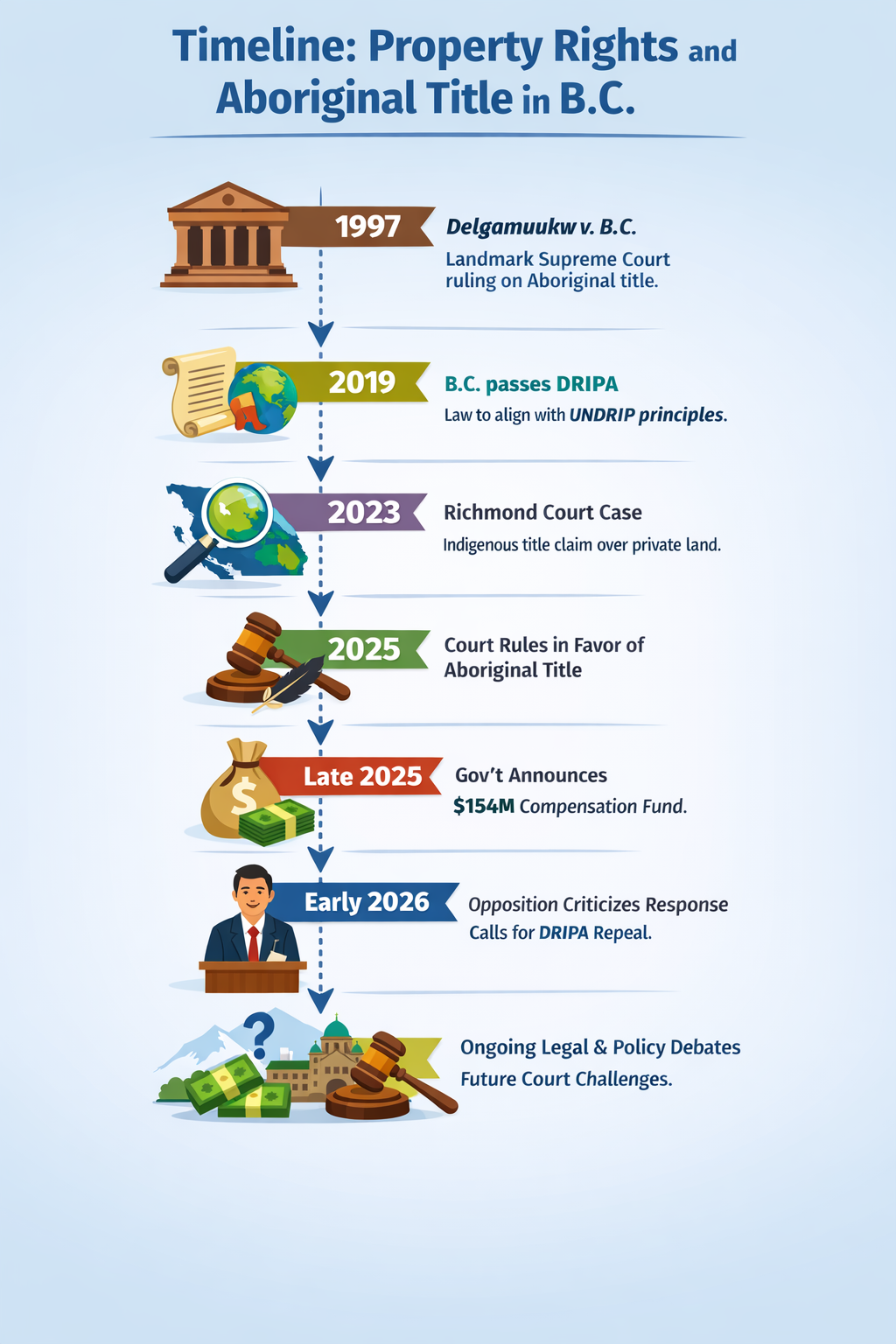
Timeline Property Rights and Aboriginal Title in BC

Timeline: Property Rights and Aboriginal Title in BC

YearEventSignificance
1997Delgamuukw v. British Columbia (Supreme Court of Canada)Landmark ruling establishing the legal framework for Aboriginal title in Canada. Recognized that Indigenous groups have constitutionally protected rights to their traditional lands.
2019B.C. passes DRIPA (Declaration on the Rights of Indigenous Peoples Act)Requires provincial laws to be aligned with UNDRIP (United Nations Declaration on the Rights of Indigenous Peoples). Lays groundwork for reconciliation policies affecting land management.
2020–2022Implementation and consultations on DRIPAProvincial government begins policy alignment; some private landowners raise concerns about potential impact on property rights.
2023Court case filed in Richmond over Aboriginal titleIndigenous groups claim title over areas including privately owned land; case raises questions about the intersection of Aboriginal title and private property.
2025Court rules in favor of Indigenous title claimConfirms that Aboriginal title applies to some privately owned parcels; creates uncertainty for homeowners and developers.
Late 2025Government announces financial compensation planPremier Eby’s government proposes up to $154 million in financial guarantees to affected property owners.
Early 2026MLA Steve Kooner and opposition criticize government responseOpposition labels measures as “band-aid solutions” that do not fully protect private property rights. Calls for DRIPA reform or repeal continue.
2026 and beyondOngoing legal and policy discussionsFurther court challenges and legislative revisions expected; potential precedent-setting impact for property rights and Indigenous reconciliation in B.C.

How the Canadian Government Broadened State Powers in 2025

In 2025, the federal government under Prime Minister Mark Carney introduced a series of legislative changes that critics argue significantly expanded state authority while reducing individual freedoms.

One of the most debated developments was the passage of Bill C-2, a wide-ranging financial and border security bill. While presented as routine administrative legislation, opponents say it granted the federal government expanded powers to access personal information at border crossings. This included access to sensitive records such as medical, therapeutic, and postal information without requiring a warrant. Civil liberties advocates raised concerns that these measures weakened long-standing privacy protections.

Later in the year, attention turned to Bill C-9, which the government framed as an effort to combat hate speech. Critics, however, argued that the legislation crossed into new territory by allowing increased oversight of religious expression. Concerns were raised that sermons, teachings, and faith-based communications could be subject to government scrutiny, marking a shift in how religious freedom has historically been protected in Canada.

Beyond individual pieces of legislation, observers pointed to a broader pattern of increased federal control over financial systems, personal data, and public expression. These concerns were reinforced by earlier government actions, including the freezing of bank accounts during past protest movements, which critics say demonstrated a willingness to bypass traditional legal safeguards during times of political tension.

Those skeptical of the government’s direction argue that the cumulative effect of these measures represents a fundamental change in the relationship between Canadians and the state. Rather than one dramatic policy shift, they say the expansion of power occurred gradually, with limited public debate and minimal transparency.

Supporters of the government maintain that the measures were necessary to address security, misinformation, and social cohesion in an increasingly complex world. Critics counter that safeguarding democracy requires constant vigilance, particularly when emergency powers or broad authorities become normalized.

The debate over state power and personal freedom is expected to remain a central issue in Canadian politics as the long-term impacts of the 2025 legislative agenda continue to unfold.