
North Island Film Seeks Sayward Locals For Extras

A feature film set to shoot on Northern Vancouver Island early next year is inviting local residents to get involved, bringing both community participation and an international story to the region.

The production, titled Exchange, will be filmed in Sayward, Campbell River and nearby locations from February 4 to 14, 2026. Casting is now underway for local background performers to appear in non-speaking roles such as students, townspeople and police officers. Applicants from their teens through middle age are welcome, and no previous acting experience is required.

Producers note that background performers are essential in creating authentic community environments throughout the movie. Although the roles do not involve dialogue, participants will be on set with professional cast and crew, gaining a close-up look at how a feature film is made. Scheduling will depend on the needs of each scene, with some individuals called for specific shoot days.

Exchange is described as a character-focused drama with strong thriller elements. The story follows an 18‑year‑old Thai exchange student who vanishes while studying in Canada. Her mother travels overseas to search for her, confronting cultural challenges, isolation and unsettling clues as she navigates an unfamiliar country. During her search, she forms a connection with a Thai teenager living in Canada, and together they work to uncover what happened. As the investigation deepens, tensions surrounding the exchange program and the student’s host family begin to surface.

Written and directed by Chatchai Hongsirikun, the film is being produced as a non‑union feature. Alongside background roles, the team has also been casting several speaking parts—such as police officers and local youth—with a focus on hiring Vancouver Island talent whenever possible.

The production is expected to bring economic benefits to Northern Vancouver Island, including increased demand for accommodations, local services and short-term employment. Community participation is also a key priority, helping highlight the region’s landscapes and small-town character on screen.

Residents interested in appearing as background performers are asked to send their name, age, a recent photo, availability during the filming window and contact details to sublunarcasting@gmail.com.

The production team encourages anyone curious about the filmmaking process to apply, emphasizing that enthusiasm and local involvement are just as valuable as experience.
Local Authorities Begin Landside Hazard Review While Seeking Additional Support From Province

The Village of Sayward and the Strathcona Regional District (SRD) have initiated an in‑depth hazard assessment of the Newcastle Creek landslide amid ongoing concerns about long‑term impacts on the community’s drinking water system and nearby infrastructure.

The slide, which occurred in late October 2025 upstream of the community’s water intake, triggered emergency response actions and prompted continued water‑use restrictions due to elevated turbidity in the creek. Although Sayward’s water treatment plant, intake, and reservoir remain fully functional, operators and residents have had to remain cautious as rainfall continues to stir up sediment.

Funding from the Province of British Columbia—provided through the Ministry of Emergency Management and Climate Readiness (EMCR)—is supporting a technical investigation now underway. The study incorporates LiDAR drone surveys, slope stability assessments, and watershed modeling to evaluate the slide’s current condition, identify potential hazards, and forecast how the area may respond to future storms and runoff.

SRD officials say the assessment will determine whether the landslide is still active, the likelihood of further movement, and any risks it may pose to downstream infrastructure and water quality. The project is expected to conclude in early May 2026, with findings to be released publicly.

While local leaders appreciate the provincial funding for the study, they remain concerned about the Province’s stance on mitigation. Despite the landslide occurring on Crown land, provincial representatives have indicated they do not intend to directly fund or undertake mitigation work, even if the assessment identifies significant ongoing risks. Instead, the Village and SRD have been directed to apply for competitive grant programs should mitigation be required.

Sayward Mayor and SRD Board Chair Mark Baker argues that this approach places small rural communities at a disadvantage and has urged the Province to take greater responsibility for hazards on Crown land—especially when essential services like drinking water are at stake.

“Understanding the risk is only the first step,” Baker said. “If mitigation is needed, communities like Sayward need provincial partnership, not just reports and recommendations.”

Water conservation measures remain in place as a precaution. Residents are being asked to continue reducing non‑essential water use, particularly during and after heavy rainfall, when sediment levels in Newcastle Creek are most likely to spike.

Local officials emphasize that the hazard study will be crucial in determining next steps, whether that means ongoing monitoring, engineering interventions, or renewed discussions with the Province about long‑term mitigation responsibilities. For now, both the Village and the SRD say safeguarding Sayward’s water supply remains their foremost priority.

Statistics Canada Is Hiring For The 2026 Census

Statistics Canada is calling on Canadians to apply for a wide range of positions with the 2026 Census, offering a meaningful way to support their communities while gaining valuable work experience. With roughly 32,000 jobs available nationwide, recruitment has officially begun.

Census information is essential for planning the future of communities across the country. The data collected helps guide decisions on key public services, including employment initiatives, education, transit, and healthcare. By joining the 2026 Census team, workers play a direct role in ensuring governments and organizations have reliable information to shape programs that benefit everyone.

Positions are located within local communities and will run from March to July 2026, depending on the role and region. Flexibility is important, as employees may need to work during daytime hours, evenings, and weekends.

The roles come with competitive wages: $25.87 per hour for non‑supervisory positions and $31.32 per hour for supervisory roles, plus eligible expenses. This makes census work an appealing short‑term opportunity for those seeking flexible schedules and community‑oriented employment.

Statistics Canada encourages applicants to apply online and to spread the word to friends and family. Assistance is available for anyone who needs support during the application process, helping ensure these opportunities are accessible to as many people as possible.

Taking part in the census is more than temporary work—it’s a chance to strengthen the accuracy of national data and contribute to the long‑term well‑being of local communities.

Critics Say Canada Is Importing LNG It Could Produce at Home

Canada’s stance on liquefied natural gas (LNG) is facing renewed criticism, as opponents argue the federal government’s long‑held claim that there is “no business case” for Canadian LNG exports no longer aligns with reality — especially now that the country is importing LNG from overseas.

For years, federal leaders have maintained that exporting Canadian natural gas as LNG was not economically viable. Critics say this position slowed or halted key infrastructure projects — including pipelines and coastal export terminals — that would have enabled Western Canadian gas to reach global markets.

Because of these delays, Canada failed to build meaningful LNG export capacity despite being one of the world’s top natural gas producers. During that time, countries such as Germany, Japan, and Greece expressed interest in Canadian LNG, but industry proponents were repeatedly told that the economics did not justify major investment.

The situation took a striking turn when Canada recently imported a full LNG shipment from Egypt. The cargo was liquefied at the Idku terminal, shipped across the Atlantic, and unloaded at the Saint John import facility in New Brunswick, where it was regasified and fed into the domestic system. Critics argue this demonstrates that both supply and demand clearly exist — and that Canada’s policy environment has constrained domestic production and export opportunities.

Opposition parties have seized on the import as evidence that the government’s “no business case” stance has allowed other countries to dominate global LNG markets while Canada missed out on jobs, investment, and the chance to help displace higher‑emission fuels like coal abroad.

These concerns have surfaced repeatedly in the House of Commons, with MPs pointing to international partners that sought Canadian LNG and arguing that federal policies prevented the infrastructure needed to meet that demand.

Supporters of the government’s approach counter that climate commitments and emissions standards must guide decisions on large fossil fuel projects. They also note that global LNG prices, construction costs, and market volatility shape investment choices, and they highlight ongoing discussions about expanding energy infrastructure — including potential export capacity in Eastern Canada.

The debate ultimately reflects larger questions about Canada’s place in global energy markets, how to balance economic opportunity with climate goals, and the extent to which federal policy encourages or discourages private‑sector investment. With LNG remaining a major global energy commodity, decisions made now will shape Canada’s competitiveness well into the future.

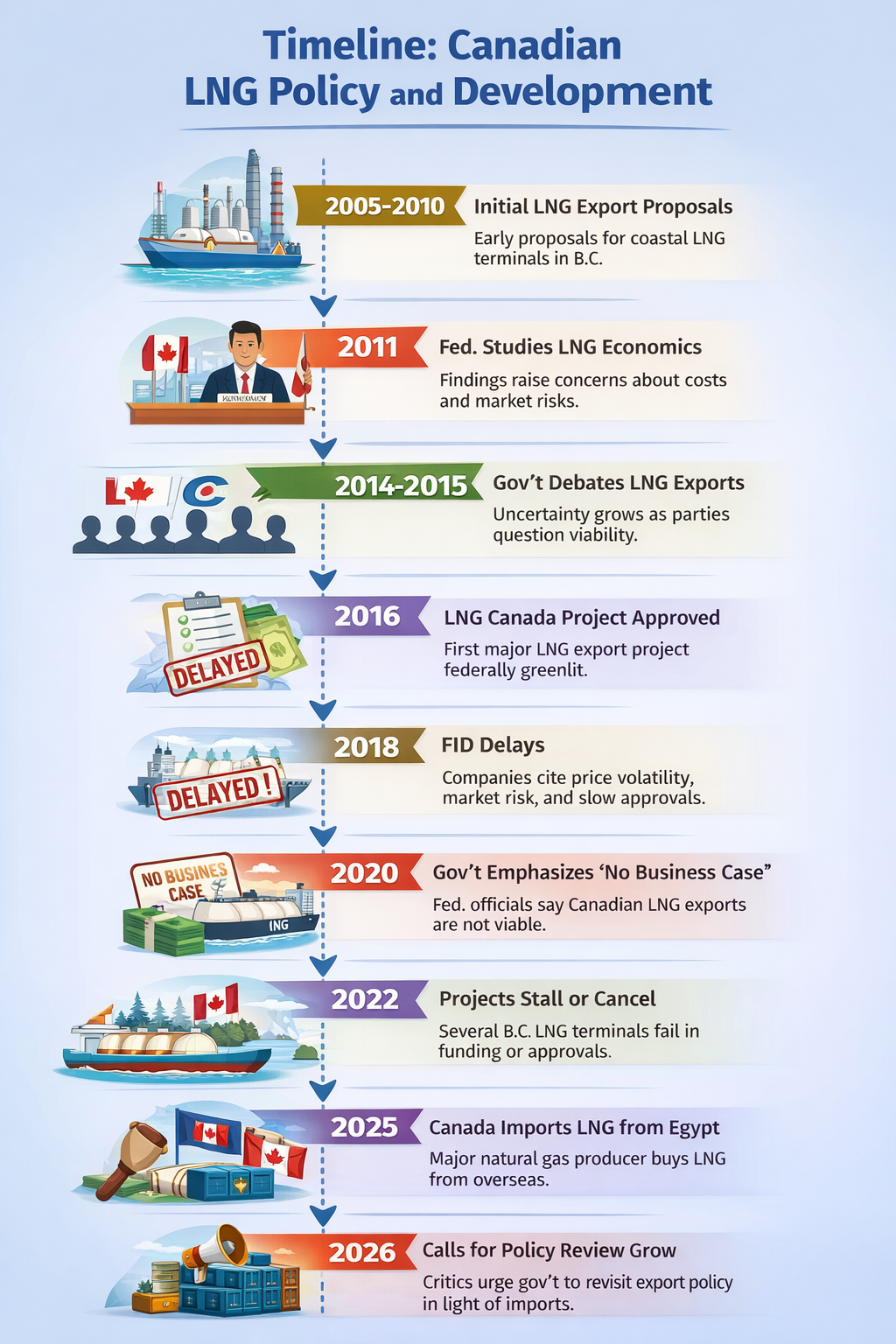
Timeline: Canadian LNG Policy and Development

Timeline: Canadian LNG Policy and Development

Year Event Significance
2005–2010 Initial LNG export proposals Early companies propose coastal LNG export terminals in British Columbia to serve Asian markets; government reviews environmental and economic feasibility.
2011 Federal government studies LNG export economics Officials assess global LNG demand and Canadian costs, concluding that infrastructure investments were high and market risks significant.
2014–2015 Liberal and Conservative governments debate LNG exports Policy uncertainty grows as governments question the economic justification for large-scale LNG exports amid fluctuating global prices.
2016 LNG Canada project receives federal environmental approval The first major project gets greenlight, but financing and construction timelines face delays; debates continue over climate impacts.
2018 FID (Final Investment Decision) delays Companies cite market risks, pricing volatility, and lack of regulatory clarity, delaying the start of LNG export projects.
2020 Federal government emphasizes “no business case” for Canadian LNG Government officials argue that exporting LNG is not economically viable under current market conditions; critics say this discourages investment.
2022 Multiple proposed projects stall or cancel Several BC LNG terminal projects fail to secure financing or government approvals, reinforcing the perception that Canada is losing ground in global LNG markets.
2025 Canada imports LNG from Egypt Despite being a major natural gas producer, Canada imports LNG to meet domestic demand, illustrating ongoing supply gaps and infrastructure challenges.
2026 Calls for policy review grow Opposition politicians argue that Canada’s export policies have ceded global markets to competitors and that domestic LNG could provide jobs, trade opportunities, and climate benefits abroad.

BC Property Rights Under Scrutiny as Critics Say Government Response Falls Short

Private property rights in British Columbia are once again under intense scrutiny after a recent court ruling affirmed elements of Aboriginal title that overlap with privately owned land in Richmond. The decision has sparked political debate and legal uncertainty, with critics arguing that the provincial government’s response—ranging from legislative amendments to financial guarantees—falls short of resolving the confusion created by the ruling.

Background: Court Ruling and Its Impact

The controversy originates from a case in which the court recognized Aboriginal title claims over specific parcels of land, including some already held by private owners. The ruling has raised difficult questions about how Indigenous rights intersect with long‑established private property interests.

Homeowners in Richmond say they are already feeling the effects, reporting difficulties selling their homes, securing mortgages, and obtaining financing. Real estate experts warn that prolonged uncertainty could depress property values and deter investment or development in the affected area.

Government Response

Premier David Eby’s government has introduced proposed amendments to the Declaration on the Rights of Indigenous Peoples Act (DRIPA) and announced up to $154 million in financial assistance for impacted homeowners. The funding is intended to help residents navigate legal and financial complications stemming from the ruling.

Provincial officials describe the measures as an attempt to balance the protection of property owners with the province’s commitments to Indigenous reconciliation. They emphasize that DRIPA is part of B.C.’s broader effort to implement the United Nations Declaration on the Rights of Indigenous Peoples and ensure Indigenous rights are reflected in provincial law.

Criticism From Opposition

Opposition voices argue the government’s actions are insufficient. Steve Kooner, Conservative MLA for Richmond‑Queensborough and Opposition critic for the Attorney General, has dismissed the measures as “band‑aid solutions” that fail to address the underlying issues.

Kooner points to several concerns:

  • Many homeowners were unaware of potential legal implications until after the ruling.

  • The uncertainty is already disrupting property sales and financing in the region.

  • Decisions made when Eby served as Attorney General may have contributed to the current ambiguity around how Aboriginal title interacts with private land.

He contends that only sweeping legislative reform—including the possibility of revising or repealing DRIPA—would adequately safeguard private property rights while clarifying how they coexist with constitutionally protected Indigenous rights.

Legal and Policy Context

Legal scholars note that the issue sits at the intersection of provincial legislation, judicial interpretations of Aboriginal title, and constitutional protections for Indigenous rights. Because Aboriginal title is constitutionally recognized, courts must reconcile it with other land interests, including private ownership. This creates a complex legal landscape in which even long‑established property rights can be affected by newly affirmed Indigenous claims.

Broader Implications

The Richmond case is being closely monitored across the province. Many see it as a potential precedent for how B.C. will navigate the relationship between private property rights and Indigenous reconciliation. There is growing concern that similar disputes could arise elsewhere, with implications for development, housing markets, and investor confidence.

Political analysts expect the debate over DRIPA and property rights to remain a flashpoint in provincial politics. Homeowners are calling for clearer communication from the government and a more definitive legal framework that reconciles private property protections with constitutional obligations to Indigenous communities.

Next Steps

As legal proceedings continue, stakeholders are watching to see whether the government will pursue deeper legislative reforms or rely primarily on financial compensation for affected landowners. The decisions made in the coming months could shape how property rights and Indigenous title are balanced not only in British Columbia but potentially across Canada.

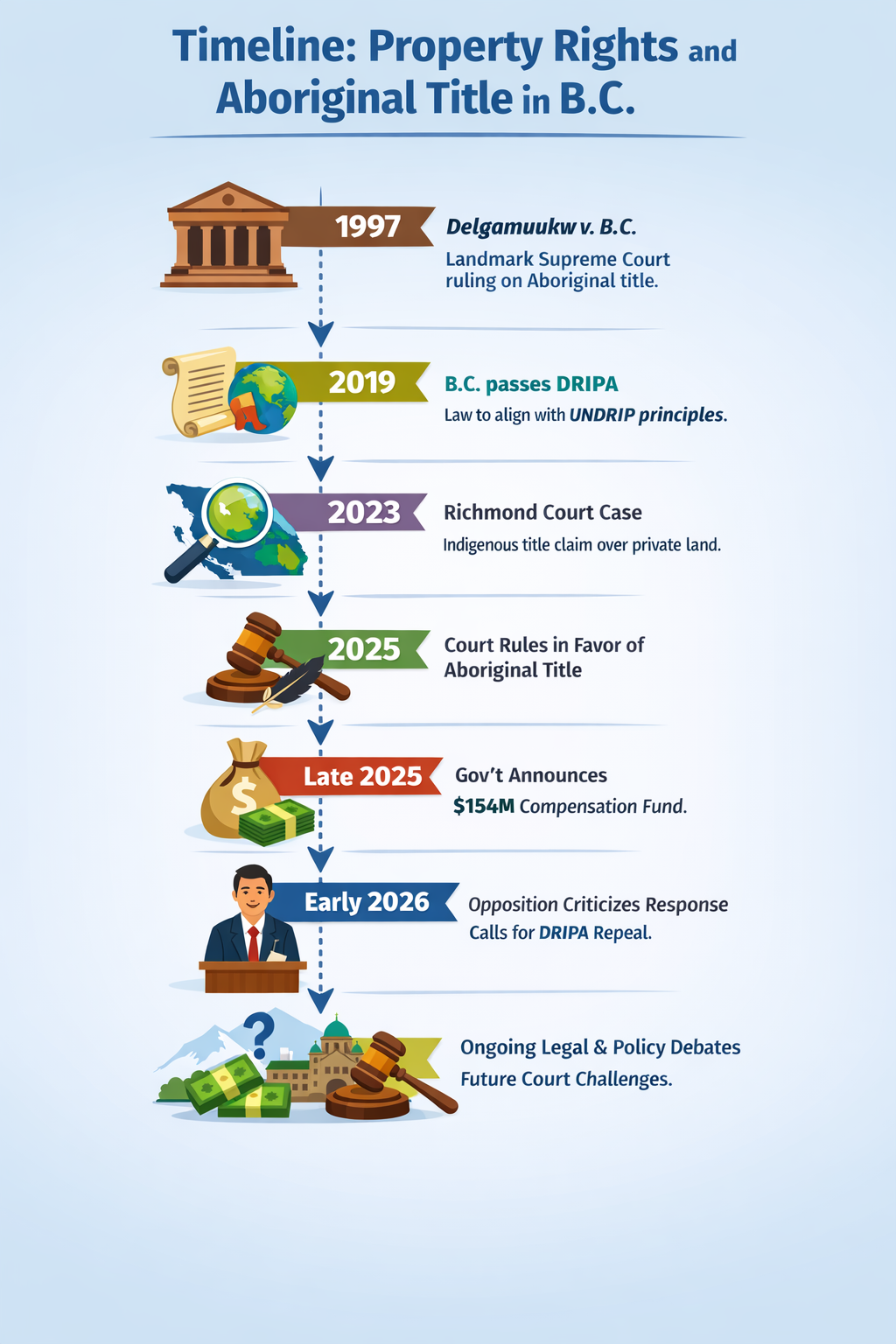
Timeline Property Rights and Aboriginal Title in BC

Timeline: Property Rights and Aboriginal Title in BC

Year Event Significance
1997 Delgamuukw v. British Columbia (Supreme Court of Canada) Landmark ruling establishing the legal framework for Aboriginal title in Canada. Recognized that Indigenous groups have constitutionally protected rights to their traditional lands.
2019 B.C. passes DRIPA (Declaration on the Rights of Indigenous Peoples Act) Requires provincial laws to be aligned with UNDRIP (United Nations Declaration on the Rights of Indigenous Peoples). Lays groundwork for reconciliation policies affecting land management.
2020–2022 Implementation and consultations on DRIPA Provincial government begins policy alignment; some private landowners raise concerns about potential impact on property rights.
2023 Court case filed in Richmond over Aboriginal title Indigenous groups claim title over areas including privately owned land; case raises questions about the intersection of Aboriginal title and private property.
2025 Court rules in favor of Indigenous title claim Confirms that Aboriginal title applies to some privately owned parcels; creates uncertainty for homeowners and developers.
Late 2025 Government announces financial compensation plan Premier Eby’s government proposes up to $154 million in financial guarantees to affected property owners.
Early 2026 MLA Steve Kooner and opposition criticize government response Opposition labels measures as “band-aid solutions” that do not fully protect private property rights. Calls for DRIPA reform or repeal continue.
2026 and beyond Ongoing legal and policy discussions Further court challenges and legislative revisions expected; potential precedent-setting impact for property rights and Indigenous reconciliation in B.C.

Federal Firearms Buyback Program Faces Criticism Over Cost, Participation, and Effectiveness

Canada’s federal firearms buyback program is drawing renewed scrutiny after a recent pilot phase saw very limited participation, prompting broader debate about its cost, implementation challenges, and overall impact on public safety.

The initiative was launched as part of the federal response to the 2020 prohibition on certain firearm models. It is designed to let owners of newly banned firearms voluntarily surrender them for compensation, with the aim of reducing the number of prohibited weapons in circulation.

Early results, however, have intensified criticism. Publicly discussed figures show that only a small number of firearms were turned in during the pilot, a level of participation that critics say falls far short of expectations. They argue the outcome underscores a gap between the program’s goals and the realities of lawful firearms ownership in Canada.

Licensed gun owners already operate under strict federal rules, including background checks, mandatory safety training, continuous eligibility monitoring, and secure storage requirements. Opponents of the buyback maintain that these individuals are not the primary contributors to gun crime, which they link more closely to smuggling and the illegal firearms trade.

Recent Statistics Canada analysis of homicides where origin information was available indicates that the vast majority of shooting homicides involve firearms that were not legally owned by the accused. In other words, the Canadian Government’s misguided focus on legal, licensed gun owners instead of criminals will not result in a significant reduction of gun violence.

Cost concerns have also become a focal point. The program has required extensive planning, staffing, and coordination with provinces, police services, and private contractors. With low participation in the pilot, critics question whether the significant public spending involved can be justified, particularly at a time of heightened attention to government expenditures and affordability pressures.

Implementation issues have added further complications. Several provinces have expressed reluctance to participate, citing jurisdictional disputes and doubts about the program’s effectiveness. Practical challenges — such as transporting, assessing, and disposing of surrendered firearms — have contributed to delays and rising administrative costs.

Supporters counter that firearms policy must be assessed over the long term and argue that reducing access to prohibited weapons remains an important public safety measure. Federal officials also emphasize that compensation programs are intended to respect property rights while enforcing updated regulations.

Even so, critics argue that resources would be better directed toward border enforcement, action against organized crime, and initiatives addressing the underlying causes of violence. They warn that focusing on compliant gun owners risks diverting attention from strategies that could more directly reduce criminal activity.

As the federal government weighs its next steps, the pilot’s results are expected to influence decisions about whether the buyback will be expanded, redesigned, or reconsidered. Future direction may hinge on participation rates, financial implications, and the program’s ability to demonstrate clear public safety benefits.

The discussion reflects a wider national debate over firearms policy — one that continues to balance public safety priorities, fiscal responsibility, and the rights of lawful gun owners across Canada.